Roofing SEO: how roofers win Google Maps, storm season and the big jobs
Roofing SEO is a race for the Google Maps top 3, with storm-season spikes, big-ticket replacements and its share of doubtful listings. This guide uses real search numbers, two live heat maps and a live spam check to show agencies what to work on, in order.
By the DrawnLocal team · · 14 minute read
What is roofing SEO?
Roofing SEO is the work that gets a roofing company found when homeowners search Google for a roofer. That means the Maps top 3, the local pack above the web results, and the web results themselves. The map matters most, because the biggest roofing searches are “near me” searches.
Roofing differs from other trades in four ways. The jobs are big, so a replacement can be worth many repairs. Demand comes in spikes after storms. Homeowners research replacements for longer and compare several quotes. And storms draw unlicensed contractors, which the FTC warns homeowners about.
This guide is written for agencies with roofing clients, and works just as well for a roofer doing it alone. It builds on local SEO for home-service businesses, which covers what all trades share, and adds what’s specific to roofing.
The roofing searches worth winning, with real numbers
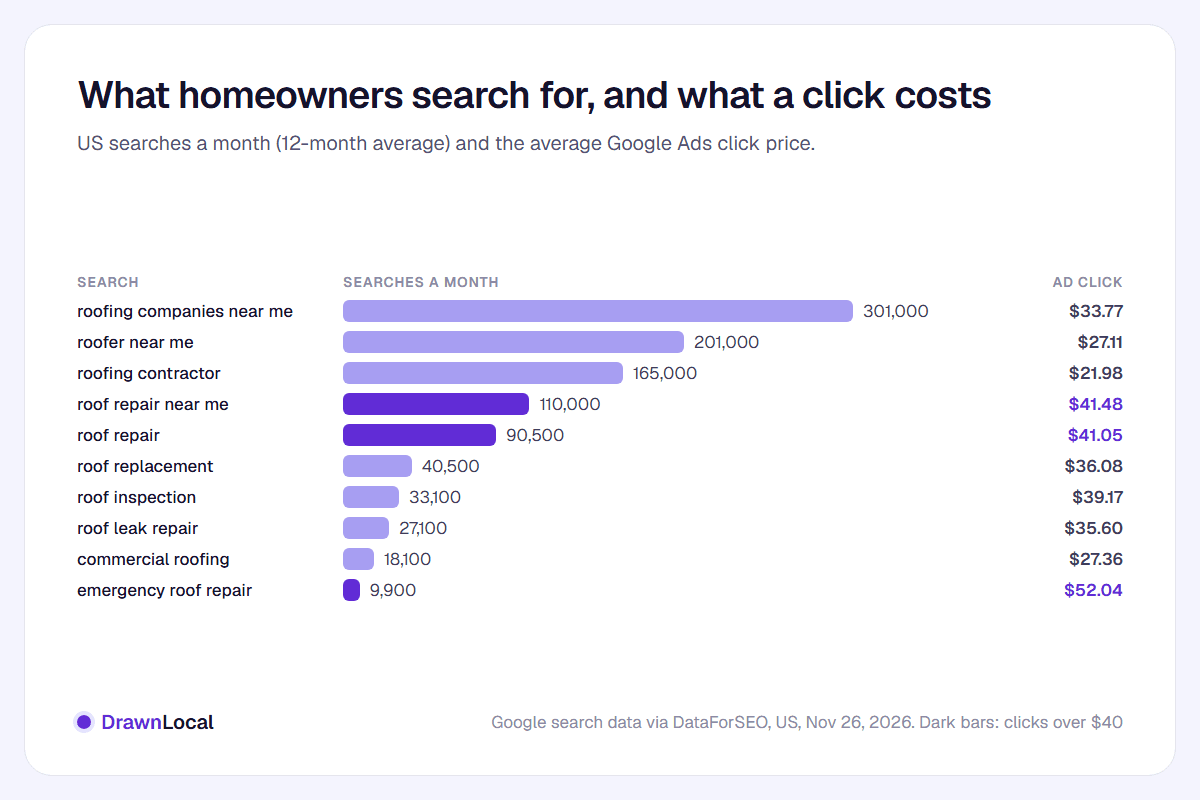
The biggest roofing searches are “near me” searches, and some of the priciest clicks are for repairs. We pulled US search volumes and average Google Ads click prices on Nov 26, 2026. The click price is a useful sign of what a search is worth to roofers, because they pay it to appear.
| Search | Searches a month | Average ad click | What it tells you |
|---|---|---|---|
| roofing companies near me | 301,000 | $33.77 | The biggest search; the searcher wants someone close |
| roofer near me | 201,000 | $27.11 | Same intent; won on the map, point by point |
| roofing contractor | 165,000 | $21.98 | Also the Google category roofers use |
| roof repair | 90,500 | $41.05 | The core job; one of the priciest clicks |
| roof replacement | 40,500 | $36.08 | Fewer searches, the biggest tickets |
| roof inspection | 33,100 | $39.17 | A way in to repairs and replacements |
| roof leak repair | 27,100 | $35.60 | Urgent; busiest from October to February in this data |
| emergency roof repair | 9,900 | $52.04 | The priciest click in the set |
| storm damage roof repair | 6,600 | $15.51 | Small on average, huge after storms |
Three points stand out. “Near me” searches dwarf the rest, and a searcher typing “near me” wants a business close by, which is what the map shows. So the Maps top 3 matters more than any single web ranking. Repair and emergency clicks cost $41 to $52, which tells you roofers compete hard for them. And replacement has fewer searches but the biggest jobs, so it deserves its own page and its own line in the report.
The numbers above are national. For a client, pull the same searches for its own city and the main towns it serves. Which keywords to track for a local business covers how many to pick.
Storm season: why roofing searches spike
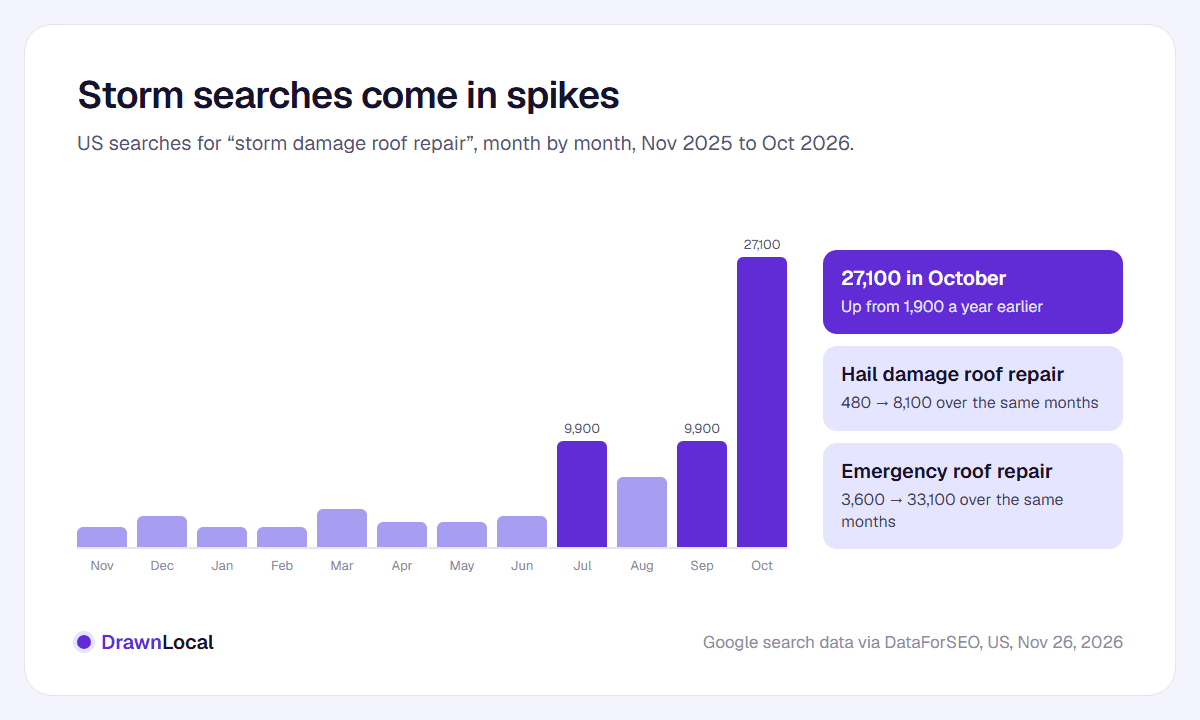
Roofing demand follows the weather. US searches for “storm damage roof repair” sat between 1,900 and 3,600 a month from November 2025 to June 2026. They hit 9,900 in July and 27,100 in October.
The related searches moved the same way. “Hail damage roof repair” went from 480 to 8,100 over the same months, and “emergency roof repair” from 3,600 to 33,100. National numbers also smooth out local storms, so the jump in one metro after a hailstorm can be sharper still.
That changes how an agency works. The pages, profile and reviews have to be ready before the storm, because the businesses in the Maps top 3 that week are the ones homeowners see first. The storm-week routine later in this guide covers what to do when one hits.
Roofing SEO starts on Google Maps
Start with the map: the biggest roofing searches are “near me” searches, answered with nearby businesses. Google says local results are mainly based on relevance, distance and popularity, which it describes as prominence: how well known a business is. It’s also clear that “there’s no way to request or pay for a better local ranking on Google.”
Distance means the map changes with where the searcher stands. So a roofer can be first on its own street and missing a mile away, and one rank check from the office tells you little. Here are two live heat maps we ran on Nov 26, 2026 for “roof repair”, for two roofers under a mile apart in downtown Denver:
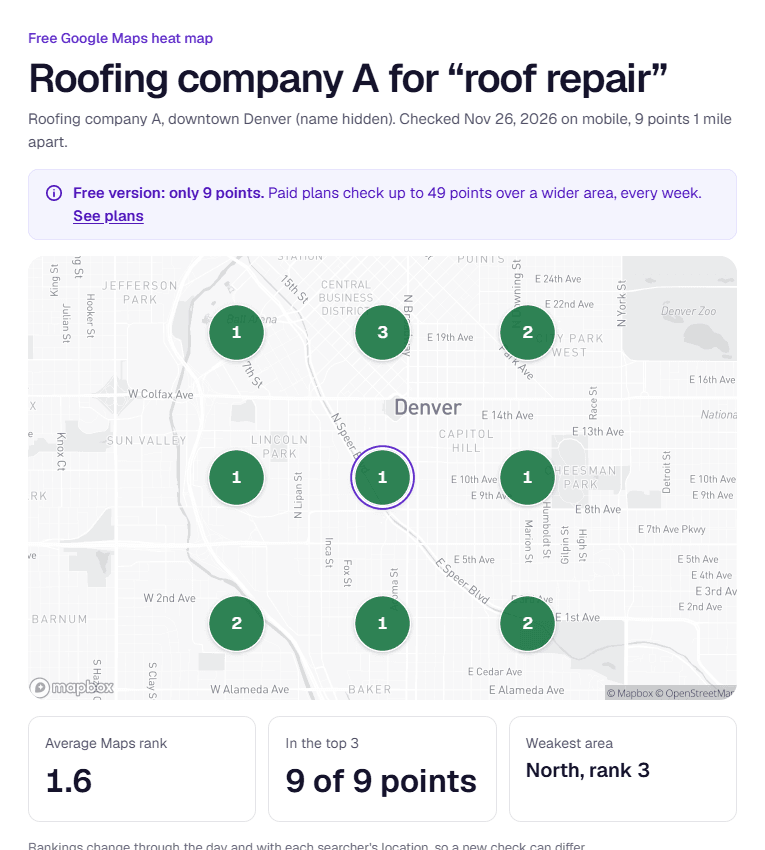
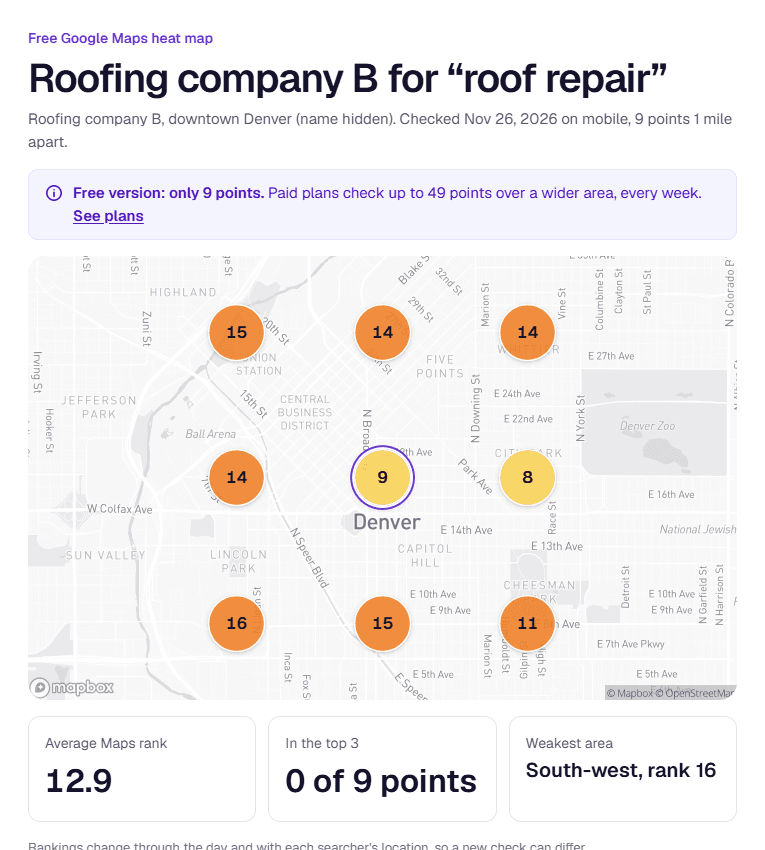
Company A is in the top 3 at all 9 points, with an average rank of 1.6. Company B, under a mile away, has the same number of Google reviews (103), a 4.8 rating against A’s 5.0, and the same primary category. Its map looks like this:
Two roofers, one mile, two different maps
Company B isn’t in the top 3 anywhere. Its best positions are 8 and 9, near its own address, and it falls to 14 to 16 around the edges.
The map can’t say why, and neither can we from two scans. Their review counts, ratings and categories are close, so the difference may lie elsewhere: the website, links, how recent the reviews are, or where each business sits relative to the searches. Finding that difference is the agency’s job, and the map shows where to look.
This is the case for heat maps in roofing. A single rank from the office would show B at 9 and call it close. The map shows it has no top-3 points at all. How to read a local SEO heat map explains the shapes, and you can run the same free heat map for any roofer.
Set up the Google Business Profile for a roofer
The profile is one of the quickest places to gain ground, and most of it takes an afternoon. In order:
- Primary category: Roofing contractor. All 12 roofers in our live Denver lookup used it. The primary category ranked 1st of 187 Maps factors in Whitespark’s 2026 survey of local search experts. See how to choose a primary category.
- Secondary categories only for real services, such as gutters or siding if the business does that work.
- The real business name. Google says “including unnecessary information in your business name isn’t permitted, and could result in the suspension of your Business Profile.” Keywords in the business name covers what counts.
- A service area that matches the trucks. Google says a service-area business “should hide your business address from customers” when customers don’t visit. List the towns the roofer really covers.
- Real hours. List the hours someone answers the phone; being open at the time of a search ranked 5th in the survey.
- Services and photos. Add each service the roofer offers, and photos of real roofs it has worked on, with the crew and trucks.
- One profile per business. Google says “there should only be one profile per business.” Google says duplicates can cause problems with how the business shows on Maps and Search.
Run the client through DrawnLocal’s free Google profile checker before and after, so you can show what changed.
Check the map for spam first
Before you work on the client, look at who holds the top spots. A listing that breaks Google’s rules can hold a place your client should have, and reporting it can move the map quickly.
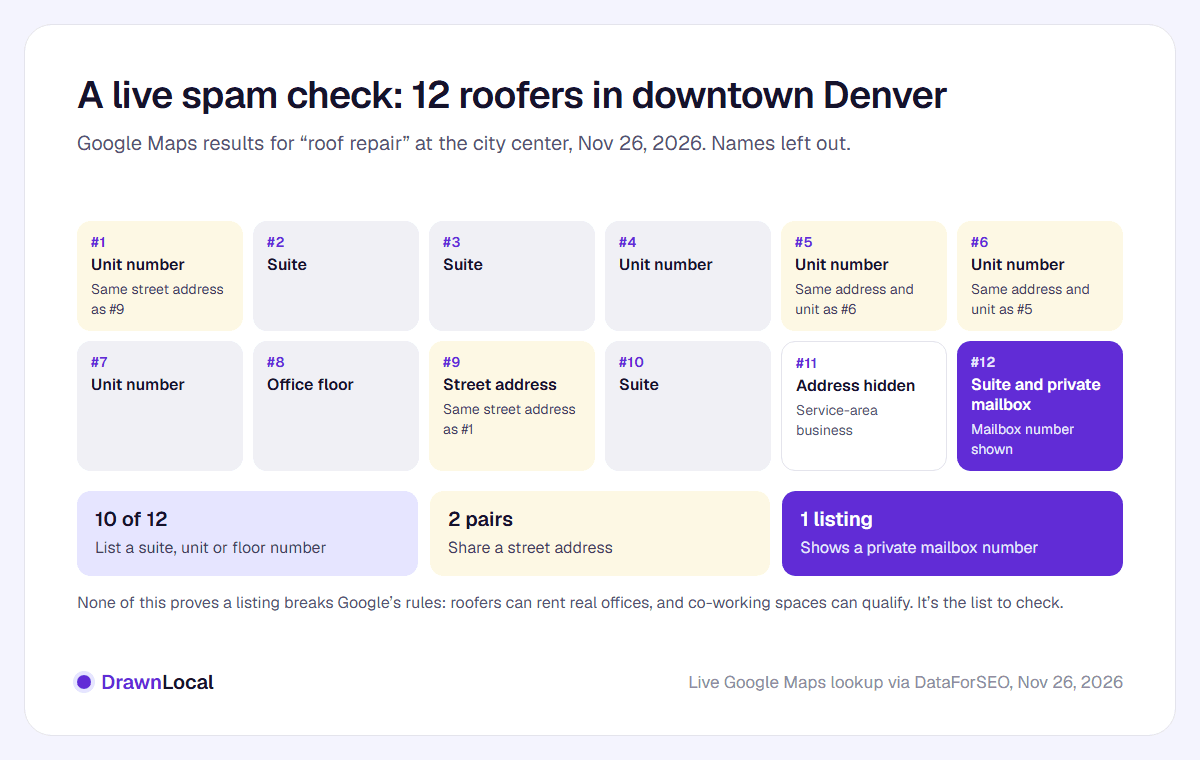
We looked up the 12 Google Maps results for “roof repair” at the center of downtown Denver on Nov 26, 2026. Ten listed a suite, unit or floor number. Two pairs shared a street address, one pair down to the same unit number. One showed a private mailbox (PMB) number, and one hid its address as a service-area business.
None of that proves a listing breaks the rules. Roofers can rent real offices downtown, and Google allows co-working spaces with signage, staff and customers received during business hours. But Google is clear on mailboxes: “P.O. boxes or mailboxes located at remote locations aren’t acceptable.” And an address rented for mail where the business doesn’t operate, a virtual office, “isn’t eligible for a Business Profile.”
So check each listing in the top 3 for the client’s main searches. Look at the address on Street View for signage, call the number, read the website, and look up the state or local contractor license where one is required. How to report a fake business on Google Maps has the four routes and the evidence to gather.
Storm chasers, and how to look like the opposite
After a storm, homeowners are warned to be careful about who they hire, and a roofer’s website and profile can answer those worries before the call. The FTC’s advice after weather emergencies tells homeowners to “confirm your contractor’s license and insurance”. It also says to “be skeptical of anyone promising immediate clean-up or repairs.”
The same advice says to get estimates from more than one contractor and to get a written contract and read it. It also warns about anyone asking to be paid for everything up front. It notes that “unlicensed contractors and scammers often appear in recovery zones.”
Turn that checklist into trust signals on the site and the profile:
- The license number and proof of insurance, on the website where homeowners can find them.
- A real local address or service area, years in business, and photos of the crew and trucks.
- Written estimates and a written contract, said plainly on the storm damage page.
- Fair payment terms: a reasonable deposit, with the balance due when the work is done.
- Reviews that mention storm and insurance jobs, from real customers in the area.
None of this is a ranking factor Google names. It’s what turns a top-3 position into a booked inspection when the homeowner is comparing three roofers after a storm.
The pages a roofing website needs
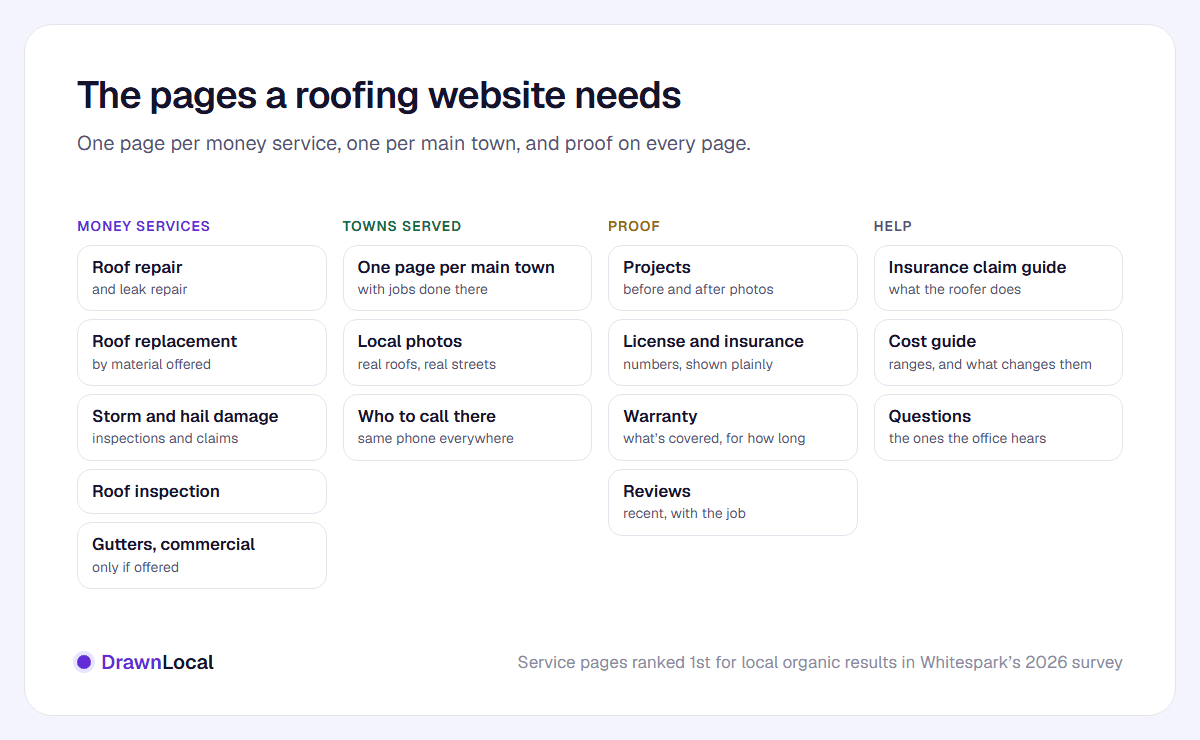
Give each money service its own page: roof repair, roof replacement, storm and hail damage, roof inspection, and gutters or commercial roofing if the roofer does them. Dedicated pages for each service ranked 1st for local organic results in Whitespark’s 2026 survey, and they match the searches in the table above.
Each service page should say what the roofer does, the materials it works with, roughly what drives the price, how fast it can inspect, and which towns it covers. Add photos of real jobs and the questions the office hears every week.
Add a page for each main town the roofer serves, with jobs done there and local detail. Pages that only swap the town name are thin and can count as spam; a page with three real local projects isn’t. Does a website affect Google Maps rankings covers the website signals that matter for the map.
Two help pages earn their keep in roofing. One is an insurance claim guide that explains what the roofer does and what the homeowner does. The other is a cost guide with honest ranges and what changes them.
Replacement pages deserve extra care, because homeowners compare several quotes before choosing. Show the materials the roofer installs, the warranty on each, how long a typical job takes, and photos of finished roofs on real local streets. It helps the homeowner picture the result before asking for a quote.
A storm-week routine for roofing clients
Agree this with the client before storm season, so nobody has to think about it when the phones are ringing:
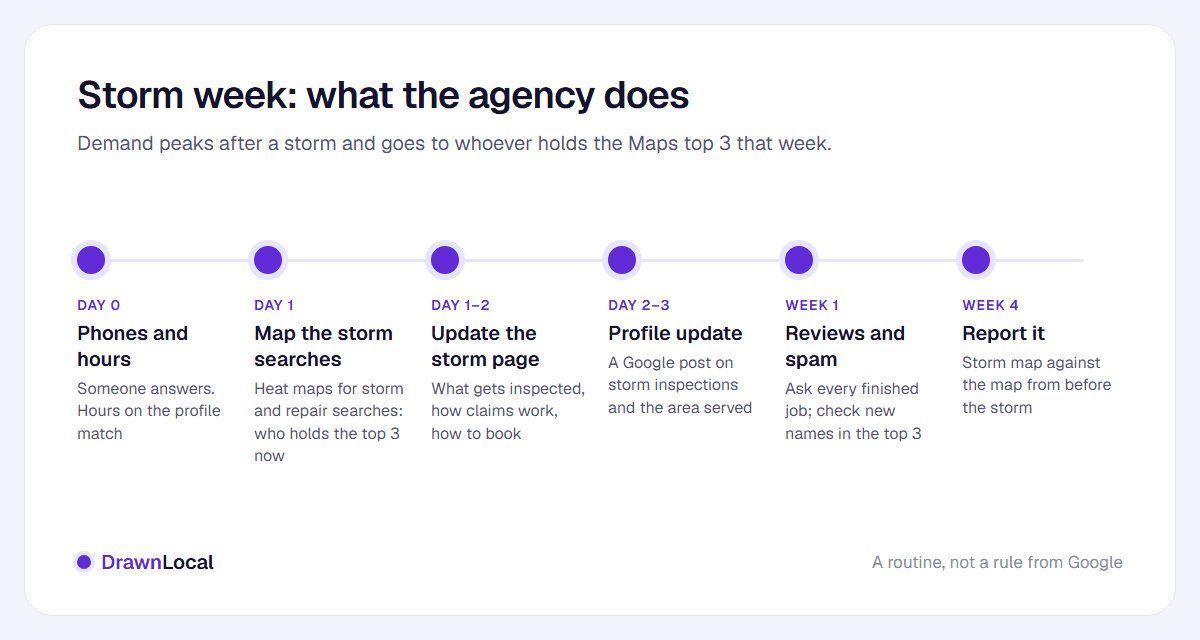
- Day 0: make sure someone answers the phone, and that the hours on the profile match.
- Day 1: run heat maps for the storm and repair searches, and note who holds the top 3 now, including any new names.
- Days 1–2: update the storm and hail damage page: what gets inspected, how insurance claims work, and how to book.
- Days 2–3: publish a Google profile update about storm inspections and the area served.
- Week 1: ask every finished job for a review, and check each new name in the top 3 for the problems in the spam section.
- Week 4: put the storm map beside the map from before the storm in the monthly report.
If the client runs Local Services Ads, check the budget the same day: a monthly cap that runs out mid-storm stops the ads when demand is highest. Google Local Services Ads covers the budget math.
Reviews for roofers
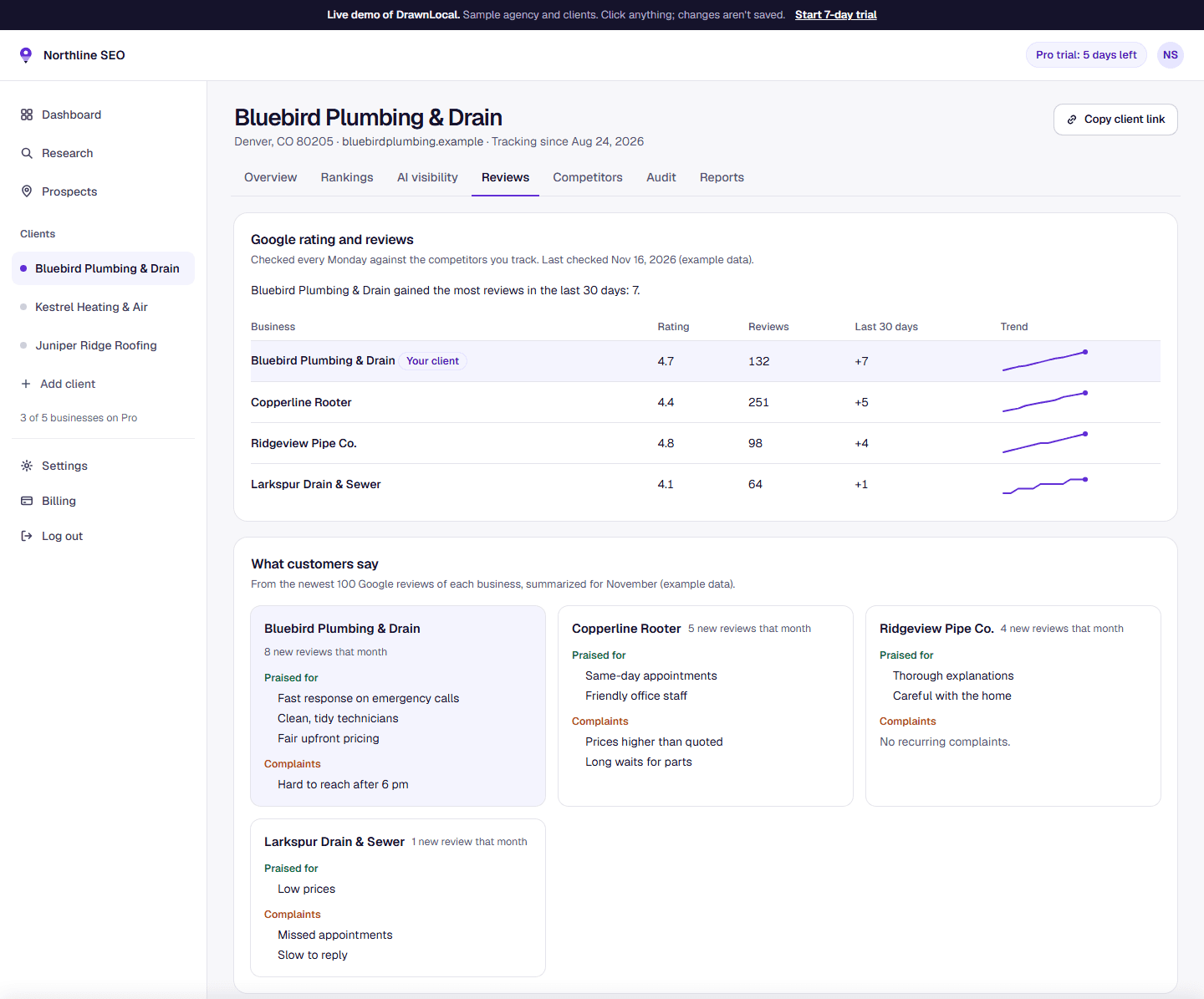
Reviews matter for roofers for ranking and for winning the quote. Google says “more reviews and positive ratings can help your business’s local ranking,” and homeowners read them before they let a roofer up a ladder.
Big jobs mean fewer of them, so every finished roof counts. Ask at the final walk-through, when the homeowner has just seen the finished roof, with the direct review link. DrawnLocal’s free review link and QR code maker builds both, and the QR code fits on the invoice or the yard sign.
Ask every customer the same way; picking only the happy ones breaks Google’s rules, as review gating explains. Encourage a photo of the finished roof, and reply to every review within a few days. How to get more Google reviews has a routine built for contractors.
Links and mentions roofers can earn
Roofers have natural link sources in the businesses they already work with:
- Suppliers and distributors that list the contractors they work with.
- Manufacturers, if the roofer holds a certification and the manufacturer lists certified contractors.
- Local trade associations and the chamber of commerce.
- Sponsorships: youth sports, school events, charity builds.
- Local news after storms, when reporters look for a roofer to explain what homeowners should check.
Spend the effort on a few genuine local links rather than dozens of directory listings; do citations still matter covers which listings are worth fixing. Keep the business name, address and phone the same everywhere.
Keywords and tracking for a roofing client
Track three groups of searches, each in the way it’s won:
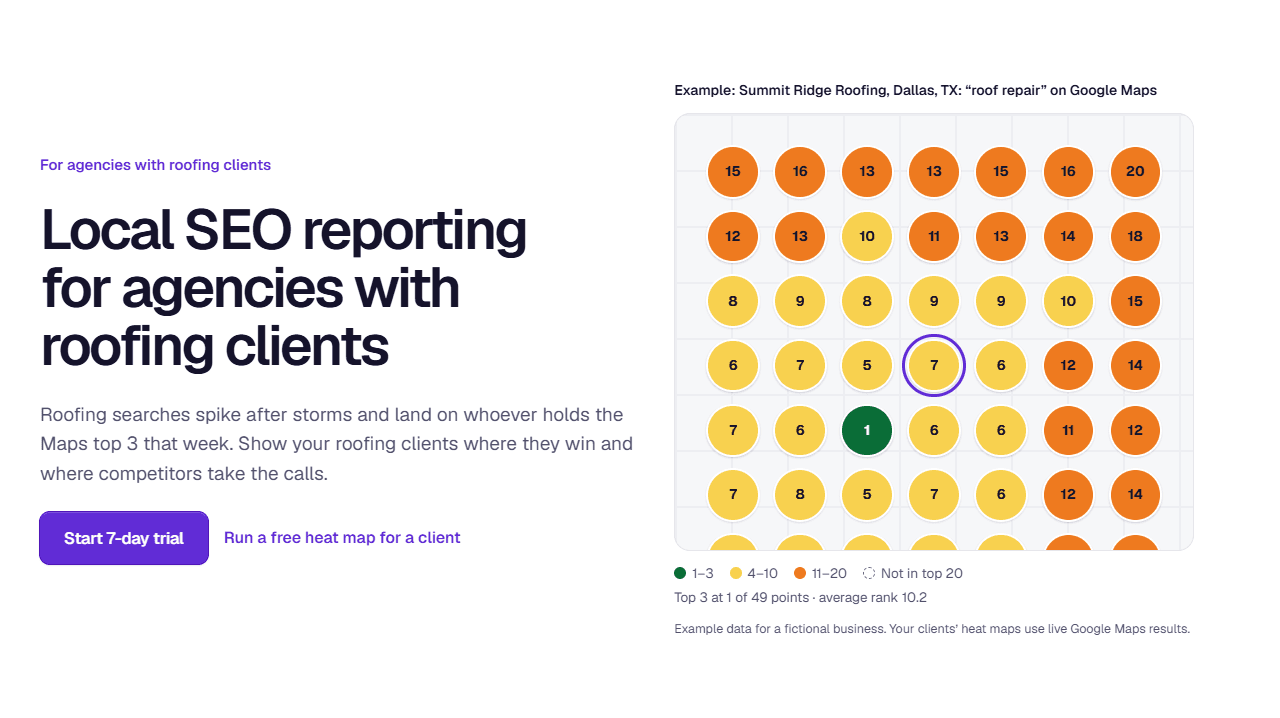
- Repair searches on the map, every week: “roof repair”, “roofer near me” and “roof leak repair”, as heat maps across the service area.
- Replacement searches on the web and the map: “roof replacement [city]” and the materials the roofer sells. They’re researched for longer, so web rankings matter more.
- Storm searches, seasonally: “storm damage roof repair” and “hail damage roof repair”, with a one-off scan the day after a storm.
Run the map the same way each time: the same keyword, the same grid and the same center. That’s what makes week-on-week change real. DrawnLocal’s page for agencies with roofing clients shows the keywords to start with and a sample 49-point map.
What roofing SEO is worth: a worked example
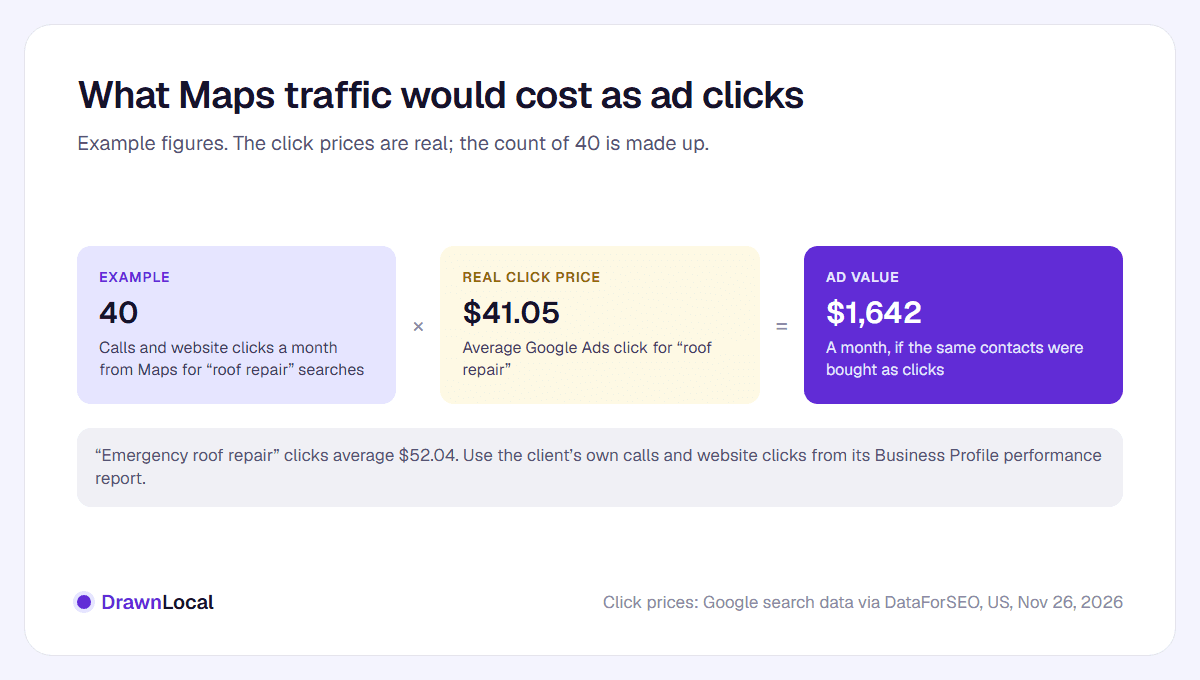
One way to show an owner what the map is worth is to price it in ad clicks. The click prices are real; the traffic in this example is made up.
Say a roofer gets 40 calls and website clicks a month from Maps for “roof repair” searches. At the average click price of $41.05, buying the same contacts as ads would cost about $1,642 a month. For “emergency roof repair”, clicks average $52.04.
Use the client’s own numbers instead. Google’s Business Profile performance report shows calls, website clicks and direction requests, so the sum takes a minute each month. A click isn’t a booked job, so treat the figure as a rough guide, not a promise.
A 90-day plan for a new roofing client
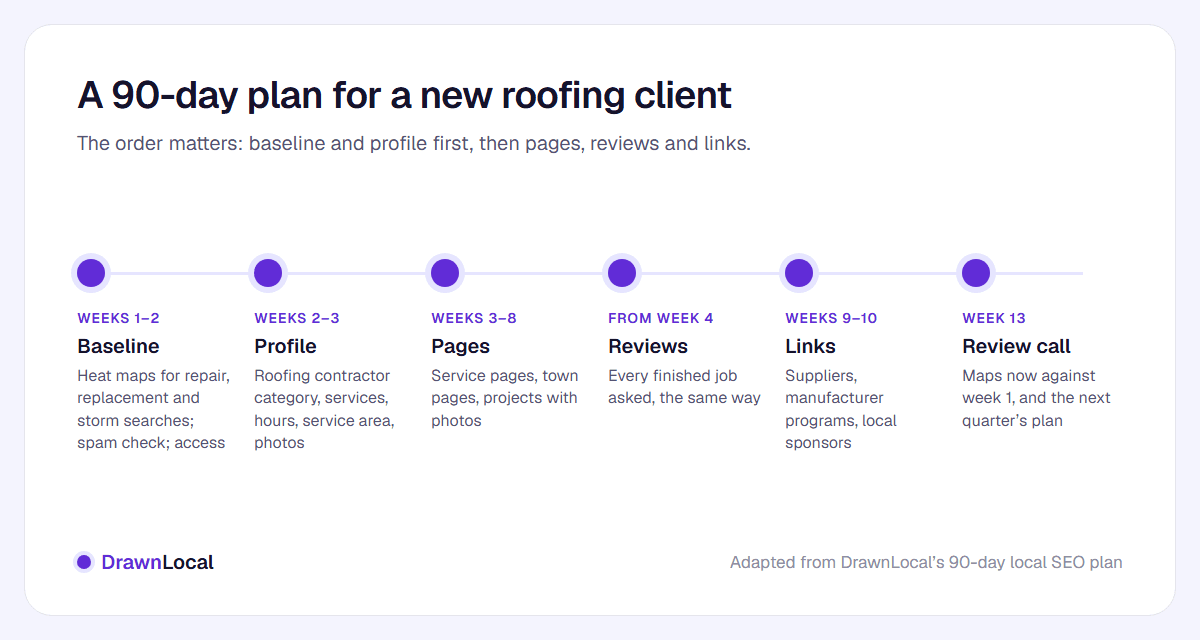
The order matters more than the speed. A plan for the first quarter:
| When | Work | What to show the owner |
|---|---|---|
| Weeks 1–2 | Baseline heat maps for repair, replacement and storm searches; spam check; profile access | Where the business wins and loses today |
| Weeks 2–3 | Profile: category, services, hours, service area, photos | The profile before and after |
| Weeks 3–8 | Service pages, town pages, projects with photos | New pages live, with what each targets |
| From week 4 | Review requests at every final walk-through | New reviews against the top 3 |
| Weeks 9–10 | Supplier, manufacturer and local links | Links earned |
| Week 13 | Review call | The map now against week 1 |
Set expectations at the start. Google’s own guidance says improvements often take four months to a year to show benefit. The 90-day local SEO plan has the full week-by-week version.
Roofing SEO mistakes to avoid
These cost roofers rankings, calls or their profile:
- Copying a competitor’s keyword-stuffed name instead of reporting it.
- Using a mailbox or virtual office as the address to look local in another town.
- One “services” page for everything, so nothing matches “roof replacement” or “storm damage”.
- Town pages that only swap the town name.
- Waiting for a storm to fix the profile and pages.
- Asking only happy customers for reviews.
- Checking rankings from the office only, which hides the rest of the service area.
- Reporting replacement and repair together, so the biggest jobs disappear in the totals.
Reporting roofing SEO to the owner
Report the map first, because it’s the part owners understand at a glance. Show the heat map for the main repair search against the month you started, and the money searches in the top 3. Add new reviews against the top competitors, and calls and website clicks from the profile.
Give replacement its own line, since its searches are fewer and its jobs are bigger. Compare storm months with storm months, not with quiet ones, or a good spring will make autumn look like failure. The monthly local SEO report template has the layout.
DrawnLocal runs the weekly heat maps, rank tracking, review insights and client reports for each roofing client. See what it tracks and the plans.
Questions
What is the best Google Business Profile category for a roofer?
Roofing contractor, as the primary category. All 12 roofers in our live Denver lookup used it, and the primary category ranked 1st of 187 Maps factors in Whitespark’s 2026 survey. Add secondary categories only for services the roofer really offers.
How long does roofing SEO take?
Profile fixes and spam reports can show results sooner, but pages, reviews and links take longer. Google’s own guidance says improvements often take four months to a year to show benefit, so plan in quarters.
Should a roofer have a page for each town it serves?
Yes, for the main towns, if each page has real local content: jobs done there, photos and local detail. Pages that only swap the town name are thin and can count as spam.
Is “roofer near me” worth targeting?
Yes, but on the map rather than in page copy. It has about 201,000 US searches a month, and Google answers it with nearby businesses. Win it with the profile, reviews and distance, and measure it with a heat map.
Why do roofing searches spike?
Storms. US searches for “storm damage roof repair” went from 1,900 in November 2025 to 27,100 in October 2026, and hail damage searches from 480 to 8,100. Demand goes to whoever holds the Maps top 3 that week.
Sources
- Google Business Profile Help: tips to improve your local ranking
- Google: guidelines for representing your business on Google
- Google: do you need an SEO?
- Google Search Central: spam policies for Google web search
- Whitespark: Local Search Ranking Factors 2026 (published Nov 6, 2025)
- FTC consumer advice: how to avoid scams after weather emergencies and natural disasters (Sep 2025)
- DrawnLocal: US Google search volumes and click prices via DataForSEO (Nov 26, 2026)
- DrawnLocal: live Google Maps lookup and two free heat maps in Denver (Nov 26, 2026)