How to scale an SEO agency: capacity, hiring, SOPs and white-label help
Many agencies hit a ceiling at the point where the founder runs out of hours. This guide covers how to scale an SEO agency past it. It starts with the capacity math, then the processes to write first, who to hire and in what order, and how to keep quality as other people do the work.
By the DrawnLocal team · · 14 minute read
How to scale an SEO agency, step 1: work out your capacity
Scaling starts with knowing how many hours each client really takes. Time-track every task for a month, then fill in a table like this. The hours here are an example, not a benchmark:
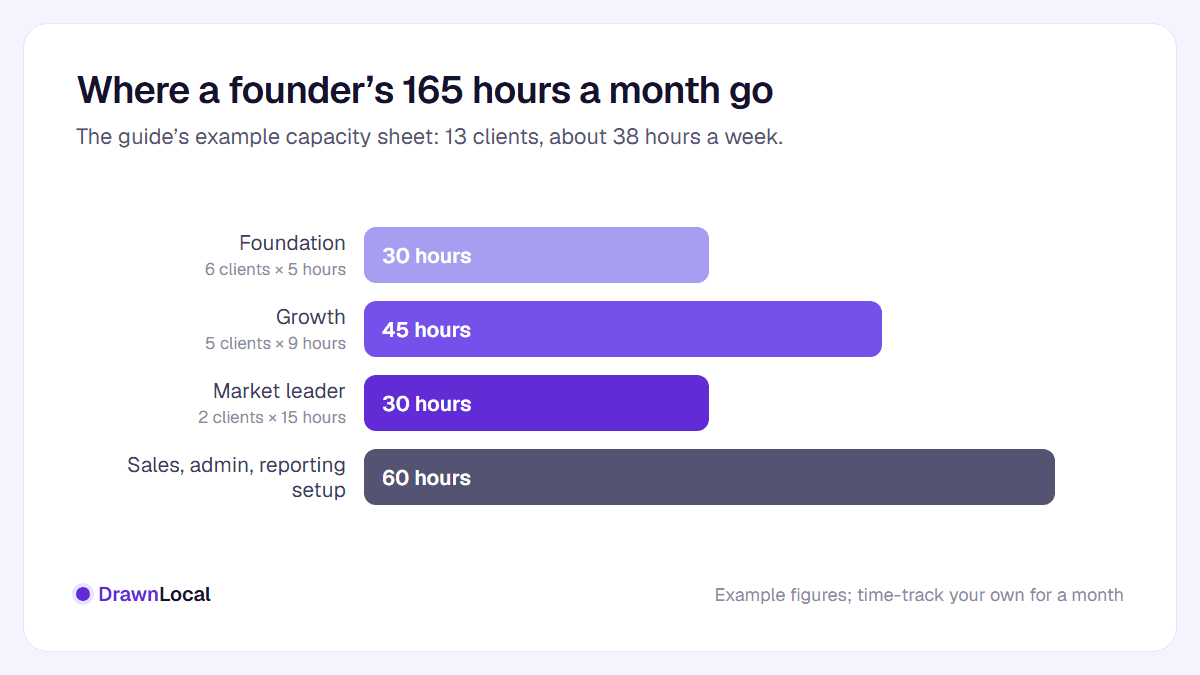
| Package | Hours a month per client | Clients | Total hours |
|---|---|---|---|
| Foundation | 5 | 6 | 30 |
| Growth | 9 | 5 | 45 |
| Market leader | 15 | 2 | 30 |
| Client work | – | 13 | 105 |
| Sales, admin, reporting setup | – | – | 60 |
| Total | – | – | 165 a month, about 38 a week |
In this example the founder can take one or two more clients, then the next sale costs evenings and weekends. That’s the moment to hire, not after the work starts slipping. The same sheet tells you which package is least profitable per hour, which is useful before you price the next one; how much to charge for local SEO shows how.
Redo the sheet every quarter. Packages drift as clients add small requests, and the sheet is how you notice before the hours run out.
The stages of growth, from solo to a small team
Each stage changes what the founder should spend time on. An example path, with client counts that depend on your packages:
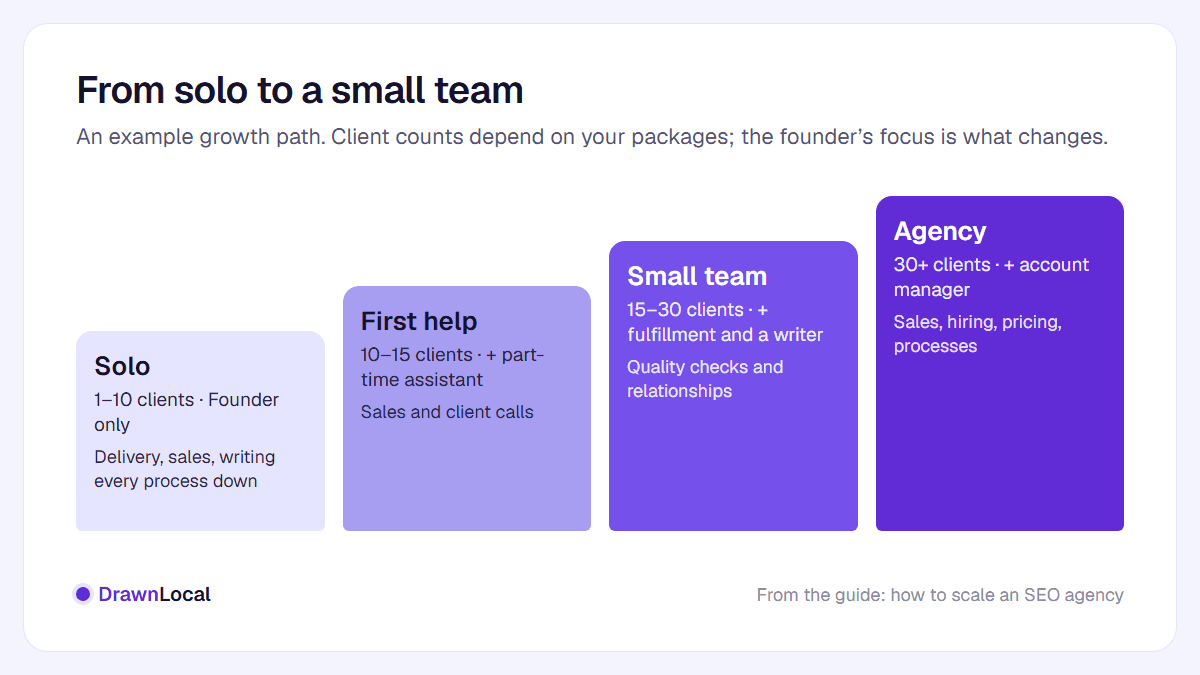
| Stage | Example clients | Team | Founder’s focus |
|---|---|---|---|
| Solo | 1–10 | Founder only | Delivery, sales and writing down every process |
| First help | 10–15 | Founder plus a part-time assistant | Sales and client calls; admin handed over |
| Small team | 15–30 | Plus a fulfillment specialist and a writer | Quality checks, client relationships, sales |
| Agency | 30+ | Plus an account manager | Sales, hiring, pricing and the processes |
The jump that catches founders out is the second one. Delivery is no longer done by the person who sold it, so the processes and the quality checks have to carry what used to live in your head.
Signs it’s time to hire
Hiring too early drains cash; hiring too late costs clients. Watch for these signs, especially when several show up at once:
- You regularly work more than about 45 to 50 hours a week, and growth is limited by your time rather than by demand.
- You turn down or delay good clients.
- Reports go out late, or a client has to chase you.
- You spend hours on work someone cheaper could do to the same standard.
- Profit after your own pay covers the new person’s cost with a buffer, for several months running.
Price so you can afford help
A hire only works if each client’s fee covers the hours someone else will spend on it. An example with illustrative figures:
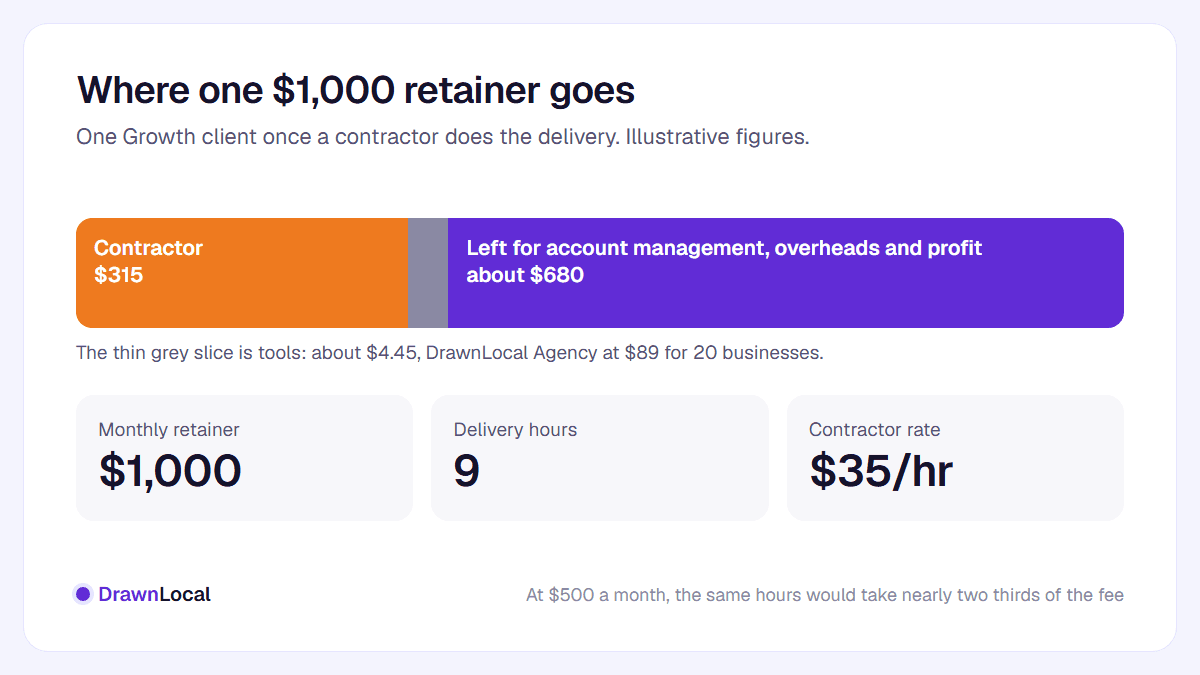
| Item | Example |
|---|---|
| Monthly retainer | $1,000 |
| Delivery hours | 9 hours |
| Contractor at $35 an hour | $315 |
| Tools (DrawnLocal Agency, $89 for 20 businesses) | about $4.45 |
| Left for account management, overheads and profit | about $680 |
At $500 a month, the same contractor hours would take nearly two thirds of the fee. That’s why pricing comes before hiring: how much to charge for local SEO shows how to set packages that leave room.
Know your numbers before and after each hire
Record these before a hire and again three months after. If they get worse and stay worse, fix the process before the next hire:
| Number | How to work it out | What you want to see |
|---|---|---|
| Profit per client | Fee minus delivery cost, tools and help | Steady or rising |
| Hours per client | From time tracking, by package | Close to what the package assumes |
| Founder hours on delivery | From your own time tracking | Falling |
| Reports sent on time | Sent by the agreed date | All of them |
| Clients who stay | Clients still with you after 12 months | Steady or rising |
A dip in the first month is normal while the new person learns. A dip that lasts past the 30-day ramp-up below often points to a missing SOP or a package priced too low.
Plan the cash before the first hire
A new person is paid every month, whether or not a client pays late or leaves. Work out the monthly cost, then decide how many months of it you want set aside before you start. An example with illustrative figures:
| Item | Example |
|---|---|
| Contractor hours a month | 60 |
| Rate | $35 an hour |
| Monthly cost | $2,100 |
| Three months set aside | $6,300 |
| New clients that cover it at $1,000 a month, after delivery | 3 to 4, at about $680 left from each |
Ask your accountant about taxes and any other costs that come with the type of hire, which the next sections touch on.
Raise prices as you grow
Growth can need higher prices, because each client now pays for someone else’s time as well as yours. Raise prices for new clients first: update the packages, and quote the new figures from the next sales call.
For existing clients, review prices once a year and give the notice your contract sets out. Tie the change to the results and the work: “Since you started, you’ve gone from the top 3 at 2 of 9 points to 7 of 9. From March the fee moves from $750 to $850, and the work stays the same.”
Some clients will leave over a fair increase. If they’re your least profitable ones, that frees hours for clients who value the work.
Make every package a fixed list of deliverables
A package someone else can deliver is a package with a fixed list. “SEO support” can’t be handed over; “one service page and two local link requests a month” can. An example:
| Package | Monthly deliverables |
|---|---|
| Foundation | Profile upkeep, the review routine, listing checks and the monthly report |
| Growth | Everything in Foundation, plus one service or area page and local link outreach |
| Market leader | Everything in Growth, plus a second page, more keywords on weekly heat maps and a quarterly competitor review |
Fixed lists also make the capacity sheet accurate, because each package now takes a predictable number of hours.
Step 2: write SOPs before you hire
A standard operating procedure (SOP) is the written way a task is done. Without them, every new person learns by watching you, and quality depends on your memory. Write them for the tasks you repeat most. A starting library for a local SEO agency:
| SOP | When it runs |
|---|---|
| Prospect audit and heat map | Before every sales call |
| Client onboarding and access | Every new client, first two weeks |
| Baseline recording | Before the first change for any client |
| Google profile clean-up | Month one for every client |
| Review routine setup | Month one for every client |
| Service page writing and publishing | Every new page |
| Listing clean-up | Month one, then quarterly |
| Spam check on the top 3 | Monthly |
| Monthly report and client note | First week of every month |
| Ranking drop investigation | Whenever a main keyword drops |
| Client offboarding | Whenever a client leaves |
Each SOP needs five parts: the trigger (when it runs), who owns it, the steps, what “done” looks like, and a link to a good example. Write it the next time you do the task, then hand it to someone else and fix every step they get wrong. The onboarding checklist and the 90-day plan are good starting points for two of them.
Step 3: decide who to hire first
Hire for the work that takes most of your time and that you do least well. A common order for a small local SEO agency:
| Role | Takes over | Hire when |
|---|---|---|
| Admin or virtual assistant | Scheduling, invoicing, report sending, data entry | Admin eats more than a day a week |
| Fulfillment specialist | Profile work, listings, page publishing, link outreach | Delivery is most of your week |
| Writer | Service pages, area pages, posts for customers | Pages are the bottleneck |
| Account manager | Client calls, monthly notes, keeping clients | You can’t give every client a monthly touchpoint |
| Salesperson | Prospecting and discovery calls | Delivery runs without you and sales is the limit |
Start part-time where you can, on a trial project with a clear SOP, and keep sales and client relationships yourself until delivery runs without you.
Write a job post that attracts the right person
A clear post saves interviews. Include these parts, in this order:
- What the agency does, in one line: who you help and with what.
- What they’ll own, taken from your SOP list, such as “Google profile updates and listing clean-up for 12 local businesses”.
- What good looks like after 90 days, so candidates can picture the job.
- Hours, pay and whether it’s contract or employment, stated plainly.
- A short paid test task, taken from a real SOP with made-up client details.
The test task tells you more than an interview: can they follow written steps, and do they ask good questions when a step is unclear? Pay for it, and keep it short.
Bring a new hire up to speed in 30 days
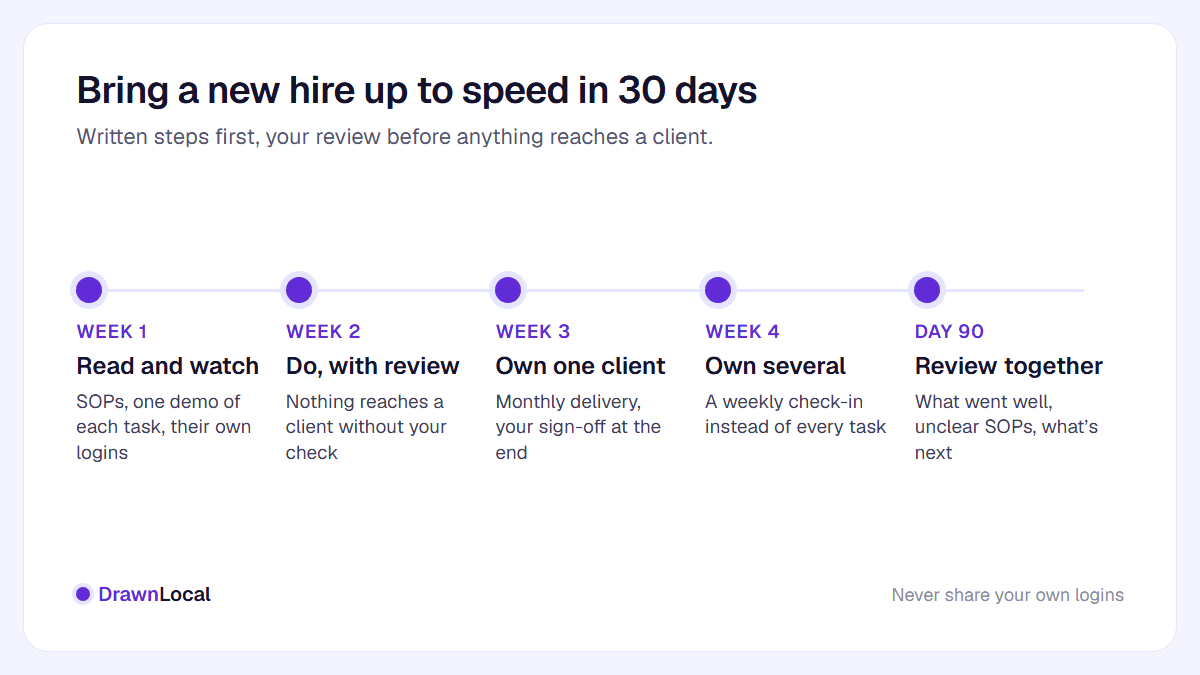
- Week 1: read the SOPs, watch you do each task once, and set up their own login on every tool. Never share yours; Google’s policy for agencies also says not to share passwords.
- Week 2: do the tasks with your review before anything reaches a client.
- Week 3: own one client’s monthly delivery, with your sign-off at the end.
- Week 4: own their tasks for several clients, with a weekly check-in.
- Day 90: review together: what’s going well, which SOPs were unclear, and what they should take on next.
Hiring mistakes to avoid
- Hiring one person to do everything. Hire for a clear set of SOPs, and add more once those run well.
- Skipping the test task because the candidate is a friend or comes recommended.
- Handing over clients before the SOPs exist. The new person then learns on your clients.
- No review at 90 days. Problems that aren’t named early tend to settle in.
- Paying by the hour with no time budget. Agree the expected hours per task, so overruns are spotted.
Contractor or employee?
In the US it isn’t your choice of label; it depends on the relationship. The IRS looks at three categories of evidence. Behavioral control asks whether the business controls what the worker does and how. Financial control asks whether the payer controls the business side of the job. Type of relationship covers contracts, benefits, and whether the work is a key part of the business.
The IRS says there’s no set number of factors, and asks businesses to document how they decided. If it’s unclear, either side can file Form SS-8 for an IRS determination, which it says can take at least six months. Payments to contractors are reported on Form 1099-NEC, for nonemployee compensation. States have their own rules too, so check with an accountant before the first hire; this is general information, not legal or tax advice.
When white-label help makes sense
White-label fulfillment means another company does work that you deliver under your brand. It can add capacity without a hire, especially for repeatable tasks like listing clean-up or page writing. It also adds risk: you’re responsible for work you didn’t do. Before using a partner, check:
- A trial project on a low-risk task, reviewed against your SOP before it reaches a client.
- That they never need the client’s passwords. Google’s policy for agencies says not to share passwords, and to use owner and manager roles instead.
- That they follow Google’s rules too: no guaranteed rankings, no keyword stuffing, no fake reviews. Breaches put your client’s profile at risk.
- That the client relationship stays with you: one point of contact and one report.
- What happens if they disappear: can you finish the work with your own SOPs?
- How you’ll describe the arrangement if a client asks. Being straightforward that specialists help with delivery keeps trust if it comes up later.
Your job changes as the team grows
Once others deliver the work, the founder’s job becomes checking, coaching and selling. A few habits help:
- Review, don’t redo. Send work back with the SOP step that was missed, so the fix lasts.
- Coach every week, even for 15 minutes: what went well, what was unclear, what’s next.
- Protect time for sales, because the pipeline is now the limit on growth.
- Improve one SOP a week, starting with whichever caused the last mistake.
It can feel slower than doing the work yourself at first. It’s also how the agency grows past your own hours.
Hand over client communication without losing the client
The riskiest handover is the client relationship, because owners hired you. Do it in steps:
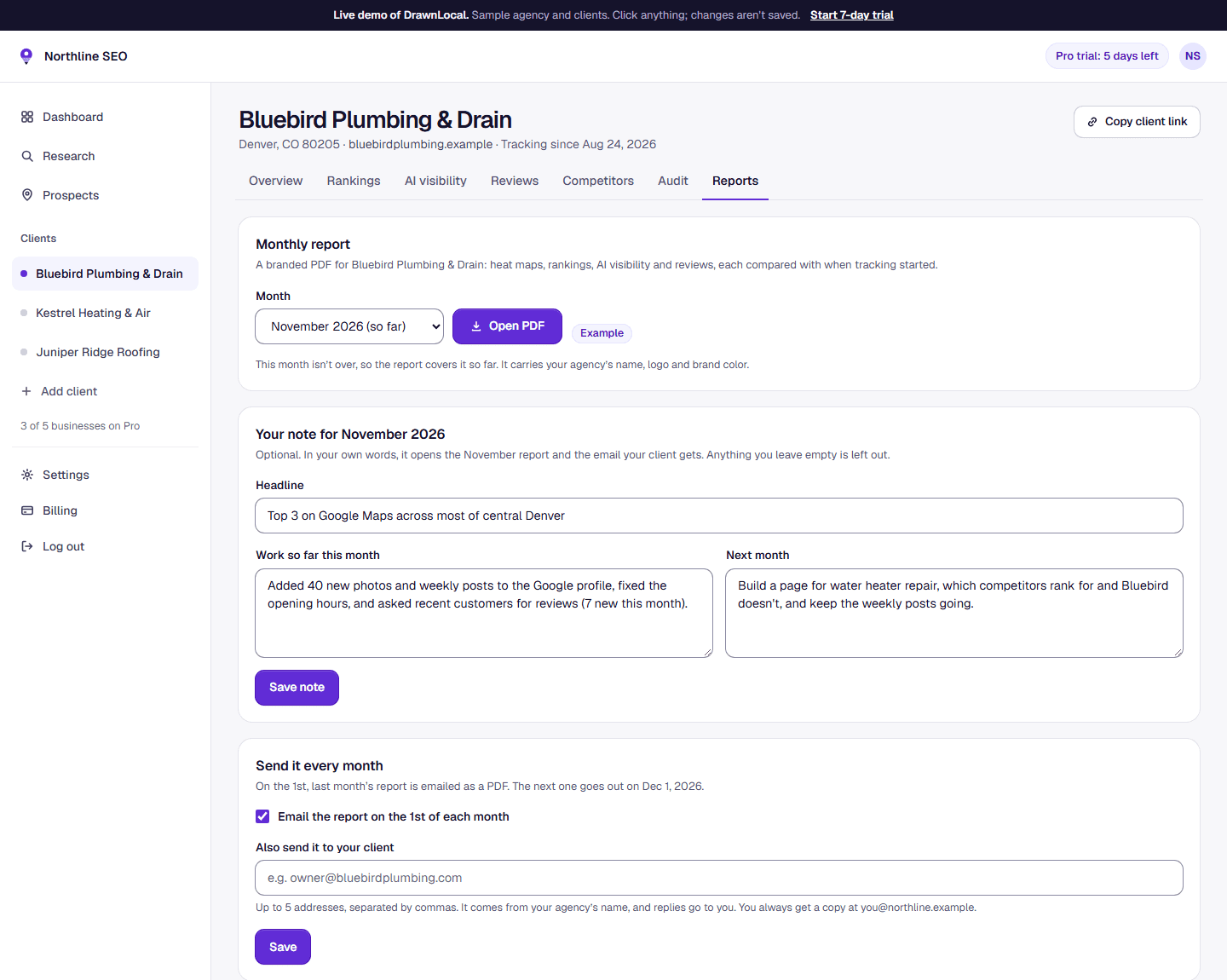
- Introduce the new account manager on a call you lead, as the person who’ll handle the day-to-day.
- Keep the monthly report and its format exactly the same, so nothing else changes at once.
- Copy yourself on the first two months of notes, and join the first quarterly review.
- Agree when the client should still come to you: price changes, a serious problem, or the end of the contract.
Many clients don’t mind a new contact. What they notice is a dip in reporting, slower replies, or losing someone who knew their business.
Write down what you know about each client
SOPs cover how tasks are done. A client sheet covers what you know about each business, which otherwise leaves with you. Keep one page per client with:
- Services and towns that matter most, and the jobs they want more of.
- The baseline date, the main keywords and the competitors to watch.
- Who you talk to, how they like to hear from you, and what they’ve been promised.
- Access: which roles the agency has on the profile and other accounts. Never passwords.
- Past problems, such as a suspension, a ranking drop or a billing dispute, and how each was resolved.
Update it after every client call. When a new account manager takes over, the client shouldn’t have to explain their business again.
A weekly rhythm for a small team
A fixed week stops work from slipping between people. An example:
| When | What happens | Who |
|---|---|---|
| Monday | Review every client’s heat map changes and alerts, and agree the week’s priorities | Whole team, 30 minutes |
| Tuesday to Thursday | Delivery against each client’s plan | Fulfillment and writers |
| Thursday | Quality check of anything a client will see | Founder or account manager |
| Friday | Client notes sent, time sheets in, one SOP improved | Everyone |
| First week of the month | Reports prepared, checked and sent on the agreed date | Account manager |
Tools that make scaling easier
Tools don’t scale an agency, but the right ones stop growth from creating chaos. The categories that matter, in the order many agencies add them:
| Category | What it does for you |
|---|---|
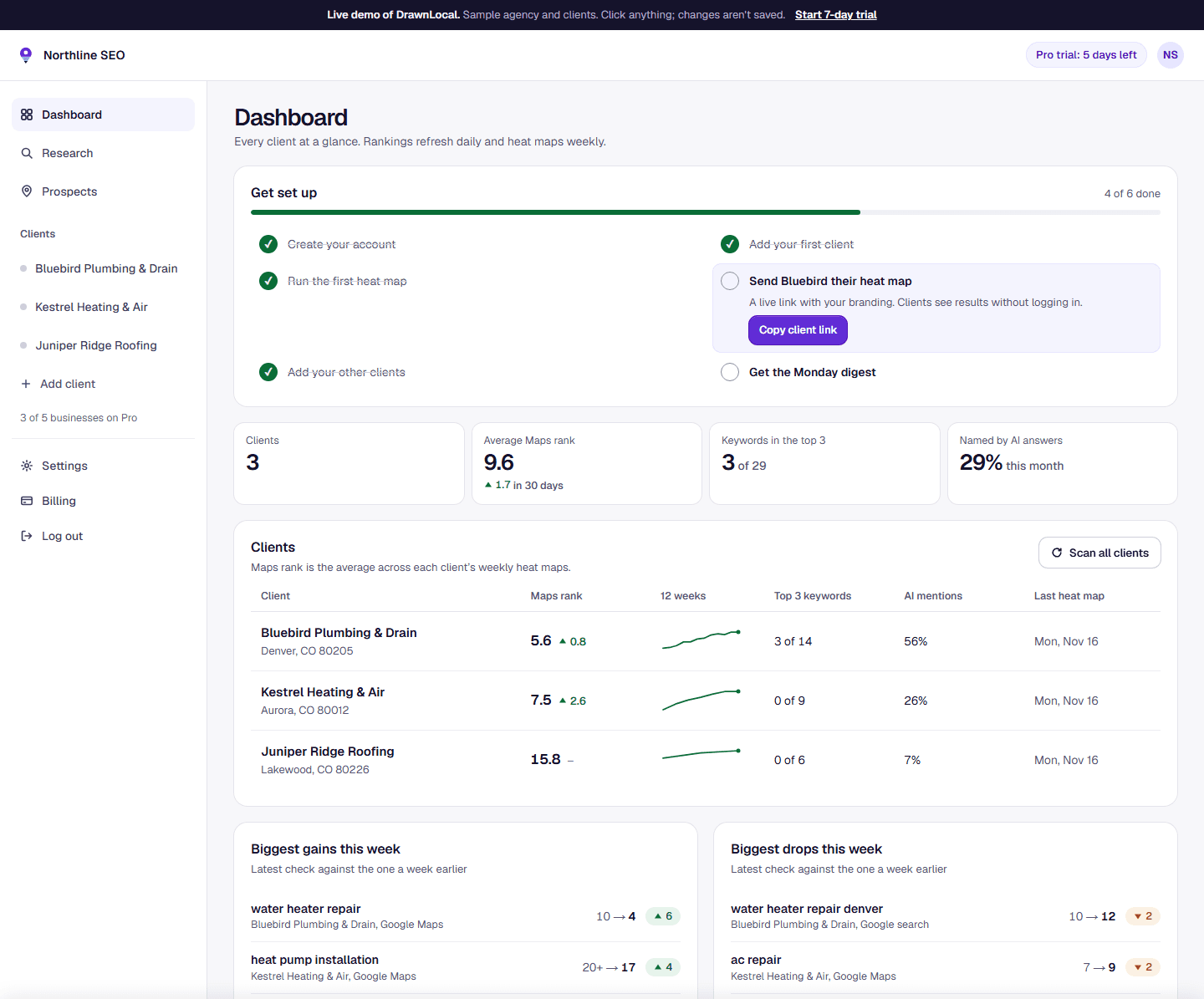
| Local SEO platform | Heat maps, rankings, reviews, AI visibility and reports for every client in one place |
| Project management | Every client’s tasks, owners and due dates where the team can see them |
| Shared docs for SOPs | One home for every process, kept up to date |
| CRM or a simple pipeline sheet | Every prospect, the last contact and the next step |
| Time tracking | The real hours per client, for pricing and capacity |
| Accounting and invoicing | Recurring invoices and clean books |
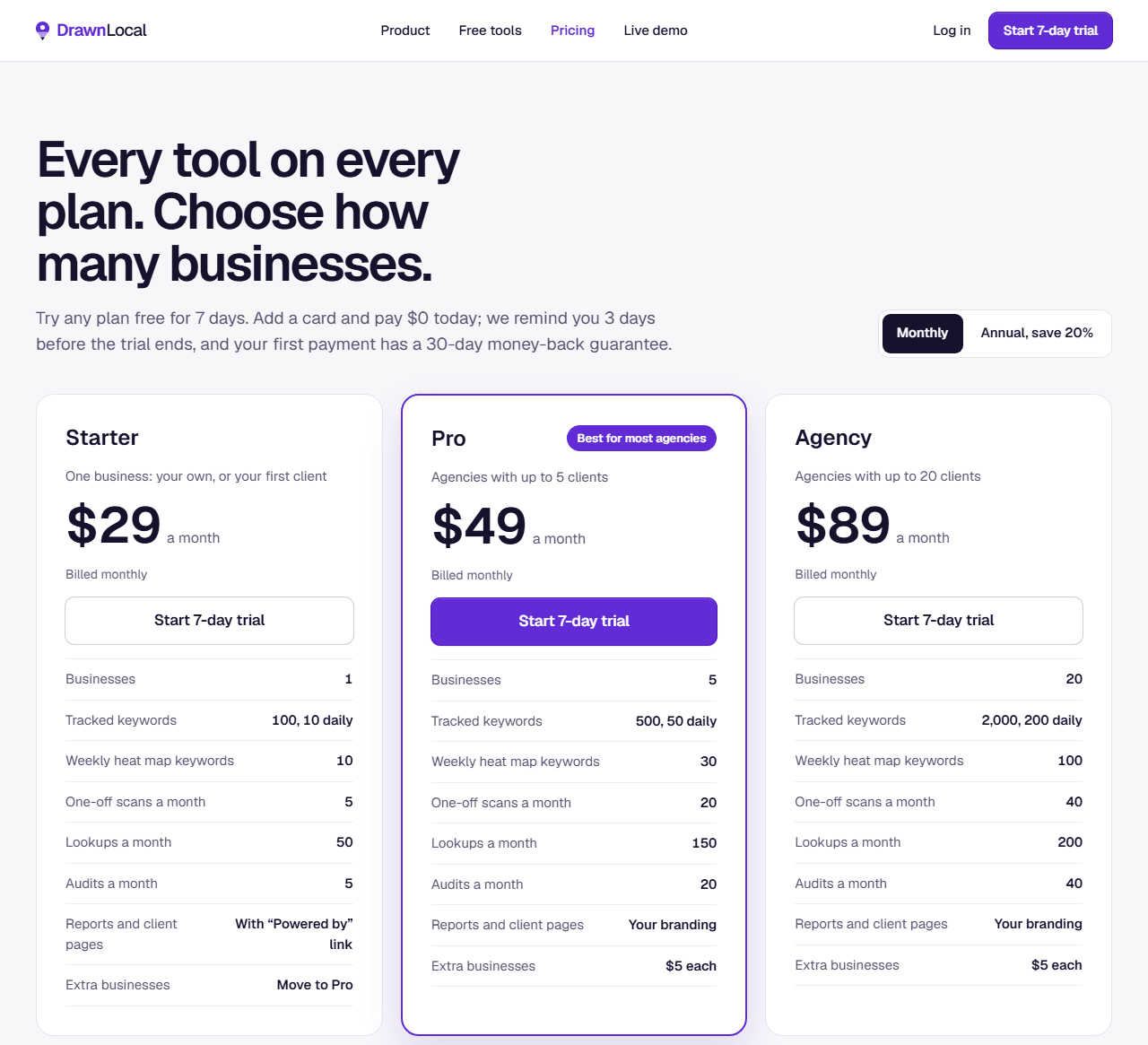
Watch per-seat pricing as the team grows. DrawnLocal includes unlimited team members on every plan, from $29 a month for one business to $89 for twenty, with each extra business $5 a month; see the pricing page.
Decide which clients to let go
Growth sometimes means saying goodbye. Your capacity sheet and profit per client show which clients take the most hours for the least money. For each one, try a fair fix first: a price that matches the hours, or a smaller scope.
If neither works, end the contract on its terms and hand over cleanly. Transfer nothing they own away from them, remove the agency’s access, and send a short summary of the work and where things stand. A clean exit protects your reputation, and the hours go to clients who fit.
When not to scale yet
More clients make some problems bigger, not smaller. Fix these first:
- Clients regularly leave within six months. More clients would then mean more clients leaving.
- Profit per client is thin. Each new client then adds work without adding much money.
- Results depend on you personally, with nothing written down.
- Reports go out late now, with the team you have.
SEO agency mistakes has a self-check that shows which of these to fix first.
Keep quality as you grow
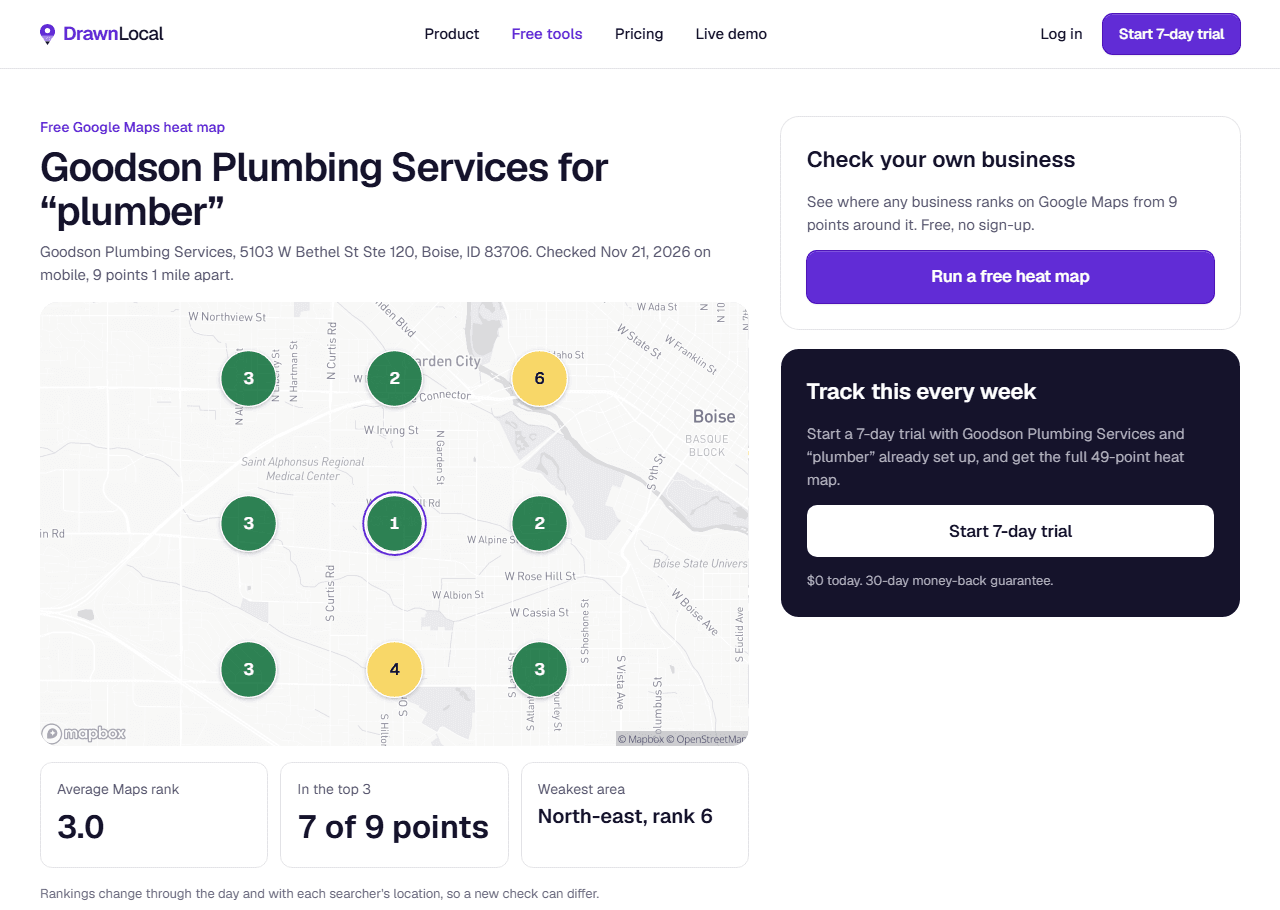
A weekly heat map is a quick quality check, because a reviewer can read it at a glance. Take this live map of a Boise plumber for “plumber”, checked Nov 21, 2026.
A reviewer looks at three numbers: the average rank of 3.0, the top 3 at 7 of 9 points, and the weakest area, north-east at sixth. If any of them gets worse from one week to the next, the account owner finds out why before the client notices.
- One owner per client, who knows the account and answers the client.
- A second pair of eyes on anything a client sees: reports, pages, profile changes.
- The same report every month, compared with the starting month; the report template shows the order.
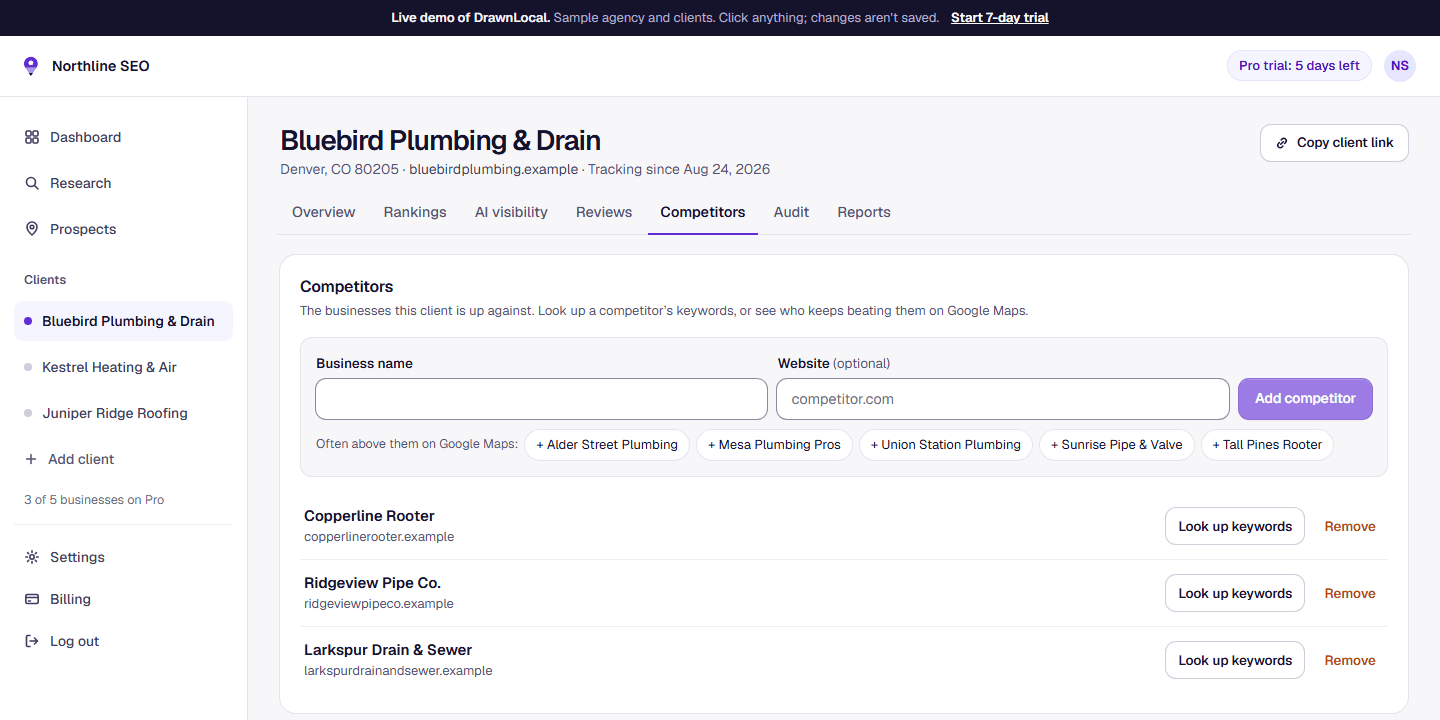
- Weekly heat maps for every client, so a drop is caught before the client spots it. DrawnLocal’s ranking alerts and Monday digest flag the big moves.
- A monthly review of SOPs: what went wrong, and which step to change.
Growth that costs you clients isn’t growth. Local SEO client retention covers the warning signs, and SEO agency mistakes lists the scaling mistakes to avoid.
Questions
When should an SEO agency hire its first employee?
When you regularly work more than about 45 to 50 hours a week and growth is limited by your time rather than demand. Profit should also cover the new person’s cost with a buffer, for several months. Write the SOPs first.
Who should a small SEO agency hire first?
Usually an admin assistant or a fulfillment specialist, whoever takes the most hours off your plate. Keep sales and the client relationship yourself until delivery runs without you, then add an account manager.
Should I hire contractors or employees?
In the US it depends on the relationship, not the label: the IRS looks at behavioral control, financial control and the type of relationship. Contractors are paid on Form 1099-NEC. Check state rules with an accountant.
Is white-label SEO a good way to scale?
It can add capacity without hiring, for repeatable tasks. Start with a trial project, never share client passwords, make sure the partner follows Google’s rules, and keep the client relationship and reporting in-house.
How many clients can one SEO specialist manage?
It depends on the hours each package takes. In this guide’s example, 13 clients at 5 to 15 hours each came to about 105 hours a month. Time-track for a month, then divide the hours someone has by the hours per client.
Sources
- IRS: independent contractor (self-employed) or employee?
- IRS: about Form 1099-NEC, nonemployee compensation
- Google Business Profile Help: third-party policies
- Google Business Profile Help: manage owners and managers