Local SEO client retention: why clients cancel, and 9 ways to keep them
Many local SEO clients who leave don’t leave because the work failed. They leave because they couldn’t see it working. Here’s why clients cancel, the early warning signs, and nine habits that make the value obvious every month.
By the DrawnLocal team · · Updated · 14 minute read
Local SEO client retention by the numbers
Retention matters for an agency’s profit, because every extra month from an existing client costs no new sales effort. An example, before costs: one client at $750 a month.
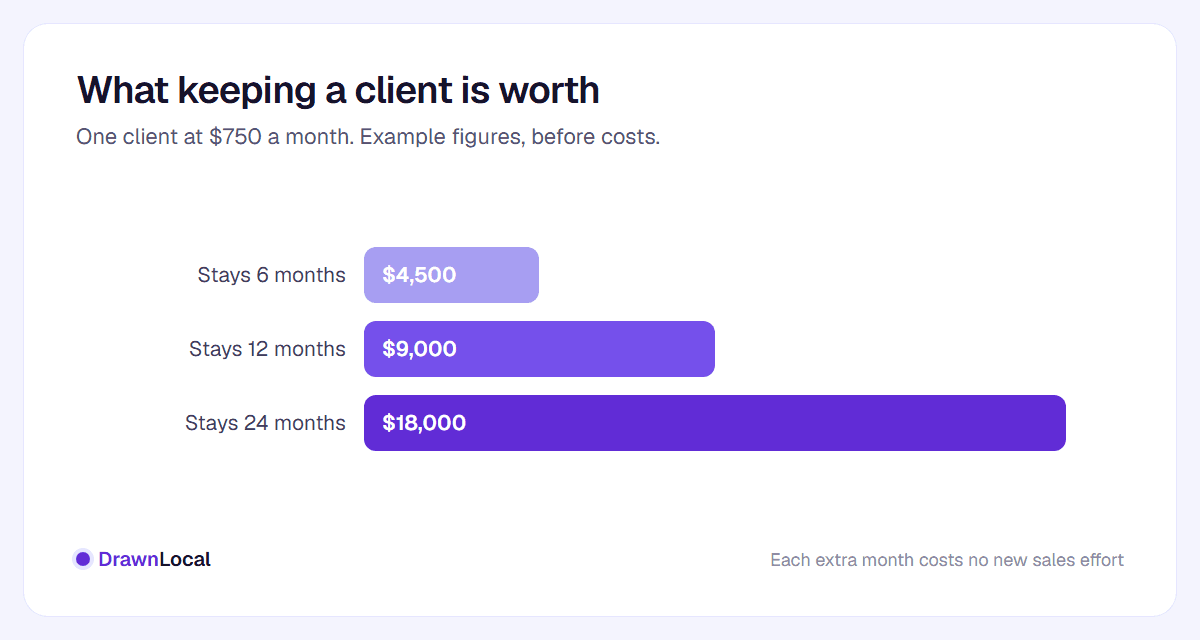
| Months kept | Revenue | Compared with 6 months |
|---|---|---|
| 6 | $4,500 | – |
| 12 | $9,000 | Twice as much |
| 24 | $18,000 | Four times as much |
Winning a new client takes prospecting, calls, a proposal and onboarding. Keeping one takes a good monthly report and a few honest conversations. That’s why the habits below are worth the time.
Retention starts in the proposal
Some cancellations trace back to a promise the work couldn’t keep. Put these in writing before the client signs:
- Timing: Google’s own guidance says an SEO usually needs four months to a year to make improvements and see potential benefit. Quick fixes can show sooner.
- What you’ll report: the heat map, rankings, reviews and profile calls, compared with the month they started.
- What you control: the work. Google, competitors and the owner’s own reviews routine control the rest.
- How you’ll keep in touch: a monthly report on a fixed date, a short note when something big changes, and a review every 90 days.
- No guarantees: nobody can promise a ranking, and you won’t.
A client who knows what to expect in month two is less likely to be surprised by it. The proposal template has a section for exactly this.
The early months need the most care
The months before results show are when doubt is most likely. The owner is paying, the fixes are invisible, and the map may not have moved yet.
Fill the gap with visible proof of work and early signs: the profile changes made, the review routine’s first new reviews, the service page published, any points gained on the map. A short note every two weeks in the first quarter costs little and heads off the “what are we paying for?” email.
Seasonal businesses: keeping them through the quiet months
Landscapers, HVAC companies, pest control and roofers often have busy and quiet seasons. Clients may question the fee most when the phone is quiet, which is exactly when the work for next season matters.
Plan for it in the proposal. Agree what the quiet months are for: pages for the busy season’s services, the review routine on every job, and links ready before demand returns. Report the quiet months against the same months last year where you can, not against the busy season.
Contracts that support retention
A contract can’t make a client stay happy, but it can give the work time to show results. A common structure: a minimum term long enough for the first fixes to take effect, then month to month, with a clear notice period.
Pair the term with the 90-day review, so the client knows there’s a planned moment to discuss progress before any renewal. Local SEO contract lists the terms to include.
Retention by client type
Different clients need slightly different attention:
| Client type | What they care about | What helps keep them |
|---|---|---|
| Single-location trade | Calls and booked jobs | Profile calls against the start; the map for their main service |
| Multi-location business | Which branches are winning | A per-location view, with the weakest branch’s plan |
| Seasonal business | Being ready for the busy season | A seasonal plan and year-on-year comparisons |
| Owner who was burned before | Not being fooled again | Weekly visibility: the live page and a short note |
| Busy owner | Not having to think about it | A two-line summary and one call a quarter |
When your team changes
A new account manager is a risk point. The owner hired a person, and a sudden change can feel like a downgrade. Introduce the new person on a call, keep the report exactly the same, and copy yourself on the first two months of notes.
Keep a one-page record for each client: what matters to them, what they’ve been told, and any past problems. The new person reads it before the first call, and the client doesn’t have to start again. How to scale an SEO agency covers handovers in more depth.
Learn from every client who leaves
Ask a few questions, kindly, once the decision is made:
- What made you decide to stop?
- When did you first start to doubt it was working?
- What did you expect to see that you didn’t?
- What would have made you stay?
Log the answers with the start date and the fee. After a few exits, patterns show up, such as doubts starting before month four or clients on the smallest package leaving first, and each pattern is a process to fix.
Winning former clients back
A clean exit keeps the door open. Three to six months later, a short, useful note can restart the conversation: a fresh heat map of their main keyword, with one thing that has changed.
Ask once, without pressure: “Here’s where you stand now. If you’d like a hand again, I’m here.” Former clients already know how you work, and the ones who left over budget or timing sometimes come back when that changes.
Why local SEO clients cancel
- They can’t see progress. Local SEO takes months, and an owner who hears “we optimized your profile” three months running starts to wonder what they’re paying for.
- The report is a task list. Hours, tasks and jargon instead of where the business now shows up and how many calls came in.
- Their own search disagrees. The owner searches from the shop and sees something different from the report; why a client’s rank looks different explains it, but only if you get there first.
- A bad month comes with no explanation. A drop after a Google update or a new competitor feels like failure when nobody mentions it.
- Silence. No contact between invoices.
- Price against results. Without a clear link to calls or jobs, the fee becomes the easiest cost to cut.
Warning signs to watch
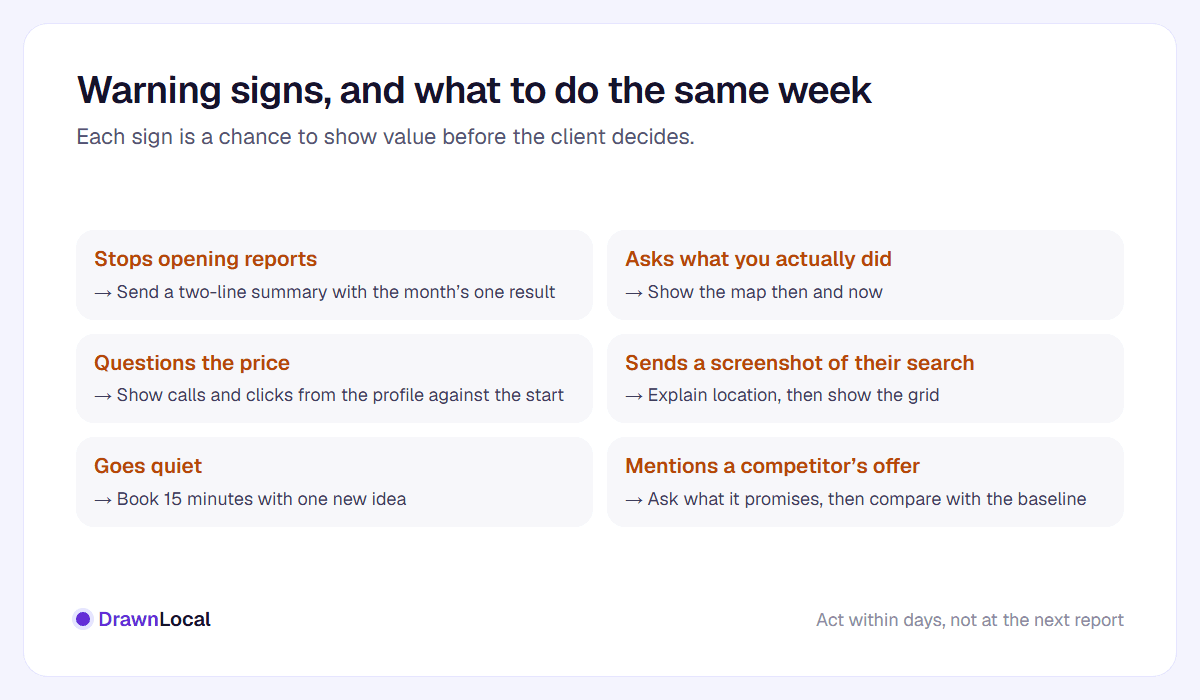
| Sign | What to do |
|---|---|
| Stops opening reports or the client page | Send a two-line summary with the one result that matters this month |
| Asks “what did you actually do?” | Show the heat map then and now, side by side |
| Questions the price | Show calls, direction requests and clicks from the profile against the starting month |
| Sends a screenshot of their own search | Explain location and personalization, then show the grid |
| Goes quiet for a month | Book a 15-minute call with one new idea |
9 ways to keep local SEO clients longer
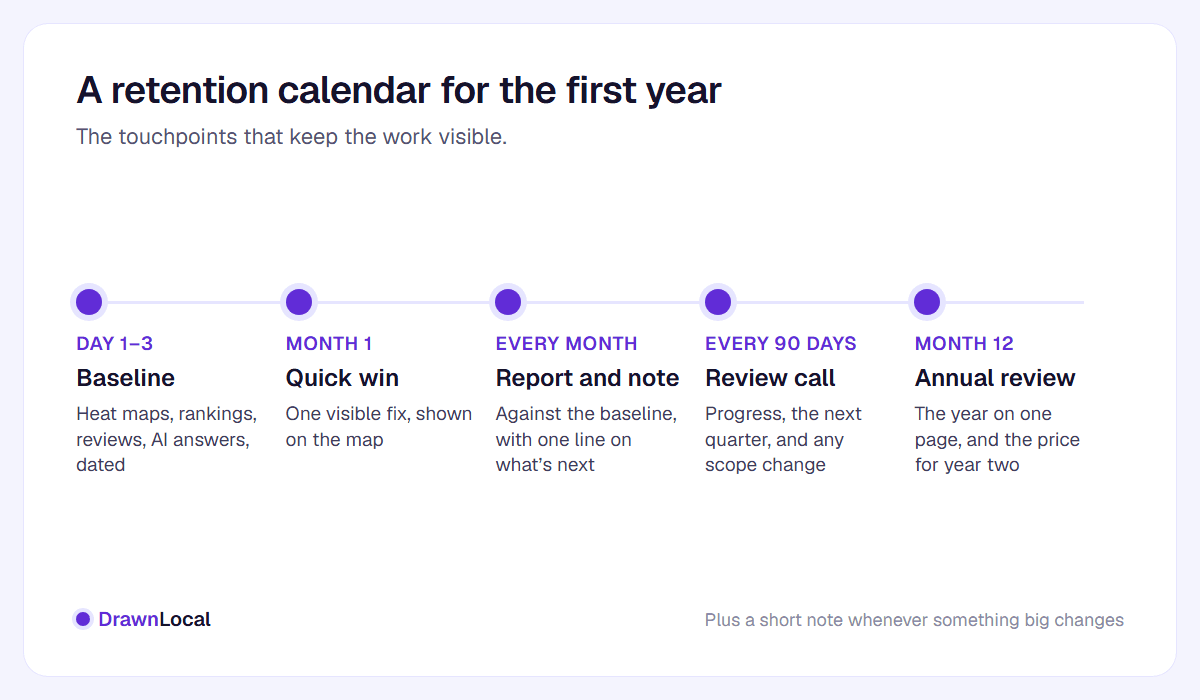
- Record a baseline before day one’s changes, and compare every report with it. Progress since the start is the strongest story you have. The onboarding checklist lists what to record.
- Set expectations in the proposal. Google’s own advice says improvements often take four months to a year to show benefit; say so before the client signs.
- Report results, not tasks. Lead with the heat map, the keywords in the top 3, reviews and profile calls; the report template gives the order.
- Give them a live page. A bookmarkable page with the heat map, rankings, AI visibility and reviews keeps your work visible between reports. See a sample client page.
- Deliver a quick win in month one, such as a category fix or a spam listing removed, and show it on the map.
- Tell them bad news first. When a keyword drops or a new competitor enters the top 3, explain it and the plan before they notice. DrawnLocal’s ranking alerts and Monday digest flag these moves for you.
- Keep a monthly touchpoint, even a short note: what changed, what you did, what’s next.
- Review the plan every 90 days against the baseline and agree the next quarter; see the 90-day plan.
- Grow the scope with the results: a new service area, a second location or AI visibility tracking, priced as a step up, not a surprise.
Show progress from the first map
The strongest retention tool is a map from day one, kept and compared. Here’s the kind of baseline to save, from DrawnLocal’s free heat map on Nov 21, 2026. A Boise plumbing company, for “plumber”, is first at its address and in the top 3 at 7 of 9 points.
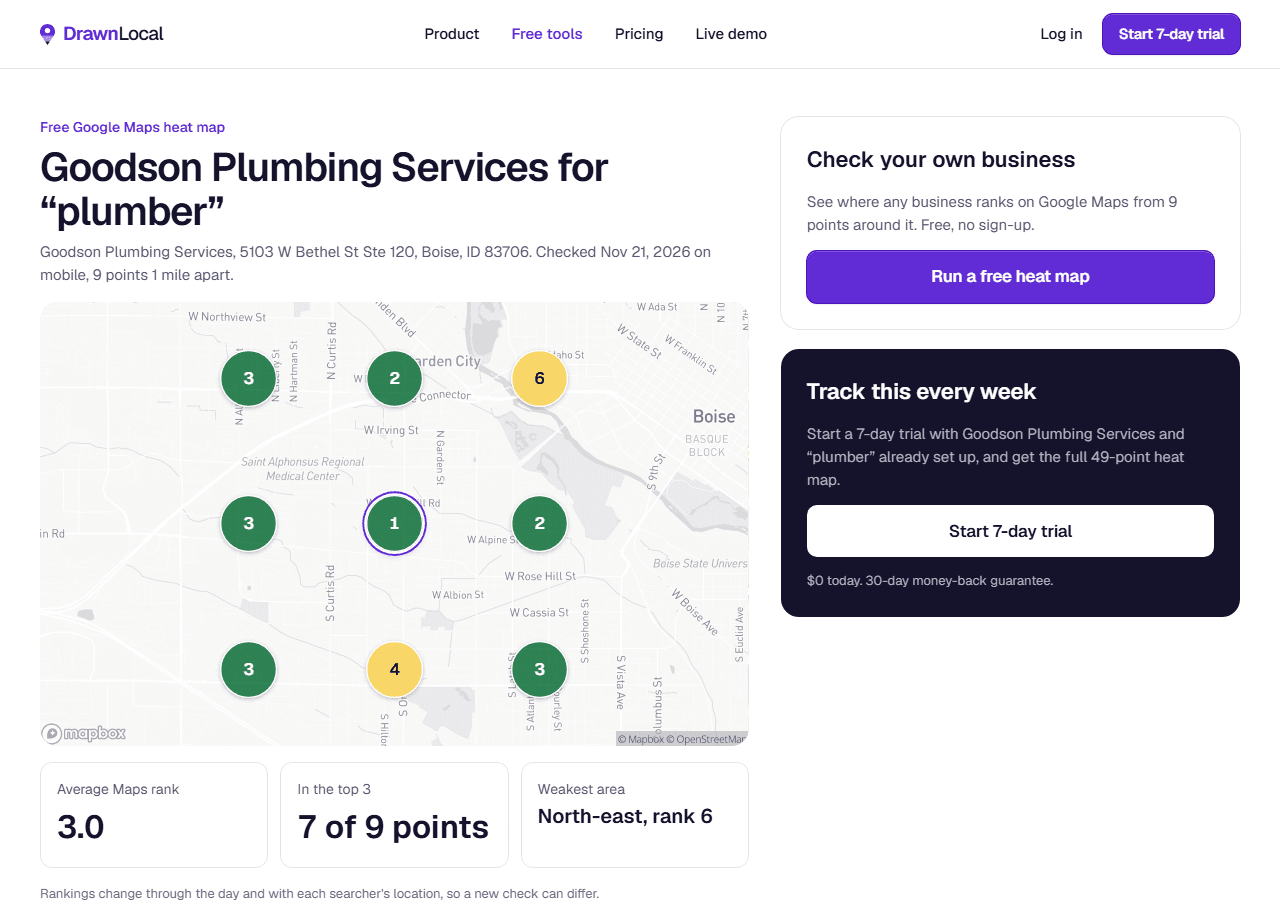
Three months on, the same keyword, center and grid show the client exactly where they gained. A map is easier for an owner to remember than a list of tasks.
A live page the client can check
Between reports, a live page answers “is it working?” without an email. Every number sits next to where it started:
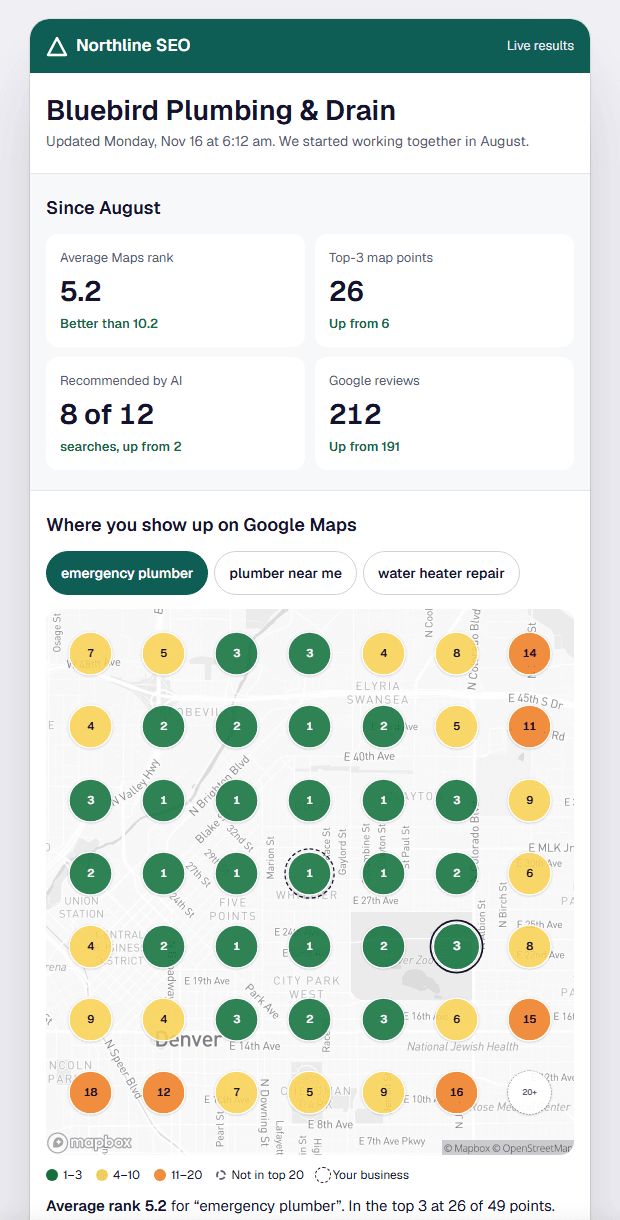
Send the link with the first report and again whenever something good happens. Each look at the start-versus-now numbers is a reminder of what the fee pays for.
The monthly note: a template
The report holds the numbers; the note tells the story. Keep it to four lines:
“[Name], here’s [month]. Result: [one number against the start, such as top 3 at 26 of 49 points, up from 6]. What we did: [two or three items]. What changed around you: [a new competitor, a review burst, a Google change, or nothing]. Next month: [one or two items].”
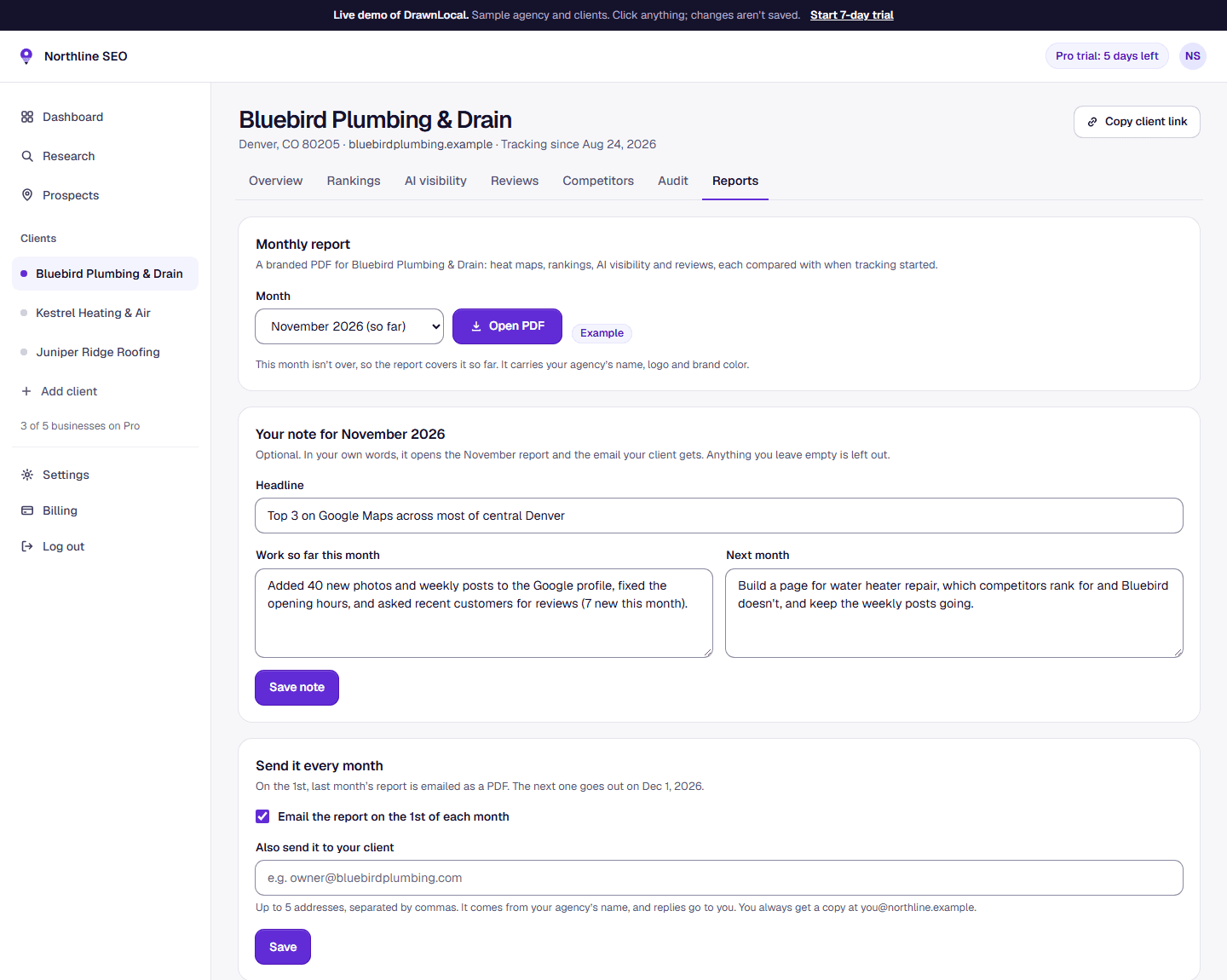
Write it even in a slow month. Saying “a quiet month, here’s why, here’s what’s next” keeps trust; silence spends it.
Keep the notes in one thread, so the owner can scroll back through the months. That history becomes its own proof of steady work, and it helps you at the quarterly review.
Catch drops before the client does
A drop the owner finds first feels like a cover-up. A drop you explain first, with a cause and a plan, feels like service. Check every client’s biggest moves each week:
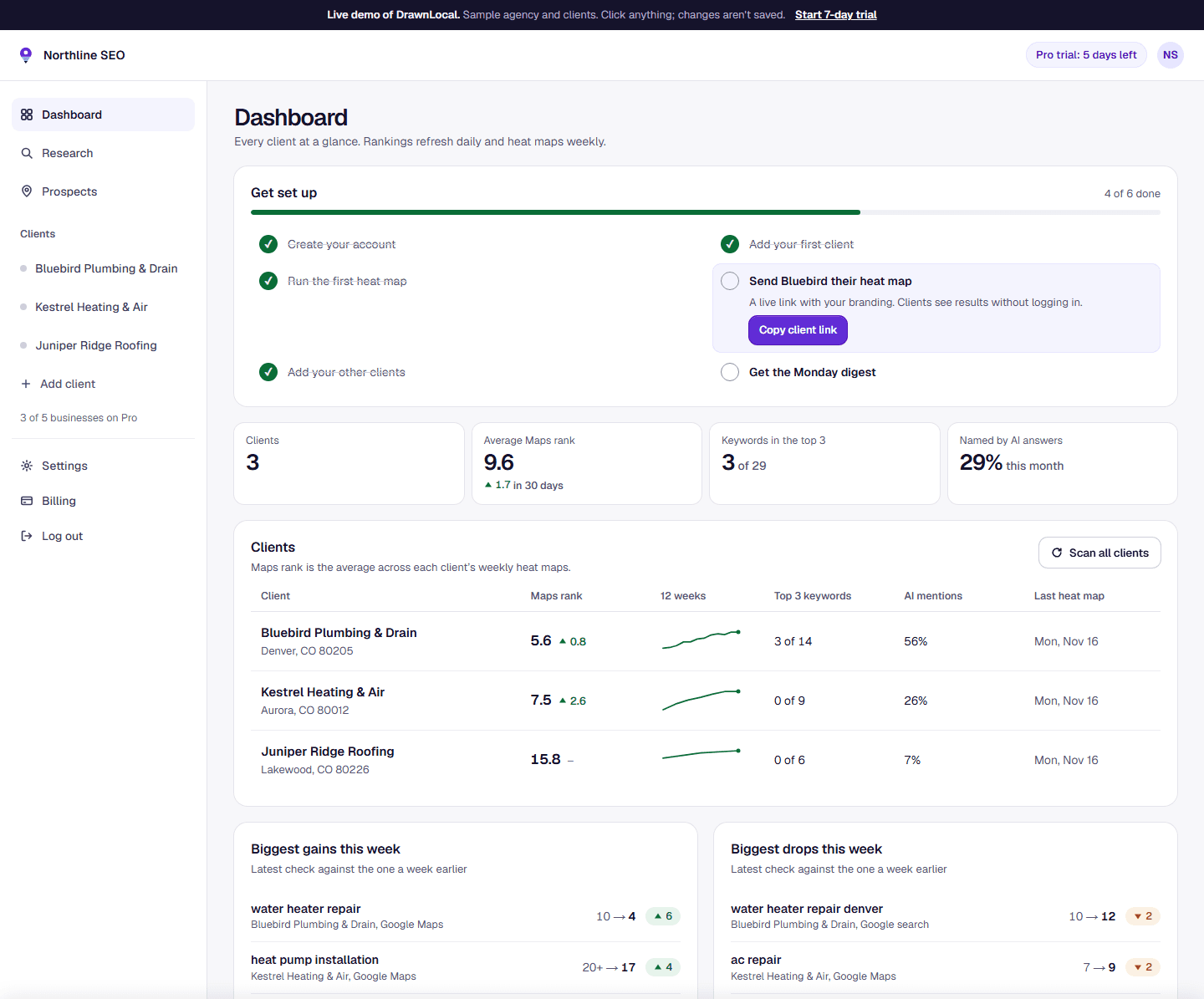
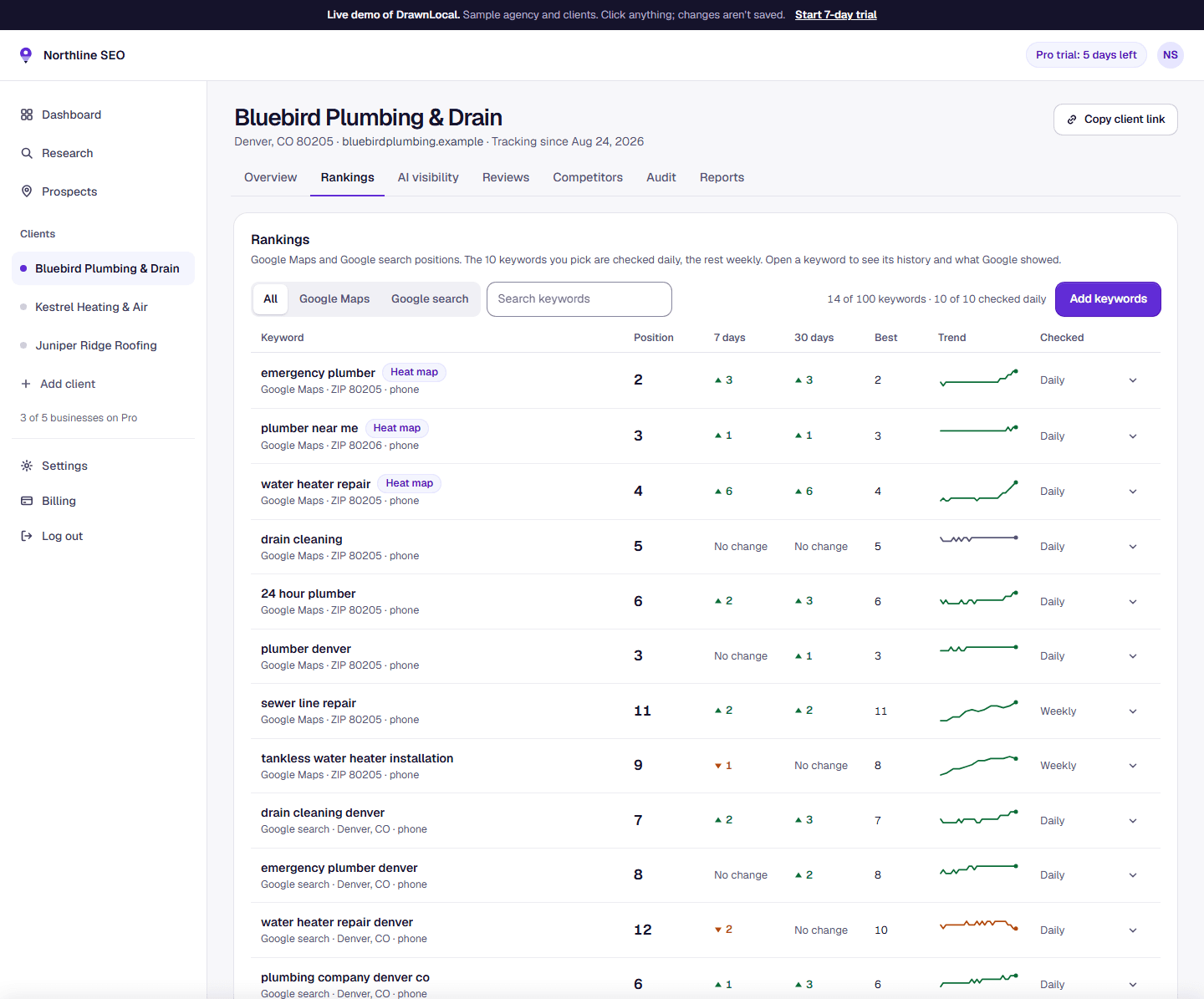
Then look at the keyword’s history before you write to the client, so you know whether it’s a blip or a trend:
Read the trend before you explain a drop
A one-week dip that recovers needs a line in the next note. A steady slide over a month needs a message now, with the likely cause: a new competitor, a lost review flow, a profile edit, or a change at Google. Why a business drops out of the Maps top 3 lists the usual causes.
The quarterly review call
Every 90 days, book 30 minutes. An agenda that keeps it useful:
| Minutes | Topic |
|---|---|
| 0–10 | The map, rankings and reviews now against the baseline |
| 10–15 | What worked, and what didn’t |
| 15–20 | Changes in the business: new services, areas, staff, busy seasons |
| 20–25 | The plan for the next 90 days |
| 25–30 | Anything else, and the next review date |
The business-changes slot matters most for retention. It’s where you hear about the new service the owner wants more of, which becomes next quarter’s focus and keeps the work feeling relevant.
The save conversation: what to say when they want to leave
Ask first, and don’t argue: “Thanks for telling me. Can I ask what’s behind it?” Then match the answer:
| Reason | A fair response |
|---|---|
| “We’re not seeing results.” | Show the map and calls then and now. If progress is real, agree one goal and a date to review it. |
| “It’s too expensive.” | Offer a smaller package that keeps the core work, rather than stopping it all. |
| “We’re busy enough.” | Suggest pausing growth work and keeping reviews and monitoring at a lower fee. |
| “Another agency offered more.” | Ask what they promised, and compare it with Google’s rules and your baseline. |
| “We’re doing it in-house.” | Offer a handover: the baseline, the plan and the routines. |
If they still go, honor the notice period, hand back access within Google’s 7 business days, and send a short summary of where things stand.
Raise prices without losing clients
Prices that never move squeeze the margin, and a squeezed margin cuts the hours that keep results coming. Review prices once a year, with the notice the contract sets out, and lead with the client’s progress: the map, the reviews and the calls against the start.
Change new clients’ prices first, and existing clients’ at their anniversary. SEO agency mistakes has a price-rise letter you can adapt.
Turn happy clients into referrals
A client who sees results is the best source of the next one. Ask at a good moment, such as right after a quarterly review that went well: “Do you know another business owner who could use this?”
Make it easy: a short line they can forward, and your booking link. Keep any thank-you simple and honest; a referral is a favor, and a client who refers you is telling you something about how well the work is going.
The retention numbers to track
Track these monthly across the agency:
| Metric | What it tells you |
|---|---|
| Average months a client stays | Whether the habits are working |
| Clients lost this quarter, and why | Patterns in the reasons |
| Reports opened, or client page visits | Early warning of drifting interest |
| Clients contacted between reports | Whether anyone was left in silence |
| Referrals received | How satisfied clients really are |
Review the reasons for every client lost. Three in a row for the same reason point to a process to fix, not bad luck.
Look at the timing too. If most losses happen in the same month of the contract, that month needs more attention: an earlier review call, a clearer report, or a quick win planned for just before it.
Agree how you’ll communicate
Some frustrations come from mismatched expectations about contact, not from the work. Agree a few rules at kickoff and write them into the welcome email:
- One main channel: email, text or a shared chat, not all three.
- A reply time each way, such as one working day.
- Who approves changes to the profile, and how quickly.
- When the report arrives each month, and when the quarterly call is.
Then keep to them. A reply that always comes within a day builds more trust than a fast reply one week and silence the next.
Write the rules into the client’s one-page record too, so anyone on your team who picks up the account knows them. When a client says “you always reply within a day”, that’s a habit worth protecting, because it’s part of what they’re paying for, even if no contract lists it.
Handling an unhappy email
When a frustrated email arrives, reply the same day, even if only to say you’re looking into it. Then call rather than write a long reply; tone travels better by voice.
On the call, listen first, then show the facts: the baseline, the map now, the work done. Agree one specific next step with a date. Follow up in writing with what you agreed. Often the frustration is about not knowing, and a call helps.
Small wins worth reporting
Big ranking moves take time. Meanwhile, these are real and visible, and worth a line in the note:
- Points on the map that moved into the top 3, even two or three.
- New reviews this month, and the gap with the top 3 closing.
- A new service or area page published, and the first searches it appears for.
- A spam listing reported and removed from the client’s area.
- More calls or direction requests from the profile than the same month last year.
- The client named in an AI answer it missed at the start.
Report each one against the baseline, and keep the tone matter-of-fact. Small wins add up to a story the owner can repeat to a business partner.
Grow the scope as results come
A client who sees progress often wants more. Natural next steps, each priced as a clear step up:
| Addition | When it fits |
|---|---|
| A second service keyword | The first is in the top 3 across most of the map |
| A new town or area | The client wants work further out, and serves it |
| A second location | The business opens another branch |
| AI visibility tracking | The owner asks whether ChatGPT recommends them |
| Review replies handled for them | The owner has no time to answer reviews |
Raise it at the quarterly review, with the map that shows why now. Growth that follows results feels like progress, not an upsell.
A retention checklist for every client
Run this monthly for each client. Any “no” is the week’s first job:
- The report went out on the agreed date.
- It compared with the baseline, not just last month.
- A note in plain words went with it.
- Any drop or new competitor was explained before the client noticed.
- The client has the live page link.
- The next quarterly review is booked.
- The price was reviewed in the last 12 months.
How DrawnLocal supports retention
Most of the habits above need data on a schedule. DrawnLocal runs weekly heat maps and daily rank checks, and emails a Monday digest of the biggest moves. It keeps every number against the month the client started. Each client also gets a live page, with your branding on Pro and Agency.
That leaves the part only you can do: the note, the call and the plan. See everything DrawnLocal does, or try the live demo.
What to do when a client wants to leave
Ask why, and listen. If the reason is something you can fix, such as no visible progress or a misunderstanding about rankings, show the baseline comparison. Then offer a short plan with a date to review it. If it’s budget, offer a smaller package rather than nothing.
If they still leave, make it easy: Google’s third-party policy requires agencies to give clients exclusive control of their Business Profile back within 7 business days of notice. A clean exit protects your reputation and keeps the door open, and clients who leave well sometimes come back.
Questions
Why do local SEO clients cancel?
Often because they can’t see progress: reports full of tasks rather than results, slow early months with no expectations set, their own searches showing something different, or silence between invoices.
How do I prove local SEO is working?
Compare with the month the client started: the heat map then and now, keywords in the Maps top 3, new reviews, and calls, clicks and direction requests from the Google profile.
How long should a local SEO contract be?
Long enough to show results. Google’s own guidance says SEO improvements often take four months to a year to show benefit. A minimum term of a few months, then month to month, keeps expectations and the contract in step.
What is a good client retention rate for a local SEO agency?
There’s no reliable public benchmark. Track your own average months per client and the reasons each one leaves, and aim to improve both every quarter. Common reasons are unclear progress and silence between reports.
What should I send clients between reports?
A short note when something important changes: a keyword entering or leaving the top 3, a new competitor, a batch of reviews. A live client page they can check any time does most of the rest.
Sources
- Google: do you need an SEO?