Keywords in a Google Business Profile name: allowed, risky or worth it?
It’s the factor that tempts so many businesses: a business called “Smith Plumbing – Emergency Plumber Denver” often outranks plain “Smith Plumbing”. Here’s exactly what Google allows in the name, what happens when you push it, and what to do instead.
By the DrawnLocal team · · Updated · 14 minute read
Why keywords in the name work
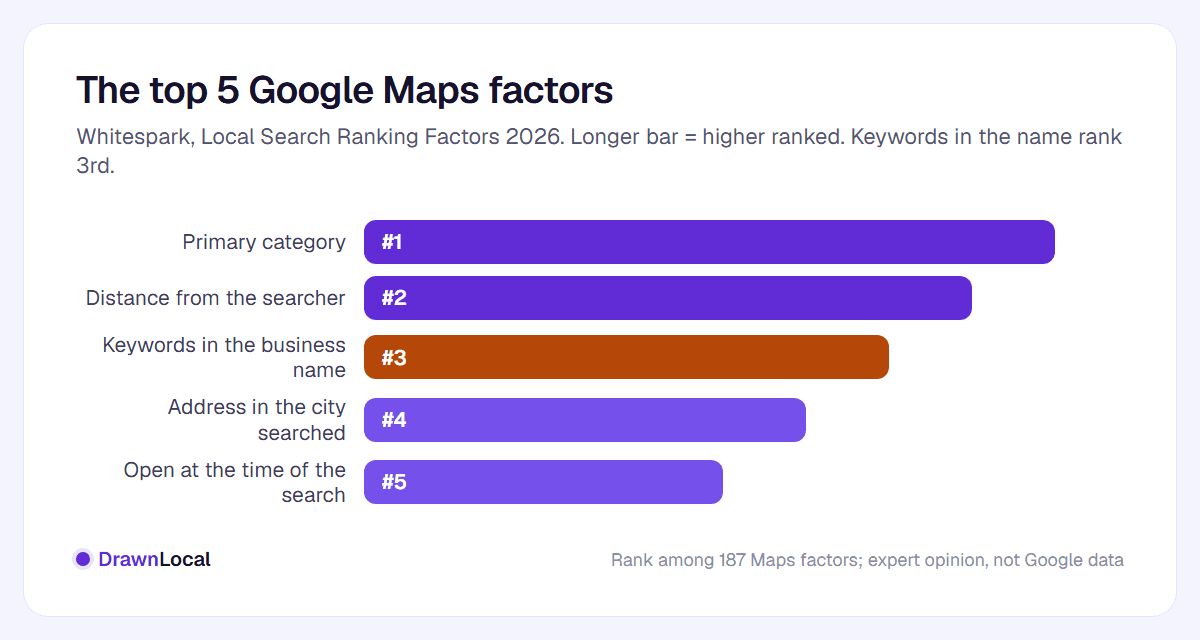
Relevance is one of Google’s three local ranking factors, and the name is one of the strongest relevance signals a profile has. Experts in Whitespark’s 2026 survey ranked keywords in the business name third of 187 Maps factors, behind only the primary category and distance from the searcher. That’s why keyword-stuffed names are so common in home services: they often work, until they don’t.
Live data: the service word in every Maps #1 name
To see how common descriptive names are at the top, we looked at six live Google Maps searches on Nov 21, 2026. In each, we noted the business Google Maps listed first.
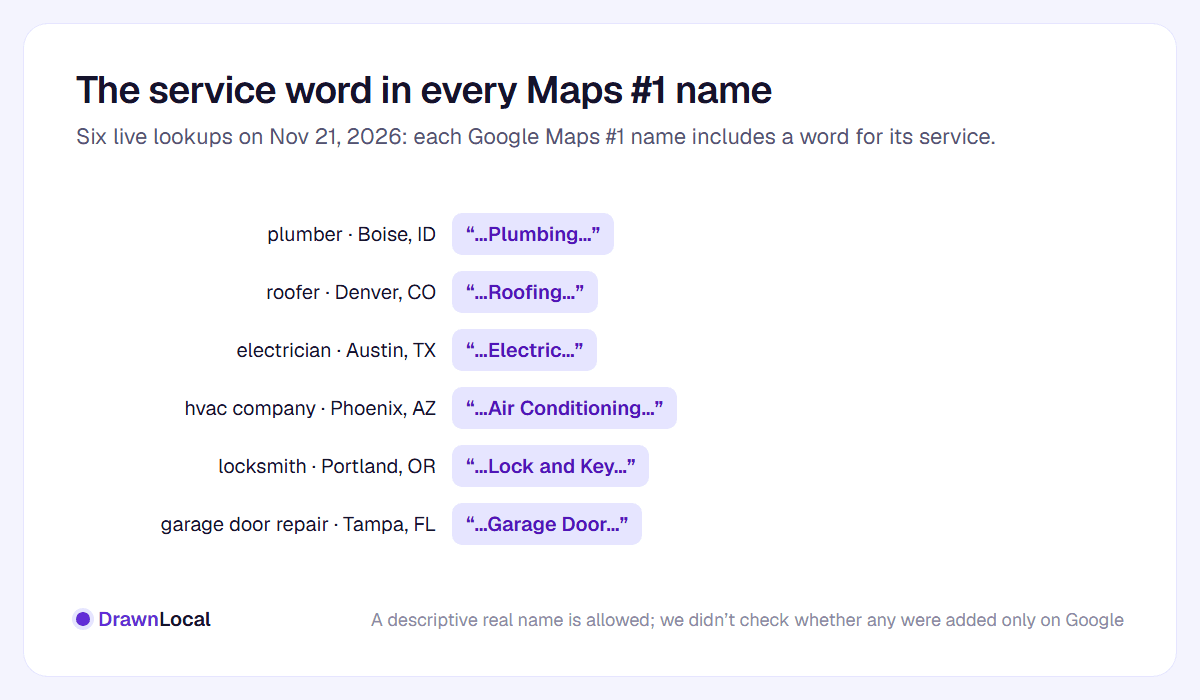
All six names include a word for the service they sell: plumbing, roofing, electric, air conditioning, lock and key, garage door. That fits the experts’ ranking of keywords in the name as the third factor.
It doesn’t mean any of them broke Google’s rules. Many real businesses are named for what they do, and a descriptive name used on the sign, the vans and the invoices is allowed. We didn’t check whether any name differs from what the business uses elsewhere. The point is simpler: a descriptive real name is an advantage, which is exactly why adding one only on Google tempts so many owners.
What Google allows in the business name
Google’s guidelines say: “Your name should reflect your business’s real-world name, as used consistently on your storefront, website, stationery, and as known to customers.” And: “Including unnecessary information in your business name isn’t permitted, and could result in the suspension of your Business Profile.”
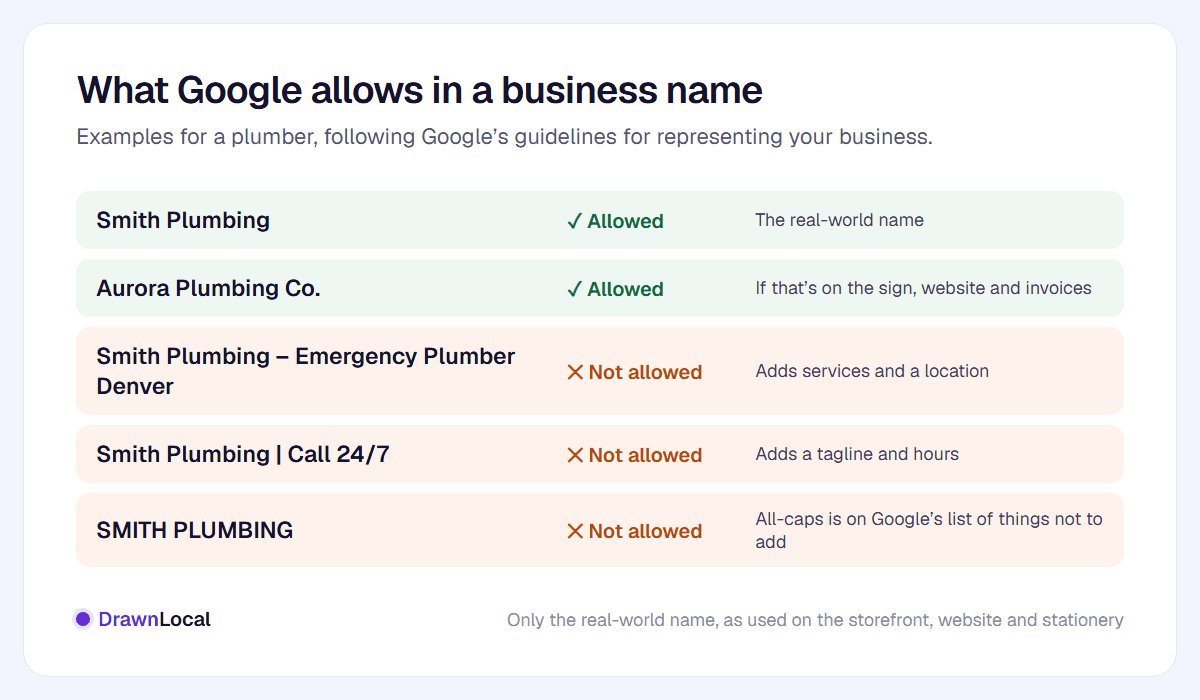
| Name on the profile | Allowed? | Why |
|---|---|---|
| Smith Plumbing | Yes | The real-world name |
| Aurora Plumbing Co. | Yes, if that’s the real name | Used on the sign, website and invoices |
| Smith Plumbing – Emergency Plumber Denver | No | Adds services and a location |
| Smith Plumbing | Call 24/7 | No | Adds a tagline and hours |
| SMITH PLUMBING | No | Google lists all-caps words among what not to add |
| Smith Plumbing LLC | Only with proof | Legal terms need real-world proof such as signage or invoices |
Google’s list of things not to add includes marketing taglines, store codes, trademark symbols, hours, phone numbers or website addresses, service information and location information.
The risks of stuffing a name
- Suspension. Google says unnecessary information in the name can get a profile suspended, which takes it off Maps entirely until it’s fixed and reinstated.
- Edits by anyone. Any Google Maps user can suggest the real name, and competitors watch for stuffed names. Google can apply the edit, and the ranking boost goes with it.
- A client relationship built on a breach. If you add the keywords for a client, the suspension lands on their profile, and the explanation lands on you.
Can a business change its name to include a keyword?
A business can genuinely rebrand, and some do pick a descriptive name. If a client chooses to, the new name has to be real everywhere first: registration, signage, vehicles, website, invoices and listings. Changing only the Google profile is exactly what Google’s guidelines forbid, and competitors can spot it.
Treat it as a business decision for the owner, not an SEO trick, and weigh it against the brand recognition they’d lose.
What counts as unnecessary information
Google lists the kinds of extra text not to add to a name. In practice, for a local trade business, they look like this:
| Don’t add | Example |
|---|---|
| Marketing taglines | “Smith Plumbing – Fast, Friendly, Fair” |
| Store codes | “Smith Plumbing #104” |
| Trademark symbols | “Smith Plumbing™” |
| Hours | “Smith Plumbing – Open 24 Hours” |
| Phone numbers or website addresses | “Smith Plumbing 555-0100” or “SmithPlumbing.com” |
| Service information | “Smith Plumbing – Water Heaters & Drains” |
| Location information | “Smith Plumbing Aurora” |
The exception is when the extra words really are part of the name the business uses everywhere. “Aurora Plumbing Co.”, used on the sign, the vans and the invoices, is a name, not location information.
If a client wants a real rebrand: a checklist
Some owners decide a descriptive name is worth it for the business as a whole. If so, change the real world first and Google last:
- Register the new name with the state, and check the legal side with an accountant or lawyer.
- Change the signage, vehicles and uniforms.
- Update the website, the logo and the email signature.
- Change invoices, quotes and the license where required.
- Update the main directories and listings.
- Change the Google profile name last, once the evidence is everywhere.
Expect Google to review a name change, and keep photos of the new sign and vans ready. Weigh the cost against the brand recognition the old name had built; for some owners, it isn’t worth it.
How a suspension plays out
Google says unnecessary information in the name can lead to suspension. A suspended profile disappears from Maps until the problem is fixed and Google reinstates it, which can take time, and calls from Maps stop meanwhile.
To recover, fix the name to the real-world name, gather proof such as photos of the sign, the website and the registration, and request reinstatement. Google Business Profile suspended? walks through the steps.
A worked example: relevance without a stuffed name
A made-up plumber called “Smith & Sons” competes with “Joe’s Emergency Plumbing Denver”, whose sign just says “Joe’s Plumbing”. A plan that stays within the rules:
| Step | What Smith & Sons does |
|---|---|
| Category | Primary category “Plumber”, with additional categories for its real services |
| Pages | A page for emergency plumbing and one for water heaters, linked from the profile |
| Hours | Real evening hours on the profile, since it answers calls until 9 pm |
| Reviews | Asks every customer; reviews mention emergency call-outs naturally |
| The rival | Suggests “Joe’s Plumbing” as the real name, with a photo of the sign |
Each step is allowed, and together they build the relevance the stuffed name was faking. Measure them with the same heat map before and after.
Questions owners ask about their business name
Short answers for common questions:
- “Can I add ‘plumbing’ if my name is just ‘Smith’?” Only if the business really uses “Smith Plumbing” on its sign, website and invoices.
- “My competitor does it. Why can’t I?” They’re risking suspension. You can report them and outrank them the allowed way.
- “Can I use my DBA name?” If it’s the name you trade under, as shown to customers, yes.
- “What about the website’s title tag?” That’s a website choice, and adding the service and city there is normal. The rules here are for the Google profile name.
- “How long does a name change take to show?” Google may review it first, so allow some time, and save a heat map before.
How to explain it on a sales call
Prospects sometimes ask why a rival with a long name outranks them. A short answer: “Keywords in the name are one of the strongest signals in local search. Adding them only on Google breaks the rules, and profiles can be suspended for it. We’ll win relevance the allowed way, and we can report names that break the rules.”
Then show the heat map and point to where the rival wins. It turns a frustration into the first item of the plan. How to sell SEO services covers the rest of the call.
What the name can’t do
Even a perfectly descriptive real name won’t beat distance. Distance from the searcher ranked second in the survey, so a business far from the person searching can still lose to a nearer one, whatever it’s called.
It won’t make up for the wrong category or poor reviews either. The name is one strong signal among several, which is why the safe alternatives work: they add up to the same kind of relevance, without the risk.
How to check whether a name breaks the rules
Before you suggest an edit to a competitor’s name, or defend a client’s, check the name against what the business really uses:
- Look at the storefront or vehicles on Street View, if the business has an address.
- Check the logo and footer on the business’s own website.
- Search the state’s business registration for the legal name.
- Look at the name on invoices or the license, if you can see them.
- Compare all of these with the name on the Google profile.
If the profile adds words that appear nowhere else, it breaks the guidelines. If the sign, site and registration all use the same descriptive name, it’s allowed, however much it helps.
When a stuffed competitor outranks your client
A rival called “[Name] Plumbing – 24/7 Emergency Plumber [City]” can sit above a client who follows the rules. A heat map shows where:
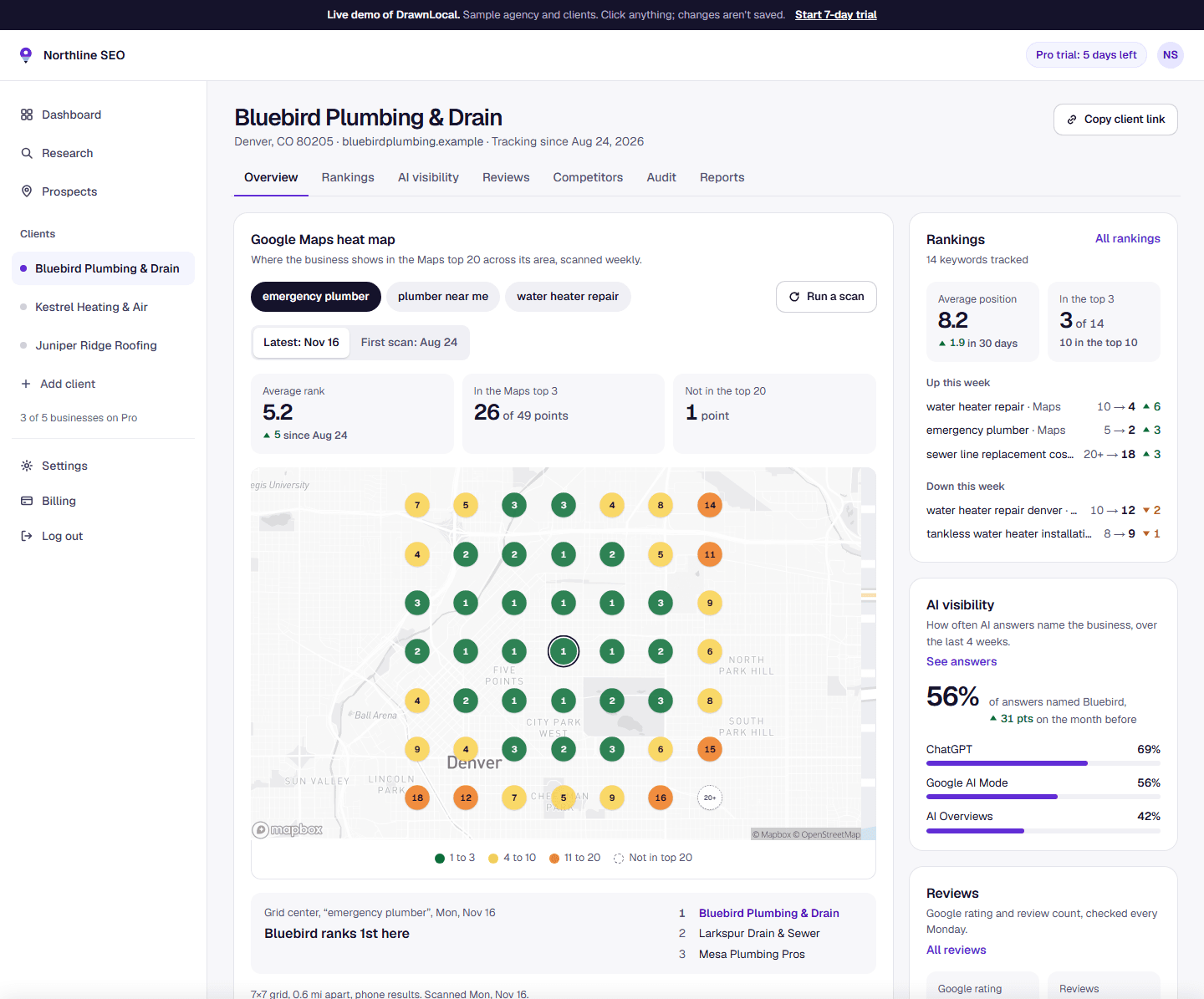
If a name breaks the rules, suggest the real name in Google Maps, with evidence such as the sign or website. Save a heat map first, so you can show the client what changes if the edit is accepted. How to report fake listings covers the routes and an evidence log.
Keep track of competitors’ names
Stuffed names can come back after an edit. Save the main competitors with the client and check their names each month:
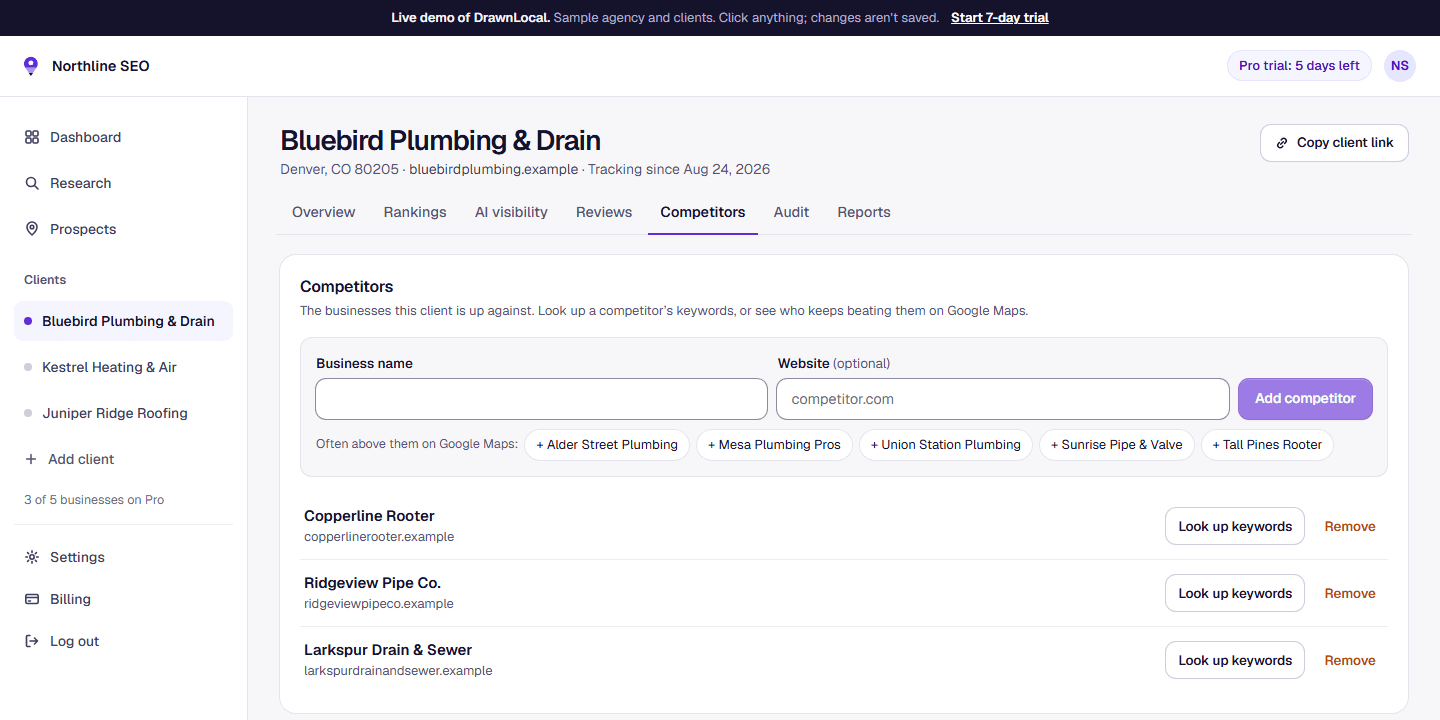
If a name has grown longer since last month, check it again and report it with fresh evidence.
When a client asks you to add keywords
Some owners ask for it directly, sometimes because they’ve seen a competitor do it. A short answer that holds up: “Google doesn’t allow it, and if they catch it, your profile can be suspended and disappear from Maps. Here’s what we can do instead.” Then show the alternatives and the heat map.
Put the advice in writing. If the owner changes the name themselves anyway, your note shows you advised against it, and you can help fix it before it costs them.
If a client’s profile already has a stuffed name
Plan for taking over a profile that already has keywords in the name:
- Explain the risk to the owner, in writing.
- Save a heat map before any change, so the effect is measured.
- Change the name to the real-world name, exactly as on the sign and website.
- Some points may drop at first; say so in advance.
- Make up the relevance with the primary category, service pages and reviews.
A small, honest drop is better than a suspension. A suspended profile disappears from Maps entirely until it’s fixed and reinstated; see Google Business Profile suspended?.
Measure before and after any name change
Whether you’re fixing a client’s name or a rival’s gets edited, the heat map is the honest record. Here’s the kind of baseline to save, from DrawnLocal’s free heat map on Nov 21, 2026. A Boise plumbing company, for “plumber”, is first at its address and in the top 3 at 7 of 9 points.
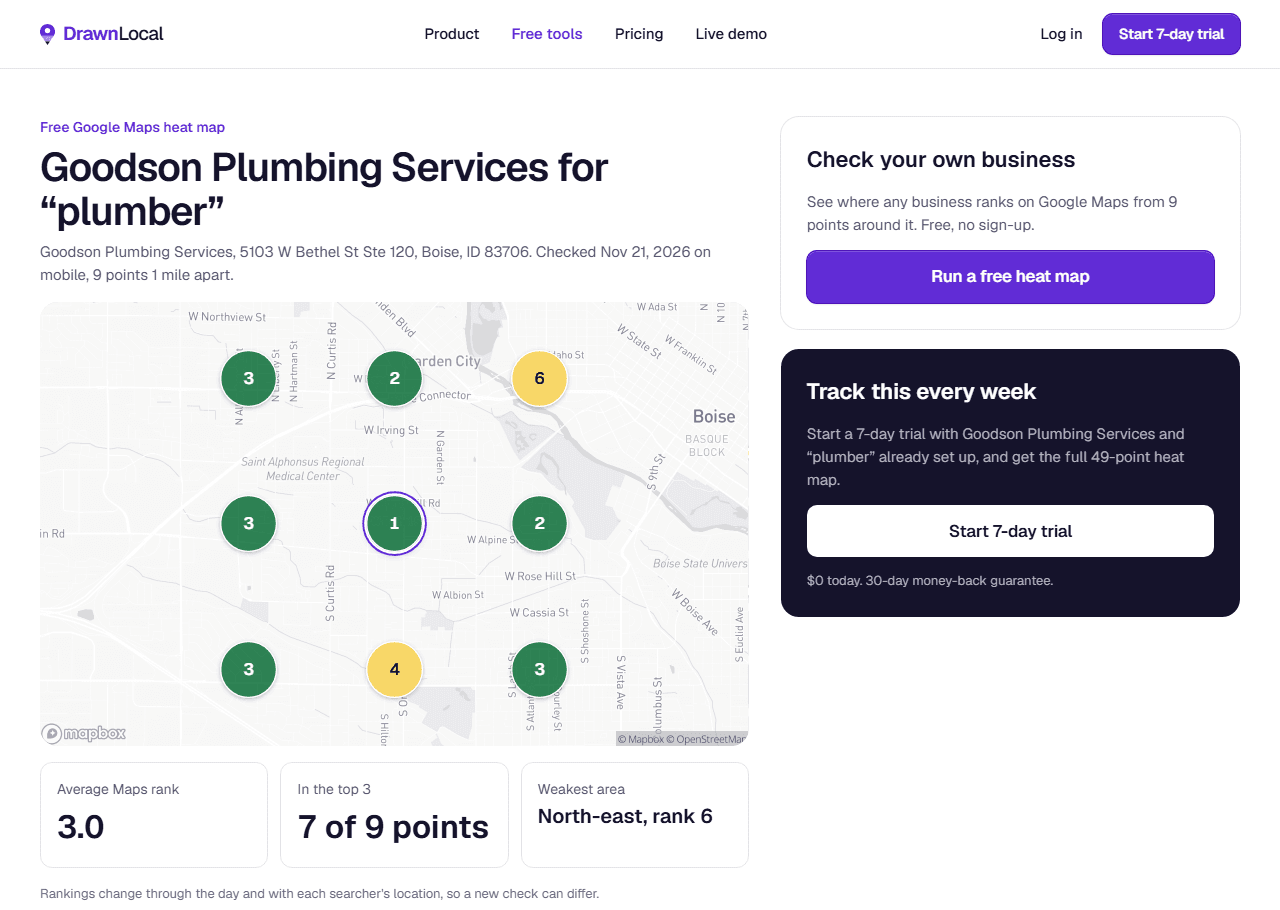
Run the same keyword and grid two to four weeks after the change, and report the difference, including any points lost.
If you’re fixing a client’s own stuffed name, tell them in advance what you expect, show the before map, and report honestly afterwards. Then show the plan to win the points back the allowed way: the category, the service pages and the review routine. A client who was warned is less likely to be caught off guard by an honest dip, and the before map shows exactly what changed and why.
Names for service-area businesses
The rules are the same for businesses that visit customers and hide their address. The name must match what the business uses on its vehicles, website and invoices, with no towns or services added.
Service-area businesses sometimes add town names to reach further. That’s location information, which Google lists among the things not to add. Area pages on the website are the allowed way to show which towns the business serves.
Names across several locations
For a business with several locations, each profile should use the same real business name. Adding a neighborhood or service to each branch name to catch more searches is location or service information, which Google lists among the things not to add.
Use each location’s own page and its own reviews to show where it is and what it does. Multi-location local SEO covers the rest.
Business name myths
- “Everyone does it, so Google doesn’t care.” Google says it can suspend profiles for it.
- “A short keyword is fine.” Any service or location that isn’t part of the real name breaks the guidelines.
- “Adding LLC helps.” Legal terms need real-world proof, and they don’t add relevance.
- “Changing the name back will lose everything.” It may cost some points; the category, pages and reviews can make them up.
- “A name change is quick SEO.” A real rebrand is a business decision, with signs, vans and invoices to change first.
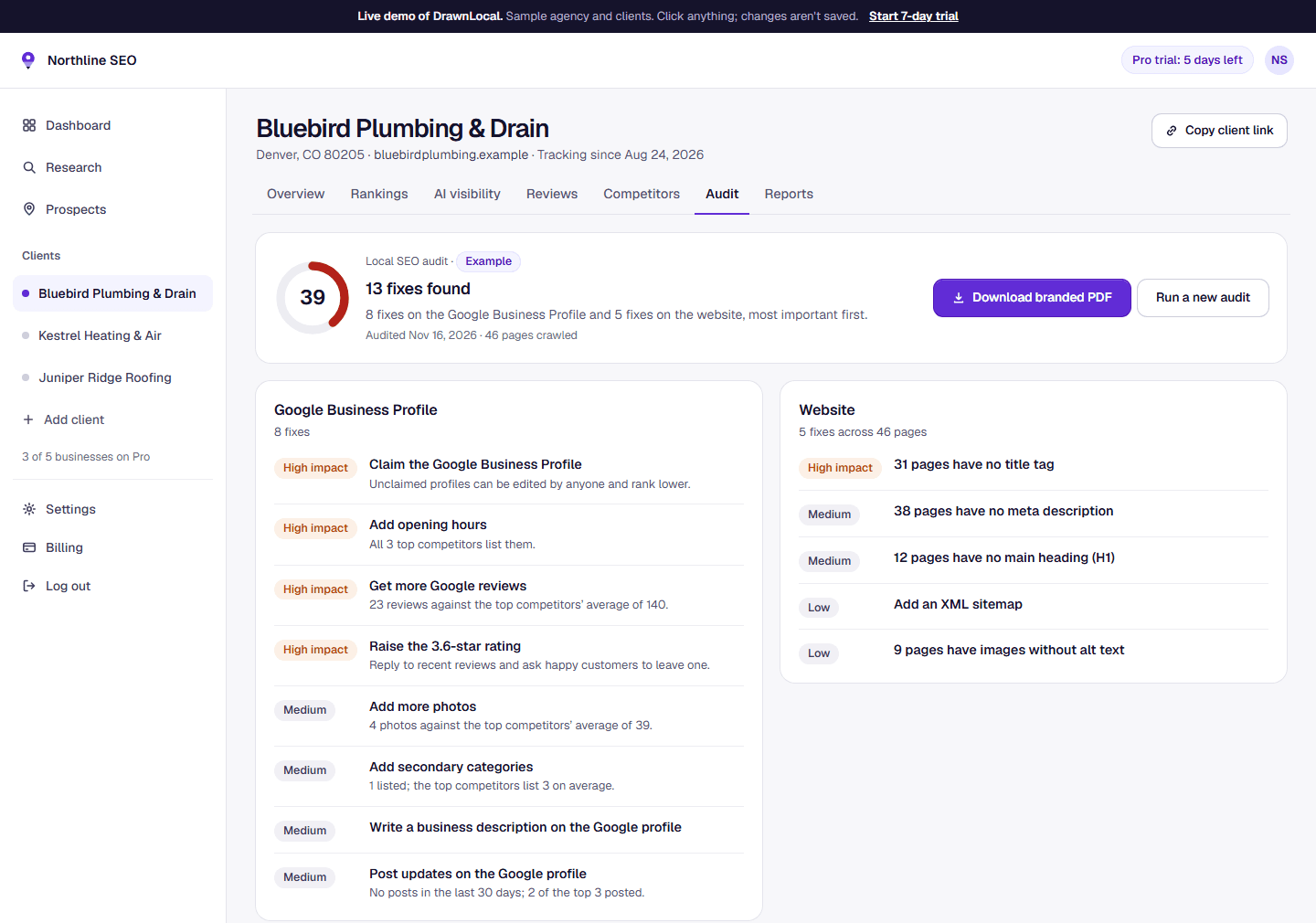
Check the name in every audit
Make the name a standard line in every audit: does the profile name match the sign, the website and the registration, word for word? It takes a minute and catches a risk before it becomes a suspension.
Check the client’s main competitors at the same time. A stuffed rival name can be one of the quickest fixes on the whole plan, because a single accepted edit can change who holds the top 3.
Watch for unwanted edits to the client’s name
Anyone can suggest an edit to a Google profile, including a client’s. Google may apply changes from the public, so check the client’s profile name, category and hours every month, and correct anything that’s wrong.
If a change appears that nobody at the business made, check it straight away. A wrong name or category can cost points until it’s put right.
The name on other listings
Use the same real name on the website, the main directories and social profiles. A name that differs from place to place makes the business harder for customers to recognize, and it muddies the evidence if the profile name is ever questioned.
If the business has changed its name, update the old listings too, or customers may find two names and wonder which is real.
Names in AI answers
AI answers name businesses too, and they don’t always use the full Google name. In our live checks on Nov 21, 2026, ChatGPT named one plumber by the first two words of a much longer name on its Google profile.
A clear, consistent real name across the website, the profile and other listings makes the business easier to recognize, whichever version an answer uses. Google AI Mode and local SEO covers AI answers in more depth.
When a rival keeps re-stuffing its name
Some stuffed names come back after an edit is accepted. Keep the evidence log, check the name monthly, and suggest the real name again each time it changes, with fresh evidence.
If the same business does it repeatedly, or runs several listings, the business redressal complaint form is the stronger route. Tell the client what you’re doing and that Google decides, so the back-and-forth doesn’t look like wasted effort.
A one-minute name check for prospects
Before a sales call, look at the top 3 names for the prospect’s main search. Look for a rival with services or towns in its Google name but a plain name on its own website. That’s a finding worth raising: a reason the prospect may be losing calls, and a fix to start on day one.
Present it carefully. Say what you see and what the rules say, and leave the verdict to Google. Never promise the rival will be edited.
Names and the searcher’s first impression
The name is one of the first things a searcher reads in the local pack. A clean, real name sits next to its rating, review count and hours, and that’s what the customer weighs up before calling.
So a real name isn’t only the safe choice. It’s the one the business can put on a van, an invoice and a review reply without anyone wondering whether it’s the same company.
Naming a new business
Owners starting out sometimes ask what to call the business. A descriptive name, such as “Aurora Water Heater Repair”, used on everything from day one, is allowed and carries the keyword advantage honestly.
The trade-offs are real, though. A name tied to one town or one service can feel limiting if the business grows into new areas or services, and it can be harder to stand out among similar names. It’s the owner’s decision; your job is to explain both sides, and to make sure whatever they choose is used consistently everywhere.
If they choose a plain name, such as their family name, the category, pages and reviews do the work that a descriptive name would have helped with.
A simple name policy for your agency
Write it into your process, so every account manager handles names the same way:
- We never add keywords, towns or taglines to a client’s profile name.
- We advise against it in writing if a client asks.
- We correct a client’s stuffed name only with the owner’s written agreement, and with a heat map saved first.
- We report rivals’ names only when they clearly break the rules, with evidence.
A policy like this protects your clients and your reputation, and it gives new staff a clear answer when an owner pushes.
What to do instead
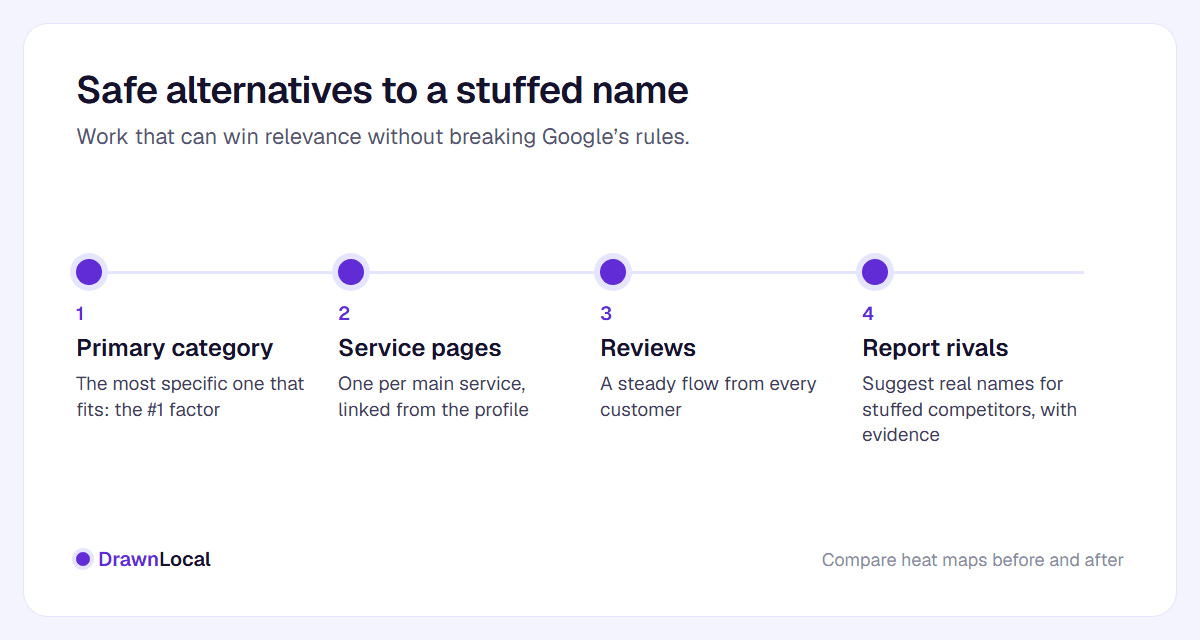
- Choose the most specific primary category that describes the business; it’s the top factor in the same survey.
- Give each main service its own page on the website, linked from the profile; see does a website affect Google Maps rankings.
- Build reviews steadily; do Google reviews help SEO covers which signals count.
- If competitors outrank the client with stuffed names, suggest the real name with evidence. How to report a fake business on Google Maps has the routes.
Compare heat maps before and after any change, so you can show what it did.
Questions
Can I put keywords in my Google Business Profile name?
Only if they’re part of the business’s real-world name, used consistently on its storefront, website and stationery. Adding services, locations or taglines breaks Google’s guidelines and can get the profile suspended.
Do keywords in the business name help rankings?
Yes. Local search experts ranked keywords in the business name third of 187 Maps factors in Whitespark’s 2026 survey, which is why stuffing is common and why Google polices it.
Can I add the city to my business name on Google?
Only if the city is part of the real-world name, as on the sign and invoices. Google lists location information among the things not to add to a name.
Will removing keywords from my business name hurt my ranking?
It may cost some points at first, because keywords in the name rank highly. It removes the risk of suspension, and the primary category, service pages and reviews can make up the relevance over time.
What happens if a competitor stuffs keywords in its name?
You can suggest an edit with the business’s real name in Google Maps, backed by evidence such as its sign or website. For fraud in the name, Google’s business redressal complaint form is the stronger route.
Sources
- Google: guidelines for representing your business
- Google Business Profile Help: tips to improve your local ranking
- Whitespark: Local Search Ranking Factors 2026 (published Nov 6, 2025)
- DrawnLocal: six live Google Maps lookups (Nov 21, 2026)