Do Google reviews help local SEO? What moves Maps rankings, and what doesn’t
Reviews are the ranking factor owners understand best, and one that’s often oversold. Here’s what Google says, how local search experts rank each review signal, and a review plan that moves the numbers without breaking Google’s rules.
By the DrawnLocal team · · Updated · 14 minute read
Do Google reviews help SEO? What Google says
Yes. Google says local results are mainly based on relevance, distance and popularity, which its help page then describes as prominence: how well known a business is. Google says it’s “also based on info like how many websites link to your business and how many reviews you have.” Its advice to businesses is direct: “More reviews and positive ratings can help your business’s local ranking.”
Google gives no target number or rating. It’s also clear that “there’s no way to request or pay for a better local ranking on Google.” So reviews work through the same system as everything else: they make a business look more established than the ones around it.
Which review signals matter most
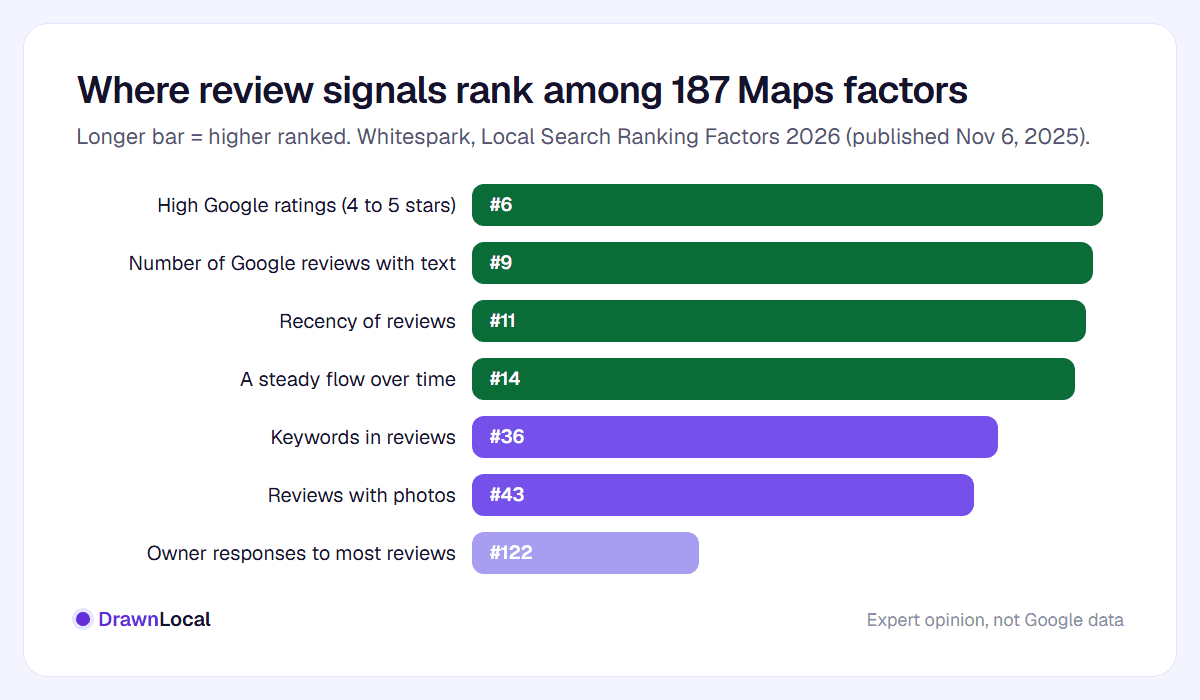
A high rating, the number of written reviews and recent reviews matter most, according to local search experts. Google doesn’t publish weights; the best public guide is Whitespark’s yearly survey of 187 factors. Its review factors for Maps:
| Rank of 187 | Review factor |
|---|---|
| 6 | High Google ratings (4 to 5 stars) |
| 9 | Number of Google reviews with text |
| 11 | Recency of reviews |
| 14 | A steady flow of reviews over time, rather than bursts |
| 36 | Keywords in Google reviews |
| 38 | Number of Google ratings without text |
| 42 | Positive sentiment in review text |
| 43 | Reviews with photos |
| 122 | Owner responses to most reviews |
It’s expert opinion, not Google data, so read it as a ranking of priorities rather than a formula. The message is consistent, though: a high rating, plenty of written reviews and a steady recent flow, in that order.
Reviews against the other ranking factors
Reviews matter, but they sit behind the factors that decide whether a business is in the running at all. The survey’s top 5 for Maps, with the review factors after them:
| Rank of 187 | Factor | Can the agency change it? |
|---|---|---|
| 1 | Primary category | Yes, in minutes |
| 2 | Distance from the searcher | No |
| 3 | Keywords in the business name | Only by a real name change; adding keywords breaks Google’s rules |
| 4 | Address in the city searched | No, unless the business moves |
| 5 | Open at the time of the search | Yes, with accurate hours |
| 6 | High Google ratings | Over time, with a routine |
| 9 | Number of reviews with text | Over time, with a routine |
| 11 | Recency of reviews | Yes, by asking every customer |
So check the category and hours before starting a review push. They’re quick, and they rank higher. Reviews are the long game that keeps paying once the basics are right.
It also explains results that puzzle owners. A competitor with fewer reviews can still rank above them if its category is a closer match or it’s nearer the searcher. Reviews raise the business’s standing among the businesses that are relevant and close; they don’t override relevance and distance.
That’s a useful line for a sales call too. It sets honest expectations, and it explains why the plan starts with the profile before the review routine.
Review velocity: why a steady flow beats a burst
Review velocity is how fast a business gains reviews, usually counted per month. The experts ranked recency 11th and a sustained flow 14th. Three new reviews a week for a year says more about a busy, current business than 40 in one week and then silence.
Bursts carry a risk too. Google’s content policy lists “unusual volumes or patterns of review contributions that are indicative of efforts to manipulate a place’s rating” as manipulation. A review drive that asks every customer from now on is safe; one that emails five years of past customers in a day can look like the pattern Google warns about.
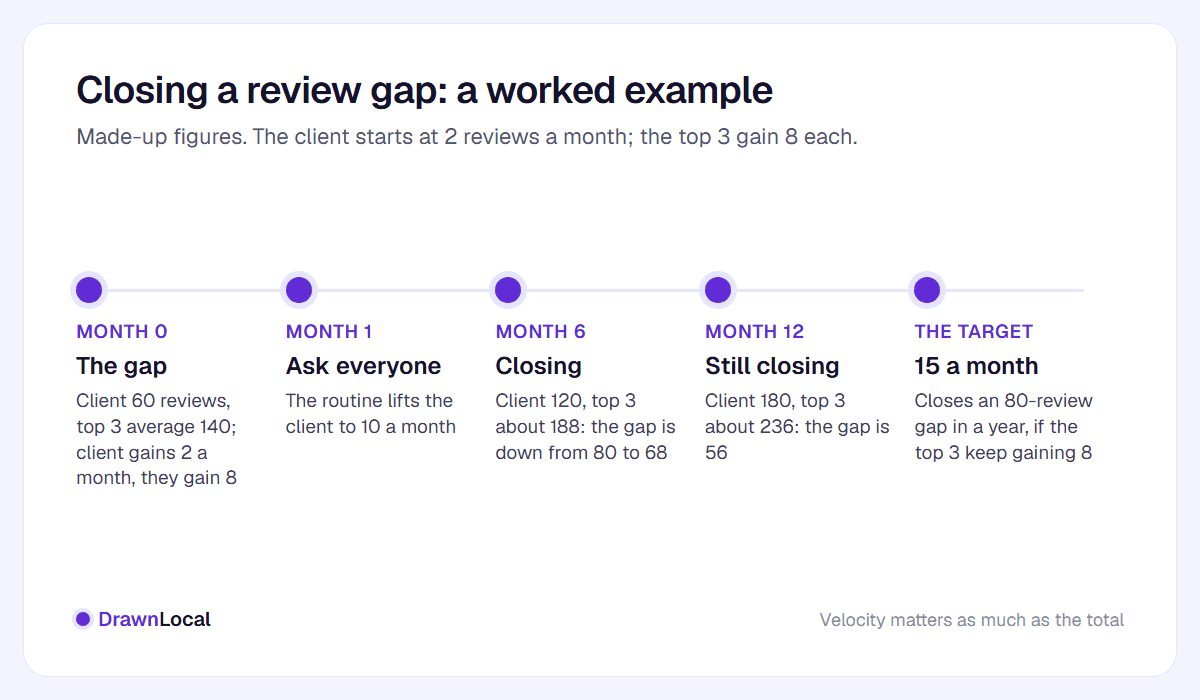
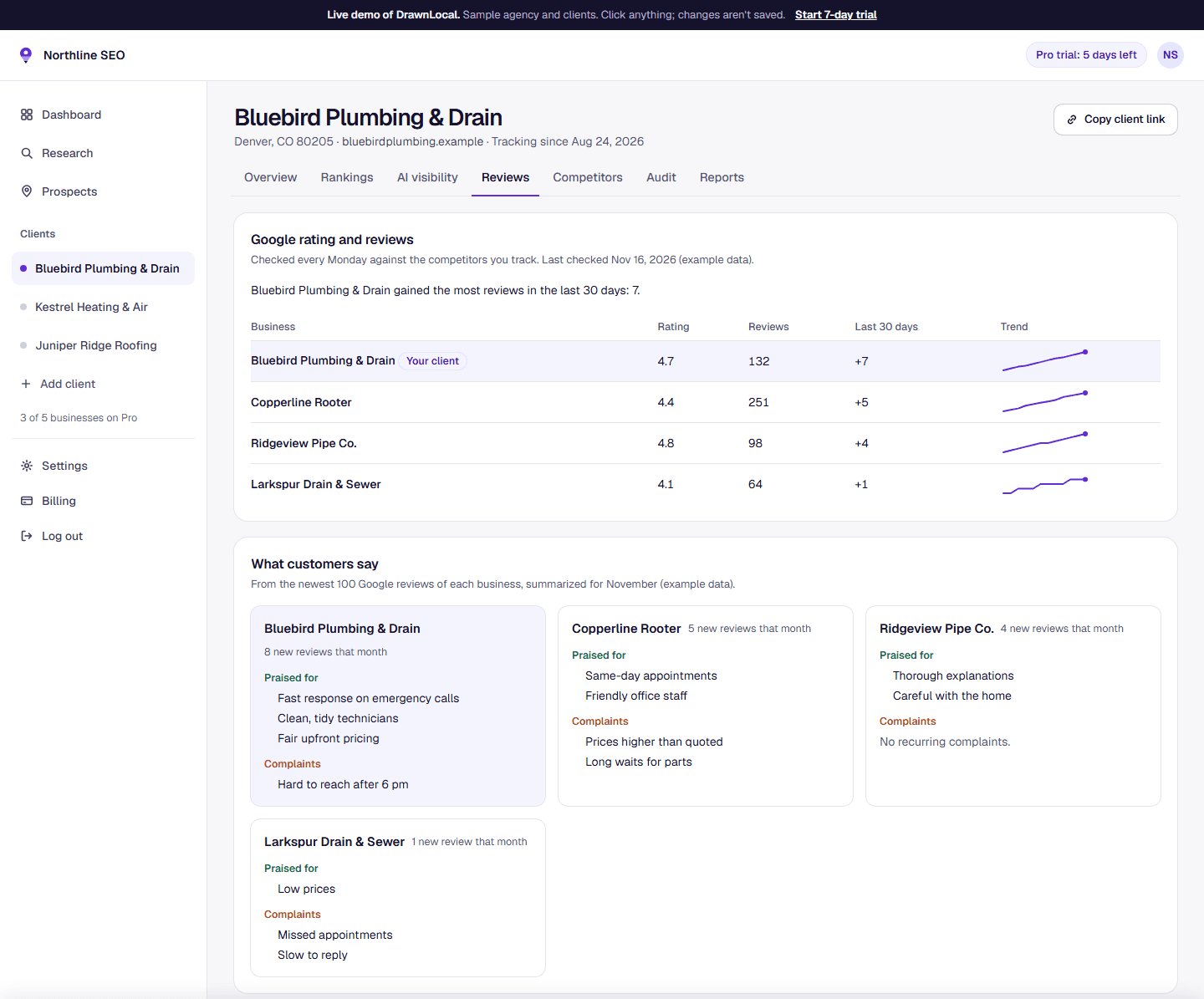
Measure velocity against the businesses that outrank your client. If the top 3 for the main search each gain about eight reviews a month and your client gains two, that gap is the target. DrawnLocal’s monthly review insights show how fast the client and its top competitors each gain reviews, alongside what their customers praise and complain about.
Do replies to reviews help rankings?
Not much, on the evidence. Google’s help says “positive reviews and helpful replies can help your business stand out”, but it doesn’t list replies as a ranking factor. The experts ranked owner responses 122nd for Maps.
Reply anyway, for the next customer reading. A few facts from Google’s help are worth knowing. The business must be verified to reply, and the customer is told when you reply and can change their review afterwards. Google also checks replies against its content policies, which usually takes up to 10 minutes but can take up to 30 days.
How many reviews does a business need?
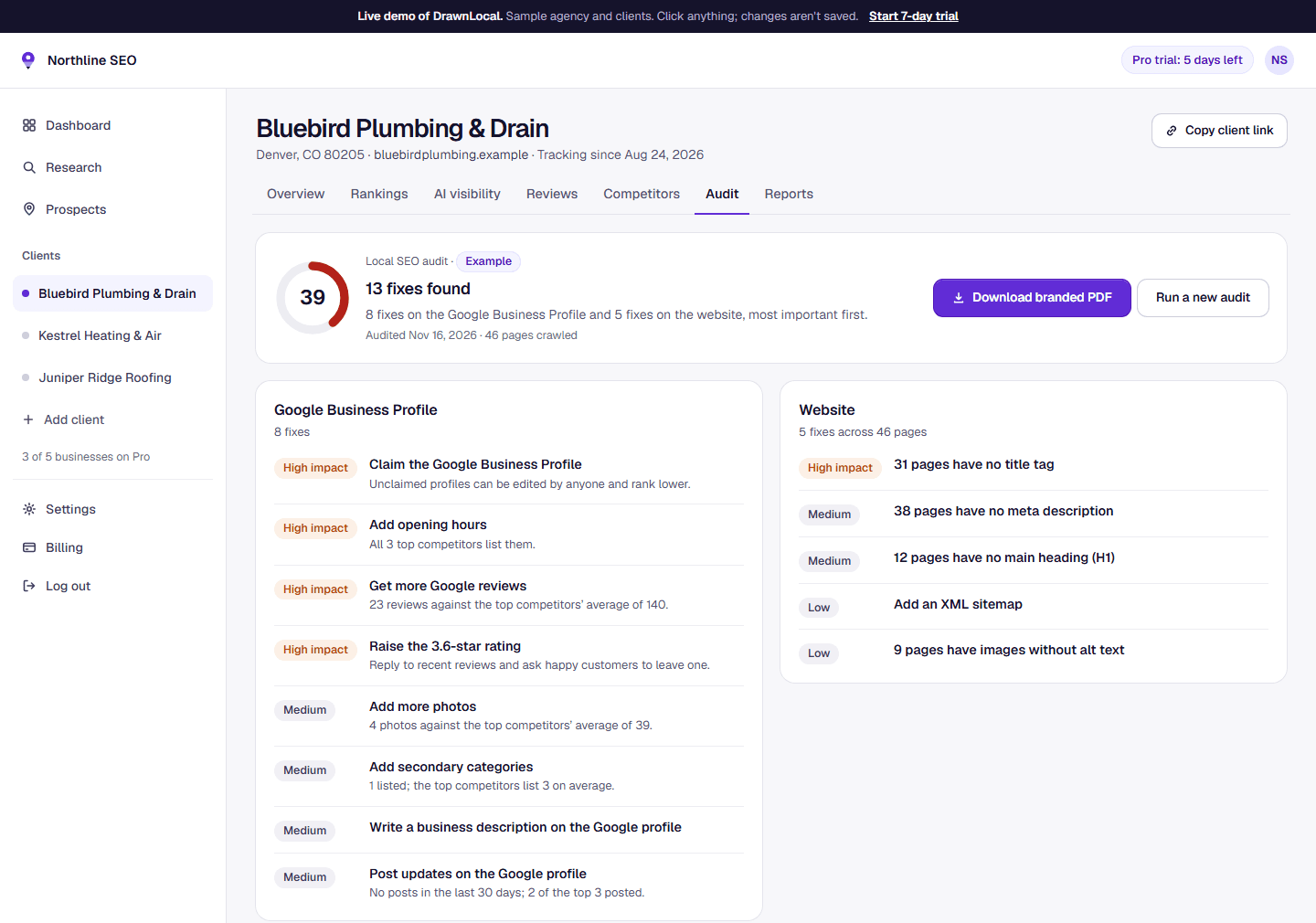
There’s no fixed number; Google gives none. What matters is the competition for each search in each part of town. A roofer with 40 reviews may lead a small town and trail badly in a city where the top 3 have 300 each.
Find the businesses in the top 3 for the client’s main keyword across its area; a heat map names them at each point. Note their rating and review count, then set the client’s target: close the count gap over 6 to 12 months at a steady pace, with a rating at or above theirs.
Live data: how many reviews the Maps #1 holds
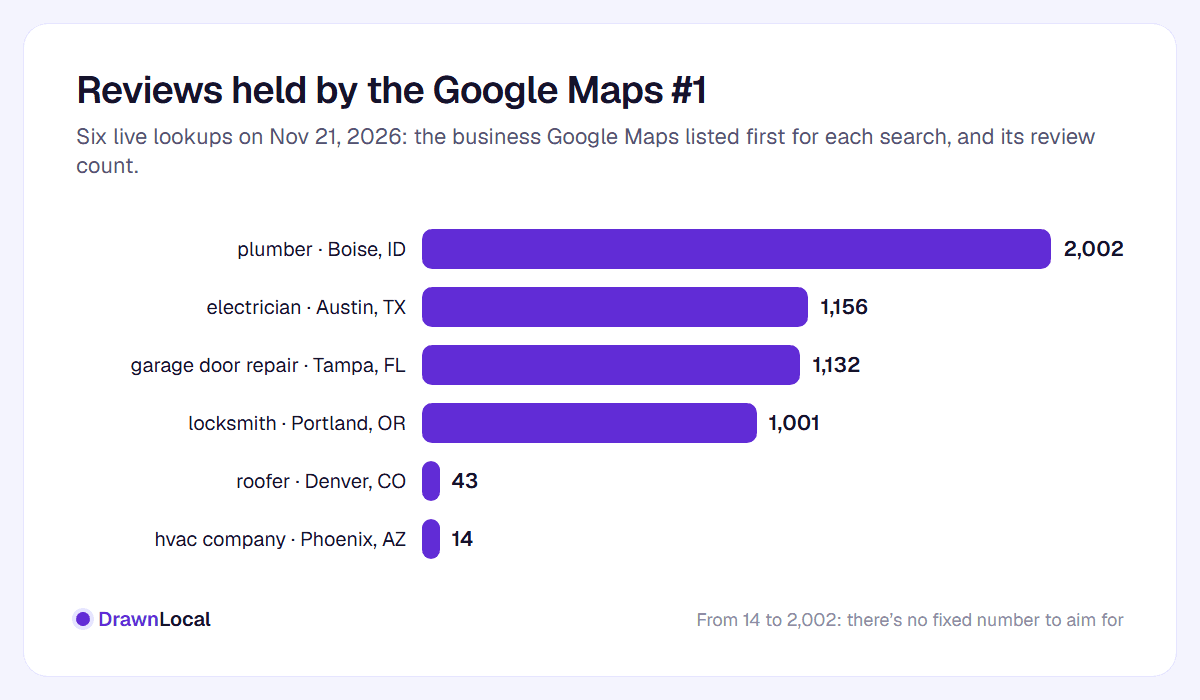
To show how much the answer depends on the market, we looked up six local searches on Nov 21, 2026. For each, we noted the business Google Maps listed first and its review count:
| Search | Maps #1 rating | Maps #1 reviews |
|---|---|---|
| plumber, Boise, ID | 5.0 | 2,002 |
| electrician, Austin, TX | 4.9 | 1,156 |
| garage door repair, Tampa, FL | 4.9 | 1,132 |
| locksmith, Portland, OR | 4.5 | 1,001 |
| roofer, Denver, CO | 4.6 | 43 |
| hvac company, Phoenix, AZ | 5.0 | 14 |
The first place was held with 14 reviews in one search and 2,002 in another. Review count clearly isn’t the whole story: category, distance and the business name all count for more in the experts’ ranking. It’s still worth closing a gap with nearby competitors, because it’s one of the few strong signals an owner can steadily improve.
A live example: reviews and the map
Here’s a business with plenty of reviews, checked with DrawnLocal’s free heat map on Nov 21, 2026. A Boise plumbing company with a 4.9 rating from 651 reviews is first at its own address for “plumber”, and in the top 3 at 7 of 9 points around it.
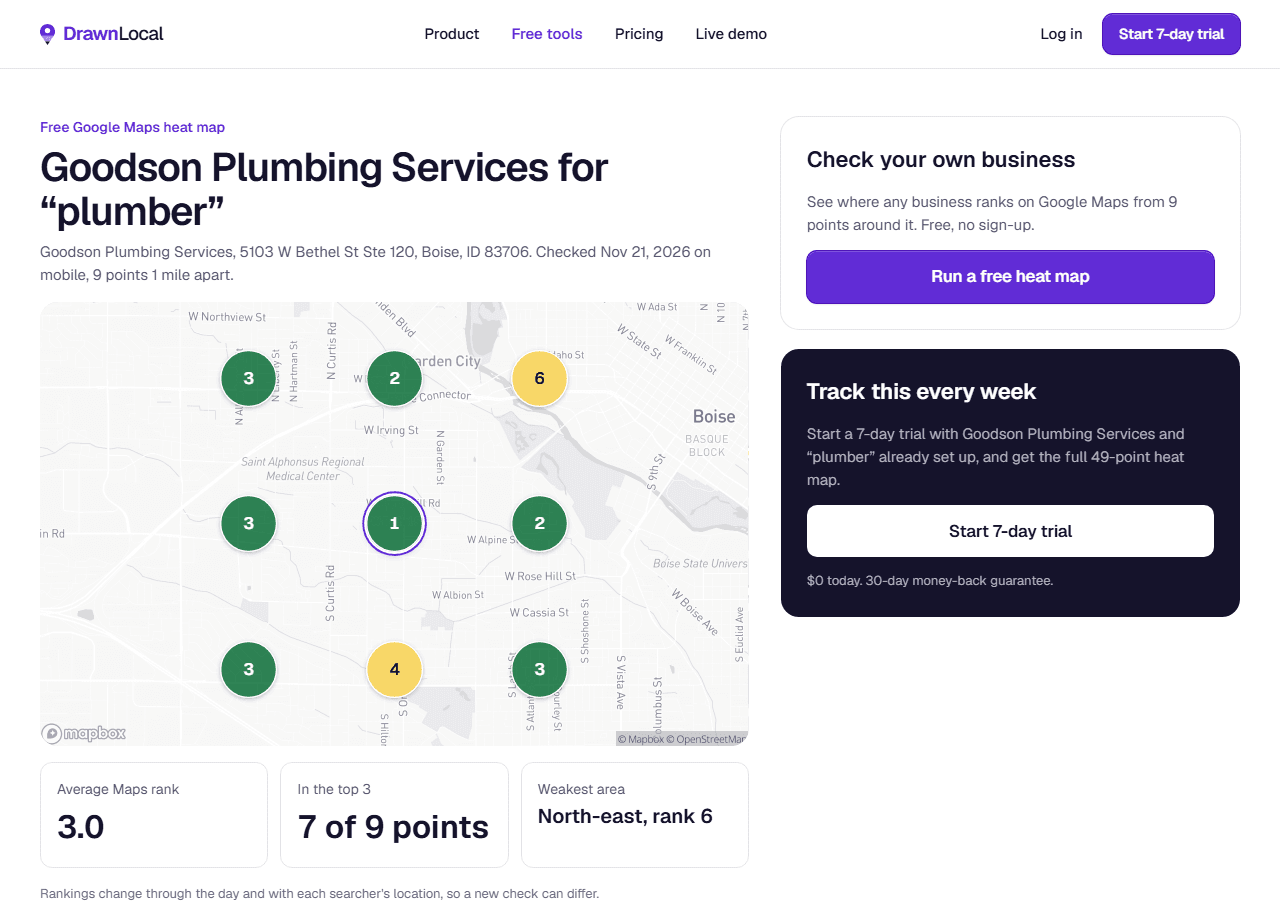
A map like this can’t isolate reviews from the other factors. What it can do is show where a business is weak, so you can check which competitors hold those points and how their reviews compare.
A review plan for clients
- Ask every customer, the same way, when the job is done, with the direct review link. Never filter who gets asked: review gating explains Google’s rule and the FTC’s view.
- Ask for a few words about the job, never for specific wording. Google’s policy doesn’t allow businesses to request specific content, so keywords in reviews have to come naturally.
- Encourage photos of the finished work; the experts ranked reviews with photos 43rd.
- Reply to every review within a few days, the negative ones first.
- Track the rating, count and monthly velocity against the top 3 competitors, and report the trend.
Rating math: how many 5-star reviews lift a rating
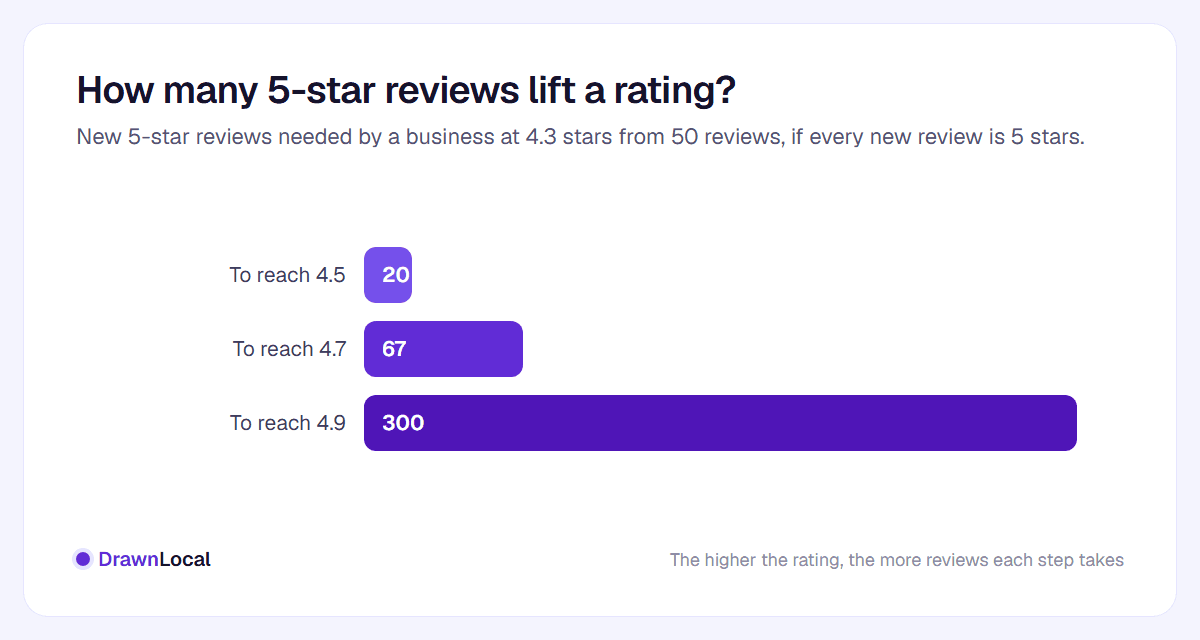
Owners often ask how long it will take to lift a rating. The sum is simple, and the answer is usually longer than they expect. Take a business at 4.3 stars from 50 reviews, and assume every new review is 5 stars:
| Target rating | New 5-star reviews needed | At 10 a month |
|---|---|---|
| 4.5 | 20 | About 2 months |
| 4.7 | 67 | About 7 months |
| 4.9 | 300 | About 2.5 years |
Real reviews won’t all be 5 stars, so the real numbers are higher. That’s why the routine matters more than a push: a business that asks every customer, every month, keeps climbing without risking the burst pattern Google warns about.
Setting a review target: a simple formula
Turn the competitor gap into a monthly number the owner can work toward. You need three figures: the client’s review count, the top 3’s average count, and how many reviews a month the top 3 gain.
Monthly target = the top 3’s monthly gain + (the count gap ÷ the months you allow).
Using the earlier example: the top 3 gain 8 a month, the gap is 80 reviews, and you allow 12 months. That’s 8 + (80 ÷ 12), about 15 reviews a month. At 10 jobs a week, with 1 in 3 customers leaving a review, a business gains about 14 a month, close enough to plan around.
If the target is far above what the business’s job volume can produce, stretch the months rather than push harder. A steady pace is safer than a burst, and recency keeps counting in the client’s favor.
How long reviews take to affect rankings
Google doesn’t say, and no single review moves a map on its own. Reviews build prominence over months, alongside everything else the business does.
Measure it the way you measure anything in local SEO: a heat map of the main keyword every week, and the review numbers every month, both against the month the plan started. If the count gap closes and the map improves over the same months, you can show the owner the two moving together, without claiming one caused the other.
Negative reviews: reply, fix, and keep asking
A negative review stands out most when it sits unanswered among a handful of others. The answer is the same routine: a calm reply within a few days, a fix for whatever caused it, and a steady flow of new reviews from every customer.
Don’t ask the customer to remove it in exchange for anything; Google forbids incentives, and the FTC says paying to remove truthful negative reviews may break the law. Only reviews that break Google’s policy can be reported. How to respond to negative reviews and how to remove a Google review cover both.
Service-area businesses and several locations
Reviews work the same way for businesses that visit customers and hide their address: they appear on the profile, and they count toward prominence. Ask every customer, wherever the job was.
For a business with several locations, each profile collects its own reviews. Give each location its own review link and track each one against its own local competitors. A location that falls behind can point to something local the business can fix. Multi-location local SEO covers the rest.
Reviews and conversion: the part owners feel
Rankings get a business seen. Reviews help decide whether the searcher calls. A rating, a count and a few recent written reviews are among the first things a customer sees in the local pack, in Maps and in AI answers.
That’s worth saying to owners, because it’s the part they notice: better reviews can mean more of the people who see the listing pick up the phone. Track calls from the profile alongside the review numbers, so the report shows both.
The review numbers to track every month
Six numbers tell you whether the review plan is working:
| Metric | Why it matters |
|---|---|
| Rating | The experts’ top review factor, and what searchers see first |
| Total reviews | The count gap against the top 3 |
| New reviews this month | Velocity: a steady flow ranked 14th |
| Share with written text | Reviews with text ranked 9th; ratings without text 38th |
| Share replied to | Not a ranking factor, but customers read the replies |
| Days to reply | Slow replies to negative reviews cost trust |
Report the first four against the competitors and the month the client started. The last two are for the owner’s routine.
A 90-day review plan
The first three months of a review plan, in order:
| Month | Work | Report |
|---|---|---|
| 1 | Set up the routine: one link, the same request to every customer; reply to every existing review | Baseline: rating, count and velocity against the top 3 |
| 2 | Add a photo invitation to the request; check every customer is being asked | New reviews, share with text, reply time |
| 3 | Compare the pace with the top 3, and adjust the target or the timeline | The gap against the start, with the heat map alongside |
From month four the routine runs on its own. Your job becomes checking it keeps running, and reporting the trend.
Where to put the review link
Make the link easy to reach. Put the same direct link everywhere the business already talks to customers: the message after each job, the invoice, the receipt, a card the technician leaves, and the office email signature.
Every placement goes to every customer. Review gating has request scripts and the rules on wording.
One line for the monthly report
Owners want reviews in one glance. A line that works: “Reviews: 14 new this month (212 total, up from 191 at the start), rating 4.8. The top 3 gained 9 each on average, so the gap closed by 5.”
It covers the count, the rating, the pace and the competition in two sentences, and it points the owner at the trend rather than one review.
When a month is slow, say so and say why: a quiet season, a staff change, or requests that stopped going out. A report that explains a dip is easier to trust than one that only shows good months.
Reviews and AI answers
Reviews now reach customers through AI answers too. Google’s AI Mode summaries show ratings and review counts drawn from Business Profiles, and in BrightLocal’s 2026 study the Business Profile was the most cited single source for local AI answers.
So the same routine helps twice: more and better reviews on the profile, and more for an AI answer to describe. Google AI Mode and local SEO covers what to track there.
Showing clients the review plan working
Owners follow reviews closely, so make progress easy to see. A live page with the review count next to where it started does more than a monthly table:
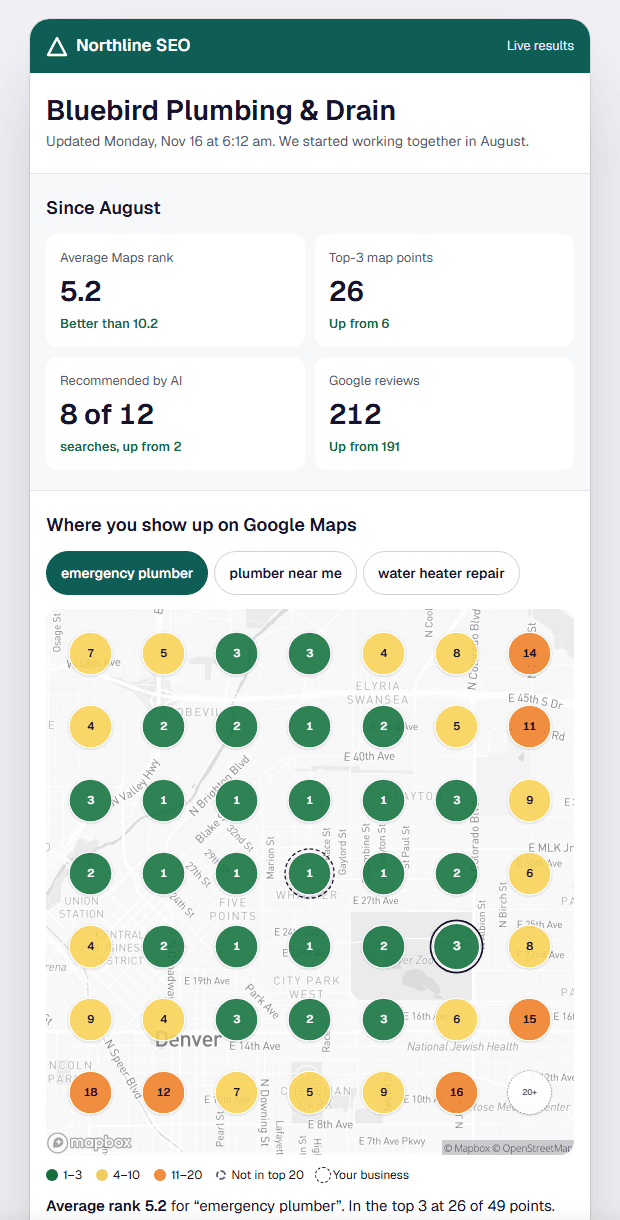
Pair it with one line in each monthly report: reviews gained, the rating, and how the pace compares with the top 3.
What a strong review profile looks like
Use this as the target for a client’s Google reviews, judged against the top 3 for its main search:
- A rating at or above the top 3’s.
- A count that’s closing the gap, month by month.
- New reviews every month, not in bursts.
- Most reviews with a few written words, not just stars.
- Some reviews with photos of the finished work.
- A reply on every review, including the old ones.
- No gated, bought or staff reviews that could be removed.
Reviews on other sites
Reviews on Yelp, Facebook and trade directories count for much less in Google’s local rankings, according to the experts: the number of third-party reviews ranked 119th of 187 for Maps. They still matter to customers who check them, and AI answers sometimes cite those sites.
Keep the main ones claimed and accurate, reply to reviews there too, and put most of the asking effort into Google, where it does the most for rankings.
Photos in reviews
Reviews with photos ranked 43rd for Maps in the survey, and a photo of a finished job tells the next customer more than a sentence. Invite every customer to add a photo when they review, in the same message you send everyone.
Don’t ask only the customers whose jobs look impressive. The same rule as for reviews applies: the same request, to everyone.
Questions owners ask about reviews
Short answers for the questions that come up on calls:
- “Can we buy reviews?” No. Google forbids incentives, even for honest reviews, and fake reviews can break consumer law.
- “Can my staff leave reviews?” No. Google’s content policy forbids reviews with a conflict of interest, such as employees reviewing their own business.
- “Should we reply to 5-star reviews?” Yes, briefly. It shows the next customer someone is listening.
- “Can you delete a bad review?” Only if it breaks Google’s policy. Otherwise, reply calmly and keep asking every customer.
- “Do old reviews still count?” They still count toward the total, but recency ranked 11th, so a steady flow of new ones matters.
Review myths to drop
- “More reviews always means a higher rank.” Category, distance and name rank higher in the experts’ list, and our live data shows a #1 with 14 reviews.
- “Ask customers to mention keywords.” Google’s policy doesn’t allow asking for specific content.
- “Reply to reviews for the ranking boost.” The experts ranked owner responses 122nd. Reply for customers.
- “A burst of reviews is a quick win.” Google lists unusual volumes or patterns as manipulation.
- “Yelp and Facebook reviews count the same.” Third-party review counts ranked 119th for Maps.
- “Only happy customers should be asked.” That’s review gating, and Google forbids it.
What reviews can’t fix
Reviews can’t make up for the wrong primary category, a business far from the searcher, or a keyword-stuffed competitor sitting in the top 3. Those come first in the survey and usually first in the work: check the primary category, the business name, and whether fake listings are taking the top spots. Why a business drops out of the Maps top 3 covers the other causes.
Questions
How many Google reviews do I need to rank?
There’s no fixed number. In six live lookups on Nov 21, 2026, the Google Maps #1 held between 14 and 2,002 reviews. Compare with the top 3 for the client’s main search, and close that gap at a steady pace.
Do Google reviews help SEO?
Yes, for local rankings. Google says more reviews and positive ratings can help a business’s local ranking. Local search experts rank a high rating, the number of written reviews and recent reviews among the top 15 Maps factors.
Do reviews on Yelp or Facebook help Google rankings?
Much less than Google reviews, according to Whitespark’s 2026 survey: the number of reviews on third-party sites ranked 119th of 187 Maps factors, against 9th for Google reviews with text. They can still help customers decide.
Does responding to reviews help ranking?
Google doesn’t say replies affect ranking, and the experts ranked owner responses 122nd for Maps. Google does say helpful replies can make a business stand out to customers, so reply to every review anyway.
Do keywords in reviews help local SEO?
A little: experts ranked keywords in Google reviews 36th for Maps. But Google’s policy doesn’t let businesses ask customers to include specific content, so ask for honest reviews and let the words come naturally.
Sources
- Google Business Profile Help: tips to improve your local ranking
- Google Business Profile Help: manage customer reviews
- Google Maps: prohibited and restricted content policy
- Whitespark: Local Search Ranking Factors 2026 (published Nov 6, 2025)
- BrightLocal: local AI visibility study (published Sep 16, 2026)
- DrawnLocal: six live Google Maps lookups (Nov 21, 2026)