How to sell SEO services: the discovery call script, objections and closing
Many local SEO deals are won or lost on one call. This guide covers how to sell SEO services from the moment a prospect agrees to talk: the prep, a discovery call script, answers to the objections you’ll hear, follow-up and closing.
By the DrawnLocal team · · 14 minute read
The SEO sales process at a glance
Selling SEO to local businesses usually runs through the same five stages. Know which one each prospect is in:
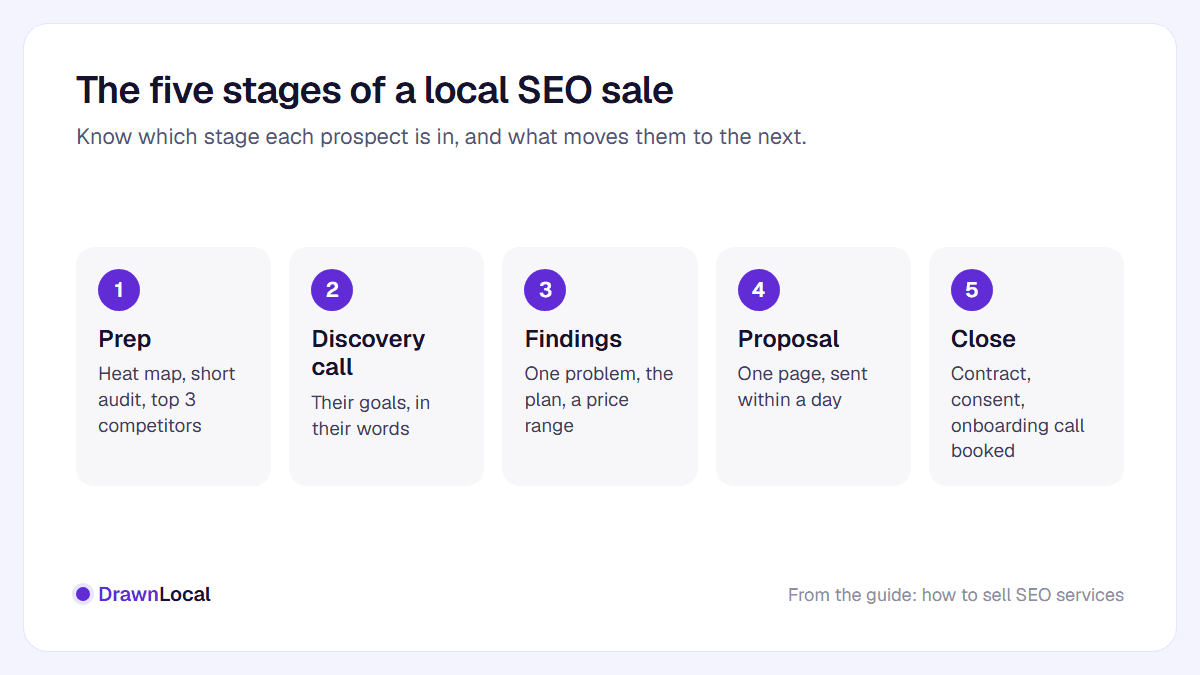
| Stage | Your goal | What you use |
|---|---|---|
| 1. Prep | Know their market before they speak | Heat map, short audit, top 3 competitors |
| 2. Discovery call | Understand the business and what a good month means | The question list below |
| 3. Findings | Show one clear problem and the plan | The map, one fix, a price range |
| 4. Proposal | Put the plan and price in writing | A one-page proposal |
| 5. Close | Agree the start date and next steps | Contract, written consent, onboarding call booked |
Getting the call in the first place is covered in how to get local SEO clients; this guide starts once a prospect has said yes to talking.
Work out your pipeline numbers
Sales gets easier when you know how many conversations one client takes. Track your own numbers from the start; until you have them, plan with an example like this one, which is illustrative rather than a benchmark:
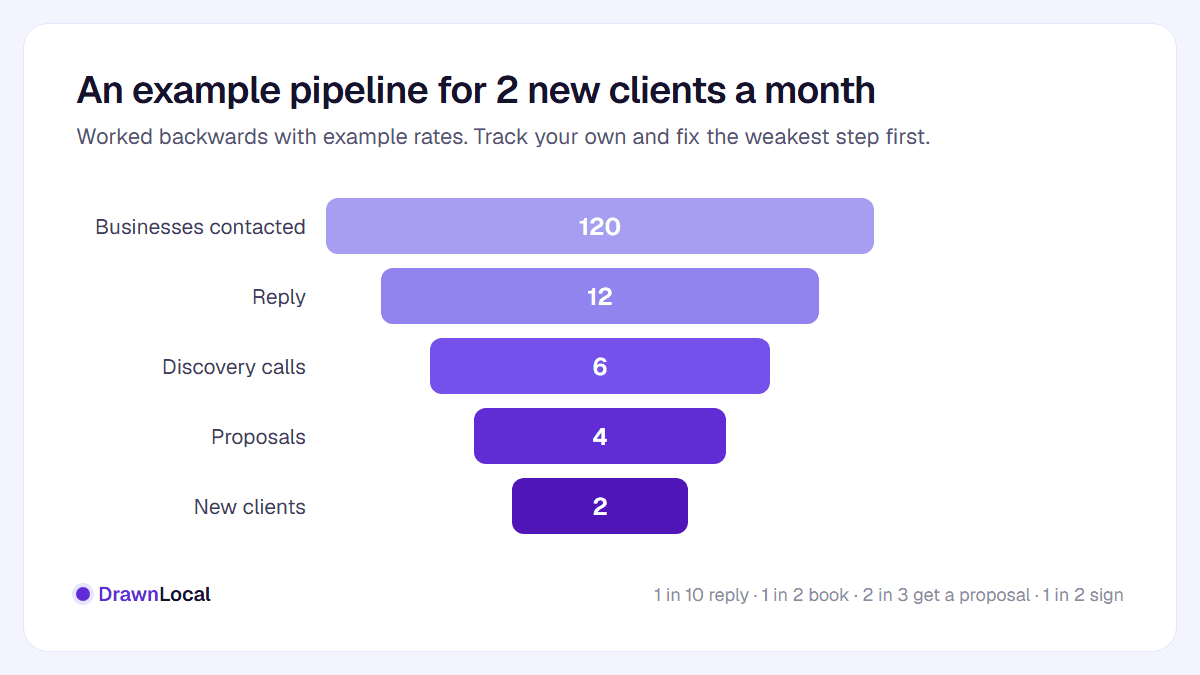
| Step | Example rate | Needed a month |
|---|---|---|
| New clients | – | 2 |
| Proposals sent | 1 in 2 signs | 4 |
| Discovery calls | 2 in 3 get a proposal | 6 |
| Replies to outreach | 1 in 2 books a call | 12 |
| Businesses contacted | 1 in 10 replies | 120 |
If the numbers don’t add up, fix the weakest step rather than sending more email. Few replies often means a weak first line; few signed proposals often means price surprises, which is why price belongs on the call.
Before the call: a 20-minute prep checklist
Two free checks do a lot of the work: a heat map of the main keyword and an AI visibility check. The rest is reading their profile, reviews and website with the list below in mind.
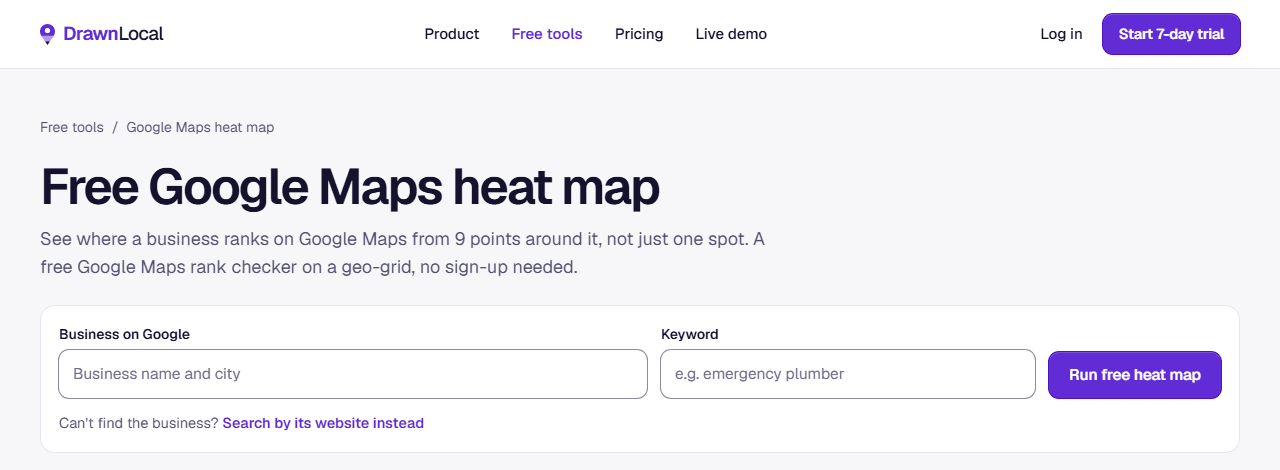
- Run a heat map of their main keyword across their area and note who holds the top 3 where they don’t. A free heat map does this in minutes.
- Check the Google profile: primary category, name, hours, photos, reviews and the last post.
- Compare rating and review count with the top 3; local SEO competitor analysis has a sheet for it.
- Look at the website: is there a page for their most valuable service?
- Ask ChatGPT or Google AI Mode for the best business of their type in their town, and note who’s named.
- Pick the one problem that costs them the most calls. That’s the heart of the call.
Put your findings on one sheet
Fill in one page per prospect before the call, so the findings are in front of you and nothing gets forgotten:
| Line | What to write |
|---|---|
| Main keyword | The service they most want, as customers search for it |
| Heat map | Top 3 at how many points, and the weakest area |
| Who leads where they don’t | The competitor’s name, reviews and category |
| Reviews | Their count and rating against the top 3 |
| Website | Is there a page for the main service? |
| AI answers | Named or not, and who’s named instead |
| The one problem | The finding that costs them the most calls |
| Price range | What the market needs, from your packages |
Phone, video or in person?
Video works well, because you can share the map on screen while the owner talks. In person suits owners who prefer it; bring the map printed, with their address marked. On a phone call, email the map a few minutes before you start, so you can both look at it.
Whichever you choose, send a calendar invite with the agenda in one line. It sets the call up as a conversation about their business, not a pitch.
The discovery call script
Open with the agenda so the owner knows what to expect: “Thanks for the time. I’d like to understand the business first, then show you what I found on Google, and if it makes sense, talk about what working together would look like. Sound OK?” Then ask, and listen far more than you talk:
- Which services bring in the most money, and which do you want more of?
- Which towns or neighborhoods matter most to you?
- Where do most of your jobs come from today?
- What does a good month look like: calls, booked jobs, quote requests?
- Who do you lose jobs to?
- What have you tried for marketing, and how did it go?
- Has anyone worked on your Google profile or website before?
- How do you ask customers for reviews now?
- How many more jobs a month could you handle?
- Who else is involved in a decision like this?
- Is there a budget you have in mind for marketing each month?
- If this works, when would you want to start?
Write their answers in their words; you’ll reuse them in the proposal. Then share your screen and show the heat map: where they win, where they disappear, and who takes those calls.
What showing the map sounds like
An example for a made-up plumber, straight after the questions:
“You said water heater installs are the jobs you want. Here’s Google Maps for ‘water heater installation’ from 49 points across Aurora. You’re in the top 3 at six points near your shop. Out east, where you said the new houses are, Smith Plumbing is first almost everywhere.”
“They have 240 reviews to your 38, and their profile category is more specific than yours. The category takes minutes to fix. The reviews take a routine and a few months. That’s the first 90 days.”
Notice what it does. It uses the owner’s own words, names a competitor they know, and shows one quick fix and one slower one. Then it leads straight into the plan.
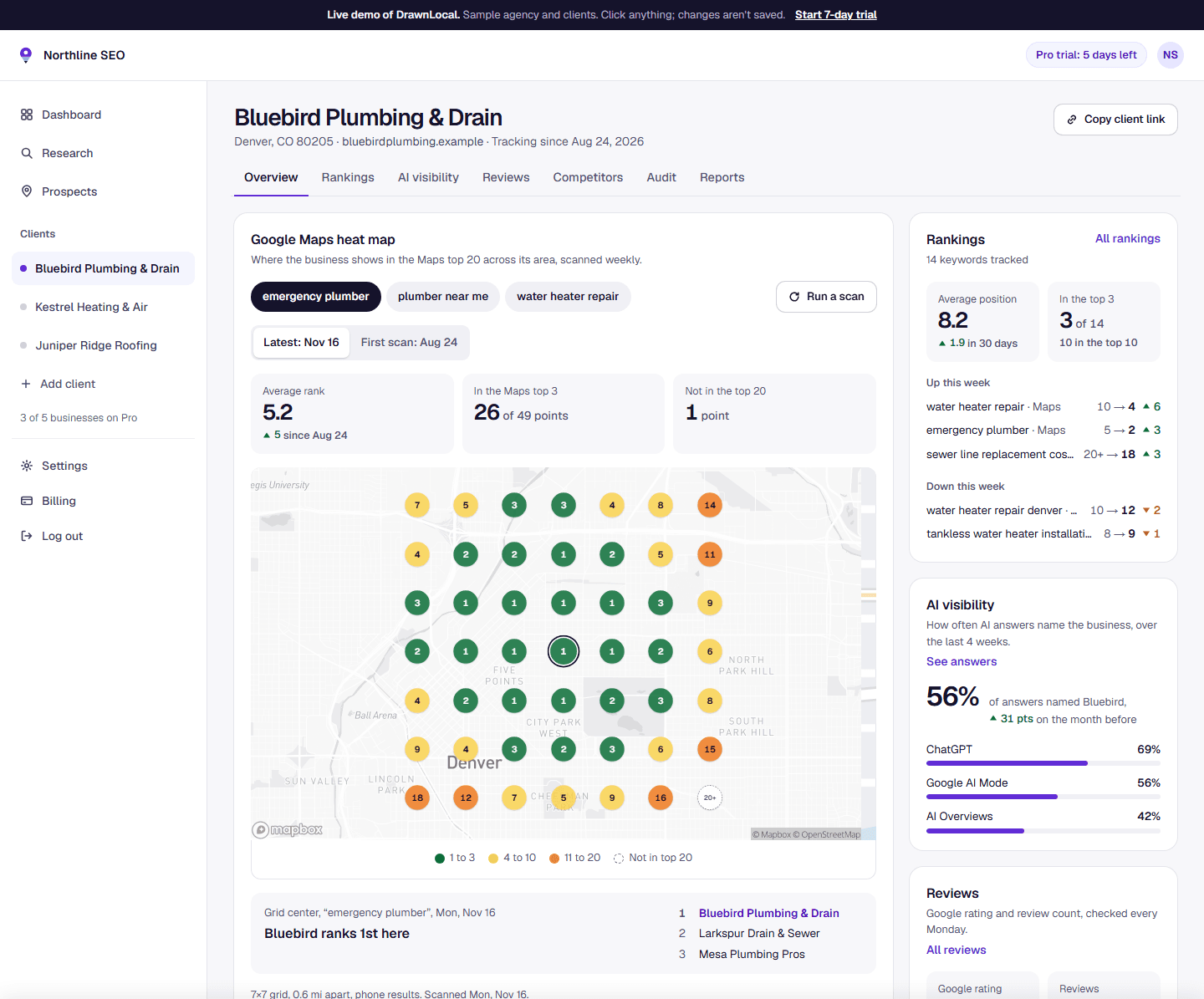
Reading a live heat map on the call
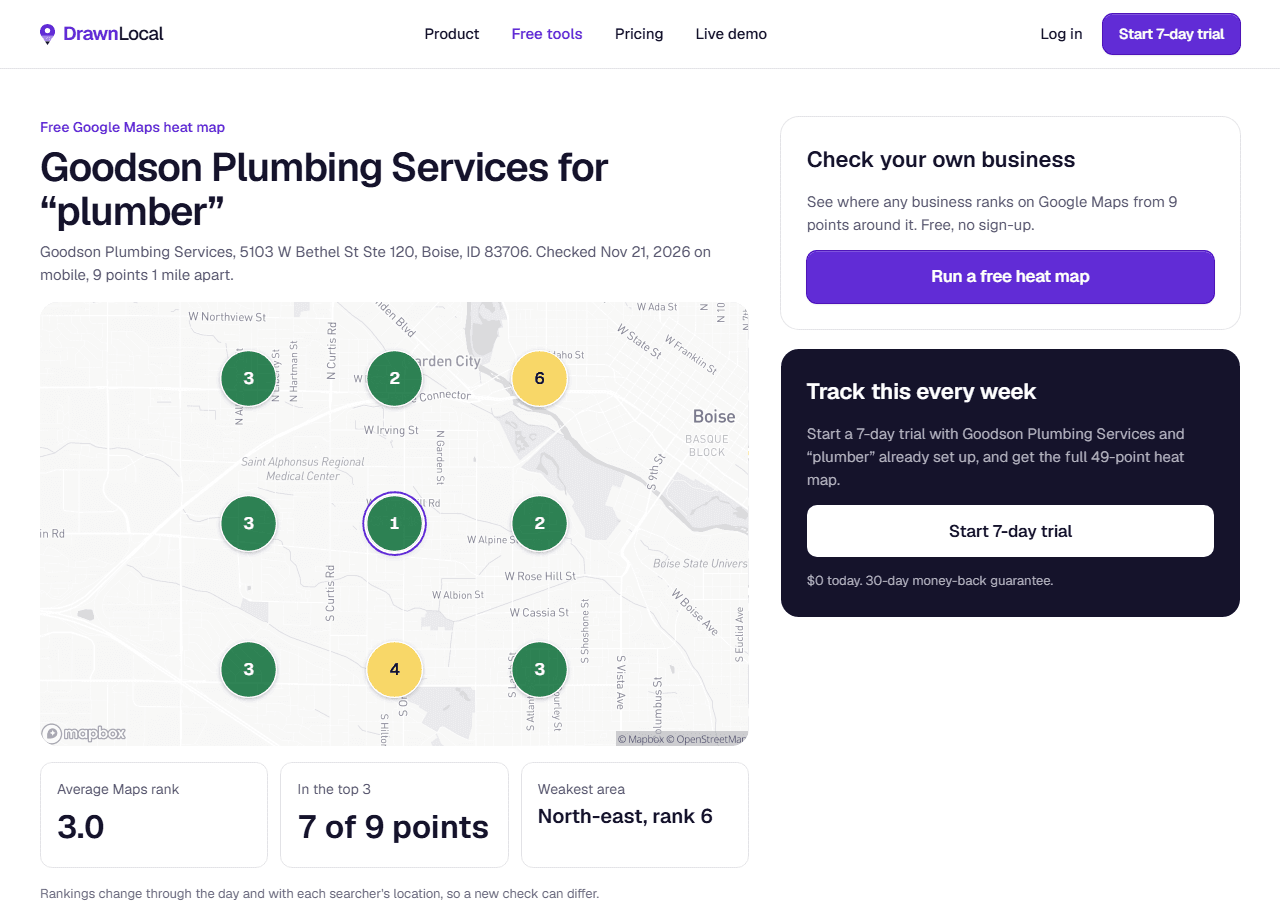
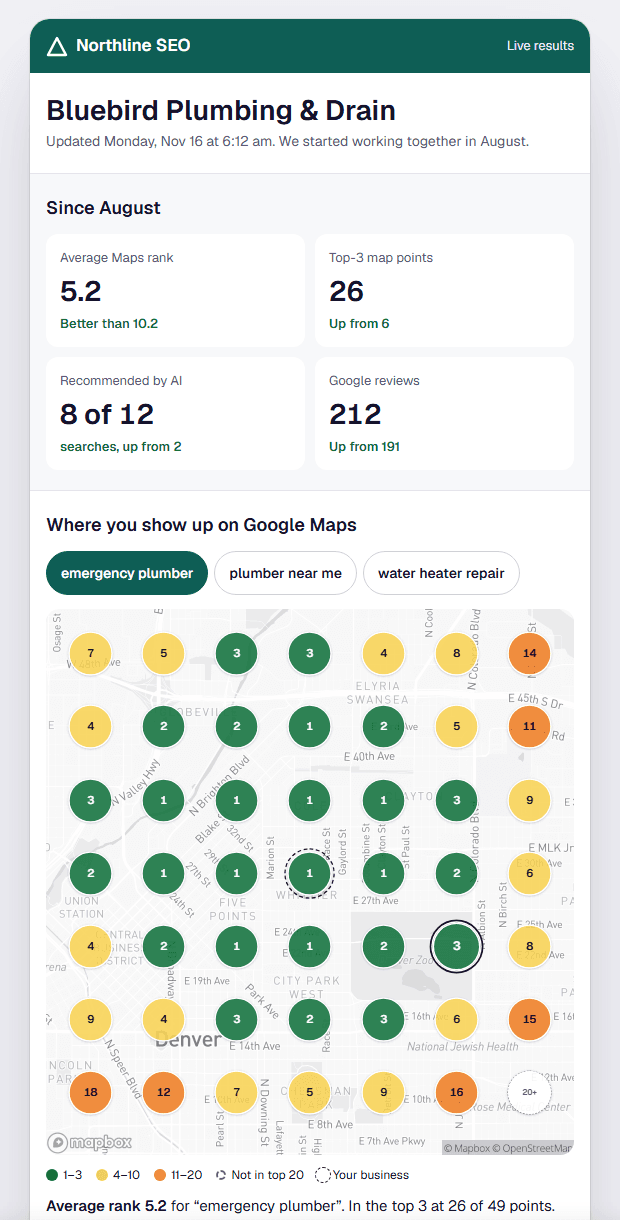
Here’s a real result to practice on: a Boise plumbing company, checked for “plumber” on Nov 21, 2026. The pin at its address is first. It’s in the top 3 at 7 of 9 points, with an average rank of 3.0.
Its weakest point is to the north-east, at sixth, and it’s fourth to the south. On a call you’d say: “You’re first around your office and top 3 across most of the area. To the north-east you drop to sixth, so searchers there see other plumbers first.”
A strong map is still a sales conversation. It shows the owner what upkeep protects, and where the next calls could come from. A weak map makes the case on its own.
Check the map yourself before the call, so you know which point to talk about first. How to read a local SEO heat map covers the common patterns and what each one usually means.
Use AI answers as a second talking point
Owners know Google Maps, but they may not have checked what ChatGPT or Google AI Mode says when a customer asks for a recommendation. That makes it a useful second finding.
The same Boise plumber, checked for “best plumber in Boise, ID” on Nov 21, 2026, was recommended by both.
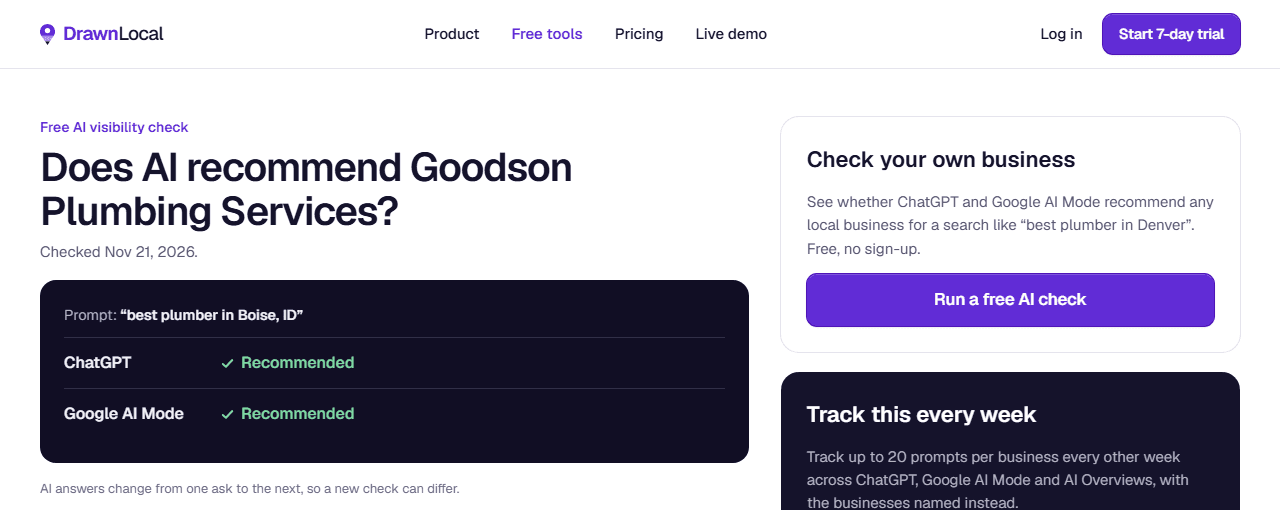
If the prospect is named, that’s good news to share and to protect. If a competitor is named instead, note who it is and whether the same business leads the map.
Say clearly that AI answers vary from one ask to the next. Present it as something you’ll track every other week, never as a ranking you can promise.
A 45-minute call agenda
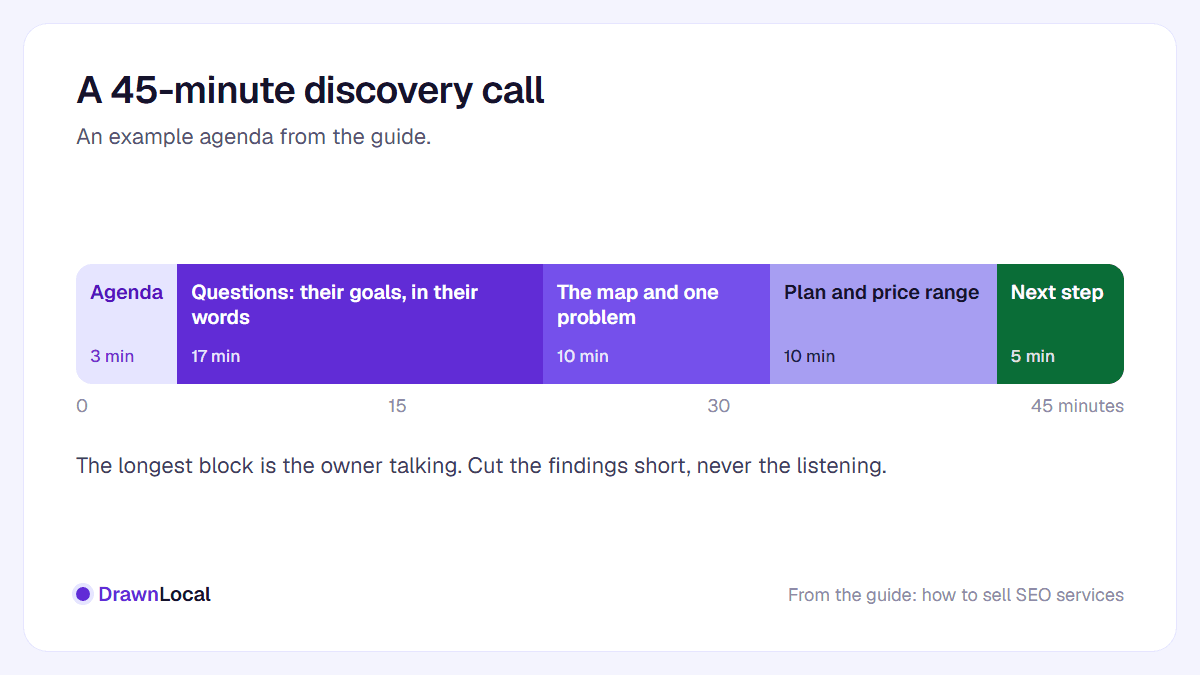
Timing keeps the call on track and leaves room for the part that matters most, the owner talking. An example agenda:
| Minutes | Part | Goal |
|---|---|---|
| 0–3 | Agenda | The owner knows what’s coming and agrees to it |
| 3–20 | Questions | Their goals and problems, in their words |
| 20–30 | The map and one problem | They see where calls go to someone else |
| 30–40 | Plan and price range | They hear the first 90 days and what it costs |
| 40–45 | Next step | A date for the proposal review, booked before you hang up |
If the owner talks past the questions, let them. Cut the findings short rather than the listening; you can send the rest in writing.
Present one problem, one plan and a price range
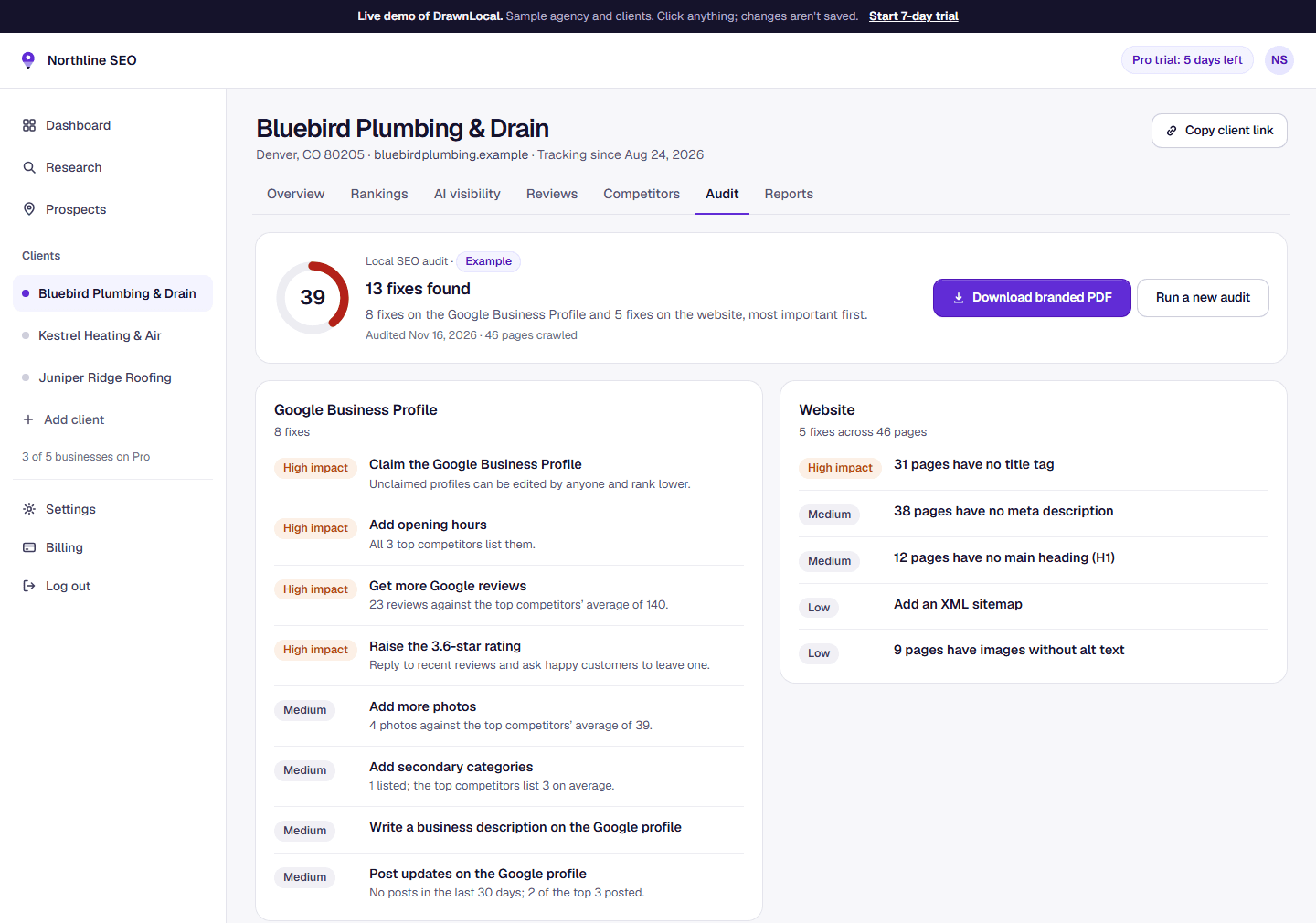
Don’t walk through twenty findings. Lead with the one problem that costs the most calls, such as a broad primary category or a competitor with ten times the reviews. Then give the plan for the first 90 days in three lines, and a price range tied to the work.
Saying the range on the call matters. A prospect who hears “most businesses like yours are between $750 and $1,000 a month” and stays on the line is qualified. One who balks tells you now, not after you’ve written a proposal. How much to charge for local SEO shows how to set the range.
Three ways to present the price
How you say the price changes how it’s heard. Three approaches that work on a call:
- Anchor it to a job’s value. “A water heater install is worth about $1,500 to you. This plan is $750 a month, so one extra job a month pays for it.” Use the owner’s own numbers from the questions.
- Show two or three packages. One you recommend, a smaller one for tight budgets and a bigger one for owners who want to move faster. The owner then compares options instead of deciding yes or no.
- Tie the price to the market. Show the heat map for a busy town next to a quiet one. The difference explains why one market needs more work than another.
Whichever you use, say the price once, then stop talking and let the owner respond.
How to handle the 8 objections you’ll hear
Many objections are questions in disguise. Ask what’s behind each one before you answer, then answer with their data:
| Objection | Often means | What to say |
|---|---|---|
| “It’s too expensive.” | They can’t see the return yet | “What’s a typical job worth to you? If this brings two more a month, does the fee pay for itself?” |
| “We tried SEO and it didn’t work.” | They paid for tasks and never saw results | “What did they report each month? With us you’d see this map every month, compared with today.” |
| “We get enough work from referrals.” | They’re busy now and wary of change | “That’s great. Which jobs would you rather have more of? The map shows who’s winning those.” |
| “I need to think about it.” | Something is unclear or someone else decides | “Of course. What would you need to see to decide? Is anyone else involved?” |
| “Can you guarantee page one?” | They’ve been burned by promises | “No one honestly can; Google says so itself. What I can promise is the work, and this map every month so you see progress.” |
| “My nephew does our website.” | Loyalty, and a cheap option | “Keep him on the website. My work is mostly the Google profile, reviews and local links.” |
| “Just send me something by email.” | A polite brush-off | “Happy to. So it’s useful, which two things should it answer?” |
| “We’re too busy already.” | They can’t take more work | “Which jobs would you swap the low-value ones for? We can target those.” |
Never answer an objection with a guarantee or an instant discount. Google’s own guidance says “no one can guarantee a #1 ranking”, and its policy for agencies that manage profiles bars promising top placement.
The email to send after the call
Send it the same day, before the proposal, while the call is fresh. A template:
“Thanks for the time today, [name]. You said [their main goal, in their words]. Here’s what I found: [one problem], which means [what it costs them in calls or jobs].”
“The first 90 days would focus on [fix one], [fix two] and [fix three]. I’ll send a one-page proposal by [day] with two options. Does [day and time] work to go through it together?”
Using their words shows you listened. Booking the review call in the same email gives the proposal a date without adding pressure.
Follow up without being a pest
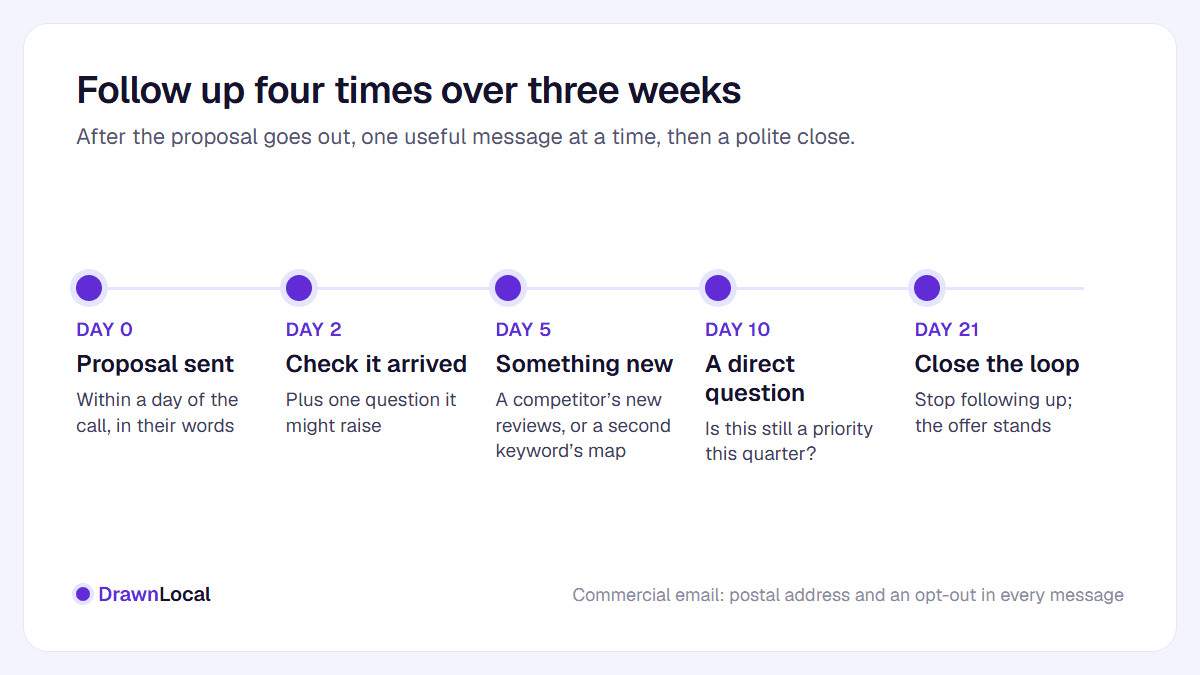
Send the proposal within a day of the call, while it’s fresh, with their own words in the problem section. Our proposal template has the sections and an example. Then follow up on a schedule:
| When | What to send |
|---|---|
| Day 2 | A short check that it arrived, and one question it might raise |
| Day 5 | One new useful thing: a competitor’s new reviews, or a second keyword’s map |
| Day 10 | A direct question: is this still a priority this quarter? |
| Day 21 | A polite close: “I’ll assume the timing isn’t right and stop following up. The offer stands if that changes.” |
If your follow-ups are commercial email in the US, the FTC’s CAN-SPAM guide applies. Use a subject line that reflects the message, include your postal address, and offer a clear opt-out, honored within 10 business days.
Closing the deal
Offer two or three packages, recommend one, and make the next step small: a start date and a 30-minute onboarding call. When they say yes, send the contract and get written consent to manage their Google Business Profile, which Google requires of agencies. The contract checklist lists what to include, and the onboarding checklist covers the first two weeks.
If the owner hesitates at the close, ask what’s holding them back rather than offering a discount. It may be a question about the contract length or the first month, which you can answer on the spot.
Make the first month concrete: name the three things you’ll do in the first two weeks, and the date of the first report. It gives the owner something specific to say yes to.
Adjust to the owner in front of you
Owners buy for different reasons. Listen for which one you’re talking to during the questions, then lead with what they care about:
| Owner | Cares most about | Lead with |
|---|---|---|
| Burned before | Not being fooled again | Monthly reporting against today’s map, and a short notice period |
| Busy | Their time | A one-page plan and one short call a month |
| Numbers-minded | Return on the fee | The job-value math, and the calls you’ll report each month |
| Cautious | Risk | A smaller first package with a clear review date |
| Growth-minded | Speed | The bigger package, and the next town or service to target |
Adjust the order and the emphasis, never the facts. Every owner gets the same honest answer on guarantees and timing.
Sell more to the clients you already have
A happy client already trusts you, which can make them the easiest next sale. Natural next steps, offered when the results justify them:
- A second service or town, once the first keyword is in the top 3 across most of the map.
- A second location, priced per location like the first.
- AI visibility tracking, for clients who ask whether ChatGPT recommends them.
- Review replies, for owners who don’t have time to answer every review.
Raise it in a quarterly review, with the map that shows why now is the time. Local SEO client retention covers how to run those reviews.
Track every deal in one simple sheet
You can’t improve what you don’t record. A spreadsheet is enough at first, with one row per prospect:
| Column | What to record |
|---|---|
| Business and contact | Name, trade, town, the person you speak to |
| Source | Referral, outreach, partner or inbound |
| Stage | Contacted, call booked, proposal sent, won or lost |
| Value | The monthly fee and any setup fee |
| Next step | What happens next, and the date |
| Lost reason | Price, timing, went with someone else, no reply |
Review it every week. The lost-reason column teaches the most: three losses on price in a row means your range or your value story needs work, not more outreach.
When to walk away from a deal
Not every yes is worth having. Some clients cost more than they pay, or put your other work at risk. Walk away politely when a prospect:
- Wants a guaranteed ranking or a guaranteed number of calls in writing.
- Asks for shortcuts that break Google’s rules, such as keywords in the business name or reviews only from happy customers.
- Has a budget that can’t cover the hours their market needs, and won’t consider a smaller scope.
- Won’t give you manager access to the profile, or wants you to use their password.
Say why, briefly, and leave the door open: “I don’t think I can get you results on those terms. If that changes, I’d be glad to talk again.”
What to do when you lose a deal
Ask why, once, and without arguing: “Thanks for letting me know. So I can improve, what made the difference?” Record the answer in the lost-reason column of your sheet.
Then stay useful. A short note every quarter with a fresh heat map keeps you in mind if the other option doesn’t work out. Ask before you add them to any regular email, and stop as soon as they ask.
Selling SEO: mistakes that lose deals
- Talking for most of the call. The owner should talk at least as much as you do.
- Jargon: “citations”, “NAP” and “schema” mean nothing to a plumber. Say “listings”, “your details everywhere” and “information Google can read”.
- A 20-page proposal. One page, their words, one plan and the price.
- Discounting at the first push-back, which tells them the first price wasn’t real.
- No next step at the end of the call. Always book the next conversation before you hang up.
- Sending the proposal days later, when the call has gone cold. Send it within a day.
More mistakes across the whole business are in SEO agency mistakes.
Questions
How do you sell SEO to a local business?
Prepare with a heat map and a short audit, ask about the business before showing anything, then present one problem, a 90-day plan and a price range. Send a one-page proposal within a day and follow up on a schedule.
What questions should I ask on an SEO discovery call?
Which services and towns matter most, where jobs come from today, what a good month looks like and who they lose to. Then what they’ve tried, who decides, the budget, and when they’d want to start.
How do I handle “SEO is too expensive”?
Ask what a typical job is worth, then work out how many extra jobs a month would cover the fee. If it still doesn’t fit, offer a smaller package rather than a discount on the same work.
How long should an SEO sales call be?
Plan for about 45 minutes. Spend a few minutes on the agenda and most of the time on their questions. Then show the map, one problem, the plan and a price range, and book the next step.
Should I guarantee results when selling SEO?
No. Google says no one can guarantee a #1 ranking, and its policy for agencies managing profiles bars promising top placement. Promise the work and monthly reporting against the starting point instead.
Sources
- Google: do you need an SEO?
- Google Business Profile Help: third-party policies
- FTC: CAN-SPAM Act compliance guide