25 SEO agency mistakes that cost clients and money, and how to avoid them
Many SEO agencies that struggle don’t fail on SEO skill. They fail on the business around it: the wrong clients, prices that can’t pay for the work, reports nobody reads. Here are 25 mistakes across the whole life of an agency, the fix for each, and a self-check to score your own.
By the DrawnLocal team · · 14 minute read
SEO agency mistakes when starting out
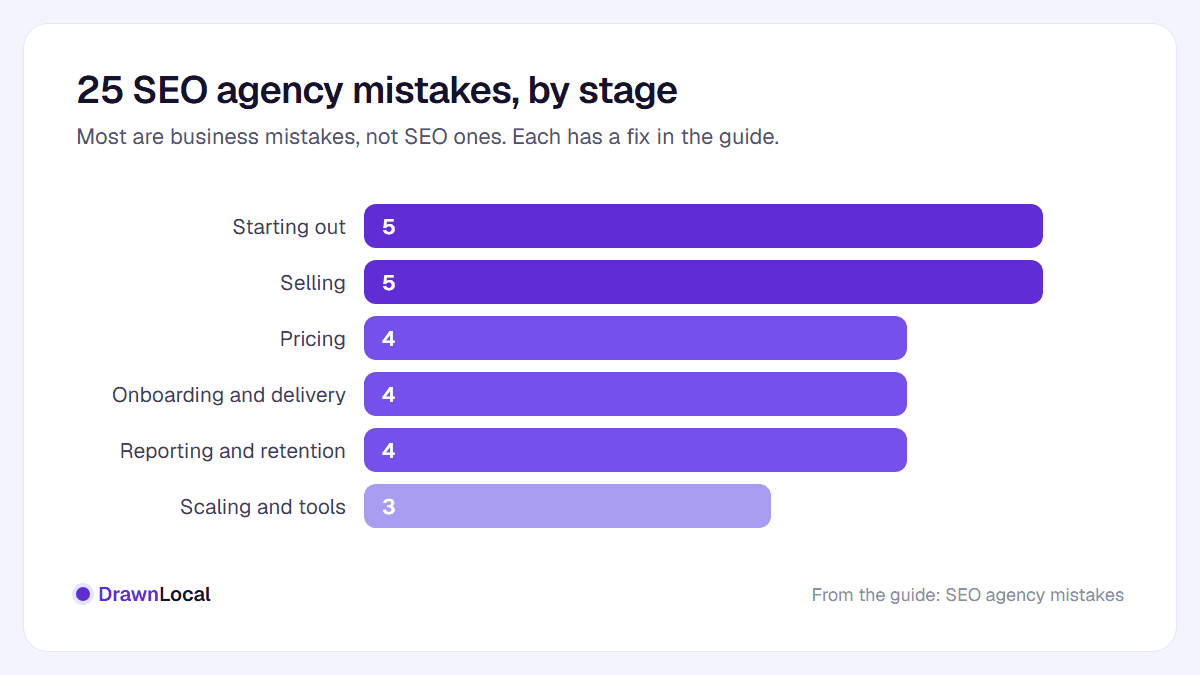
- Selling before you can show results. Without proof, you compete on price alone. Get one business moving first, your own or a free case study, and keep the before-and-after heat maps. See how to start a local SEO business.
- Taking any client who pays. A plumber, a dentist and a law firm need three different playbooks, and your proof from one doesn’t sell the others. Pick one or two trades and get good at them.
- Selling too many services. Web design, ads and social on top of SEO spread a new agency thin, and one weak service colors how clients see the rest. Sell what you can deliver well; refer the rest.
- Creating a Google profile for a remote agency. Google says a business must make in-person contact with customers during its stated hours. A profile that breaks the rules can be suspended.
- Skipping the paperwork. No contract, no written consent to manage the client’s profile, no separate bank account. It costs nothing until a dispute, then everything. The contract checklist covers the first two.
Questions to ask before you take on a client
Taking any client who pays is easier to avoid with a short checklist. Before you send a proposal, answer these:
- Is the business in a trade and region you already know, or close to them?
- Is it eligible for a Google Business Profile at the address it uses?
- Does the budget cover the hours its market needs?
- Is there a realistic first win, such as a better category, a missing service page or a review gap?
- Will the owner give manager access and answer questions within a few days?
- Are they asking for anything that breaks Google’s rules?
Two or more “no” answers are a warning sign: the client may cost more than they pay. It’s better to refer them on than to lose them in month three.
Selling mistakes
- Guaranteeing rankings. Google says no one can guarantee a #1 ranking, and its policy for agencies bars promising top placement. Promise the work and the reporting.
- Pitching “SEO” instead of a problem. Owners tend to ignore generic pitches, because so many agencies send them. Lead with one fixable problem and a heat map; see how to get local SEO clients.
- Hiding the price until the proposal. Proposals then die quietly on price. Give a range on the call so price objections surface while you can still answer them.
- Discounting at the first push-back. Offer a smaller package instead; the same work for less teaches clients your prices aren’t real.
- No follow-up. Many proposals need a few nudges. How to sell SEO services has a follow-up schedule and objection scripts.
Set expectations on day one
Promises that sink agencies can start as hopeful words on a sales call. Replace them with expectations you can keep, in writing, at the start:
- Timing: Google’s own guidance says an SEO usually needs four months to a year to make improvements and see potential benefit. Quick fixes like the category can move sooner.
- What you’ll report: the heat map, rankings, reviews and calls, compared with the month the client started.
- What you control and what you don’t: you control the work; Google and competitors control the rest.
- How you’ll communicate: a monthly report on a fixed date, a short note between reports, and a reply to messages within an agreed time.
Put the same points in the proposal and the welcome email. A client who knows what to expect is easier to keep than one who hoped for page one in a month.
Pricing mistakes
- Charging too little. A low retainer can’t pay for the hours good work takes, so results slip and the client leaves. Work out your cost per client first; see how much to charge for local SEO.
- Billing by the hour. Clients watch the clock instead of the results, and small requests can become negotiations. A monthly retainer per location, with a clear scope, avoids both.
- One price for every market. Ranking a roofer in a big city takes far more work than in a small town, so a flat price can lose money on the hard ones. Scope with a heat map before you quote.
- Never raising prices. Costs and your skill tend to rise each year, so a fixed price quietly shrinks your margin. Review prices once a year, and raise them for new clients first.
A price increase letter that keeps clients
Never raising prices is easier to fix than it feels. Raise prices for new clients first, then for existing ones once a year, with the notice your contract sets out. A template:
“Hi [name], a note about next year. Since you started in [month], you’ve gone from the top 3 at [baseline] of 9 points to [now], and reviews from [baseline] to [now].”
“From [date], your monthly fee moves from [old price] to [new price]. The work stays the same: [the main deliverables]. Happy to talk it through on our next call.”
Lead with their results, state the change once, and keep it short. A client who has seen their progress every month has context for the increase, rather than just a bigger invoice.
Onboarding and delivery mistakes
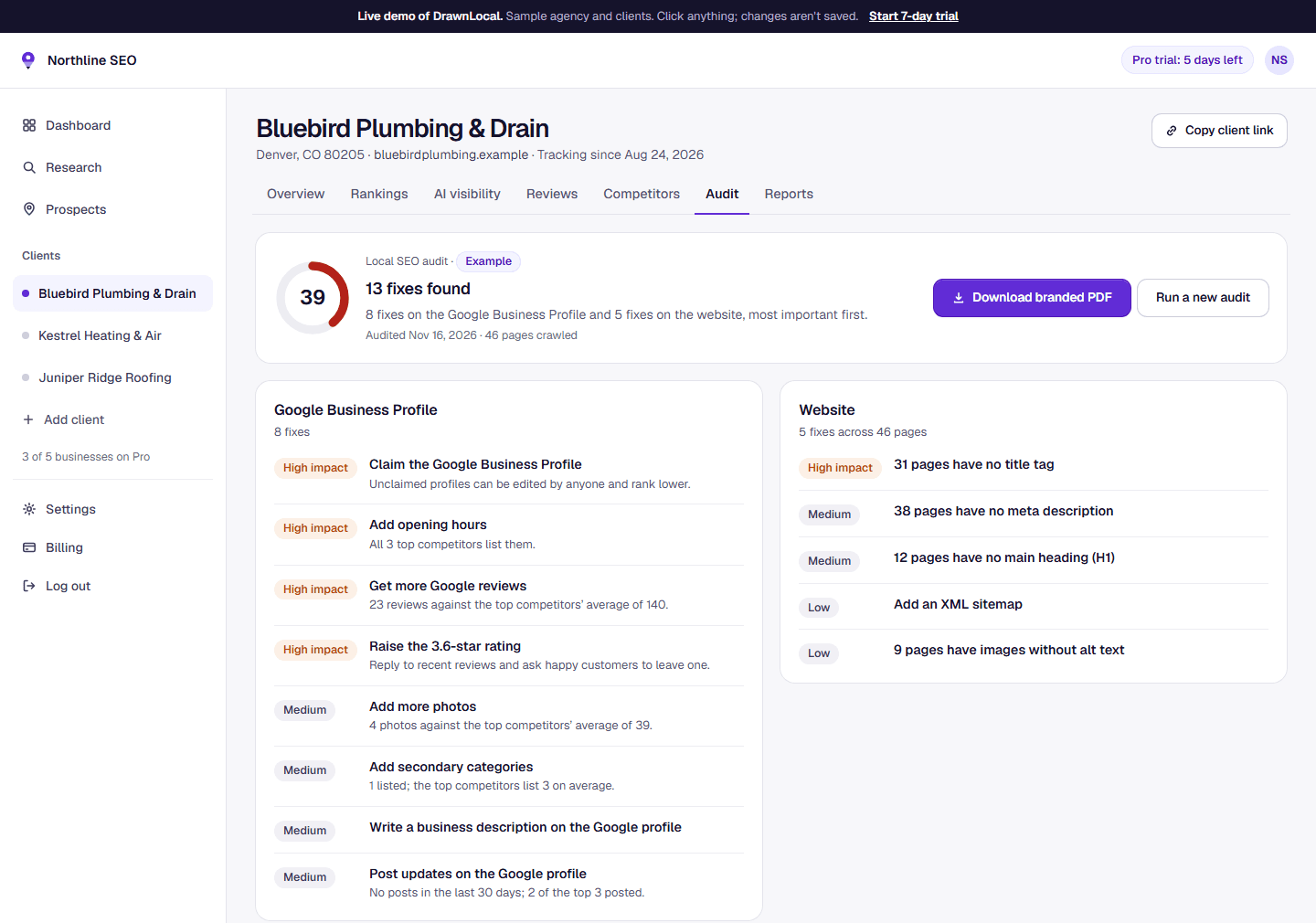
- Changing things before recording a baseline. Without a dated starting point, you can’t prove progress. See the onboarding checklist.
- Asking for passwords or ownership. Google’s policy says clients keep ownership and agencies get manager access; see how to get access to a client’s Google Business Profile.
- Unwritten scope. A verbal “sure, we’ll take care of it” becomes permanent extra work. Write the scope down, list what’s out of scope, and price any changes to it.
- Starting with the small stuff. Posts and citations before the primary category and the business name, which local search experts rank far higher. Fix the heaviest factors first; see how to rank higher on Google Maps.
What a written scope looks like
Unwritten scope has a simple fix: a short list of what’s in and what’s out, agreed before the work starts. An example for a one-location retainer:
| In scope each month | Out of scope (quoted separately) |
|---|---|
| Google profile upkeep: posts, photos, Q&A and edits | A new website or a redesign |
| The review routine and replies to new reviews | Paid ads |
| One service or area page | Social media management |
| Listing checks and fixes | Extra locations |
| Local link outreach | Printed marketing |
| The monthly report and a short call | Rush work outside the agreed schedule |
When a client asks for something in the right-hand column, say yes with a price, or suggest swapping it for something in the left. Either way, the scope stays written.
Reporting and retention mistakes
- Reporting tasks instead of results. Lead with where the business now shows up and the calls it got; the report template has the order.
- Comparing only with last month. Month-to-month changes are often small and noisy. Compare with the month the client started, so the progress is obvious.
- Letting the client find bad news first. A drop they discover feels like a cover-up. Tell them about a drop or a new competitor, with the plan, before they notice.
- Silence between invoices. A short monthly note and a live page they can check keep your work visible. See local SEO client retention.
The mistake in action: reporting from one spot
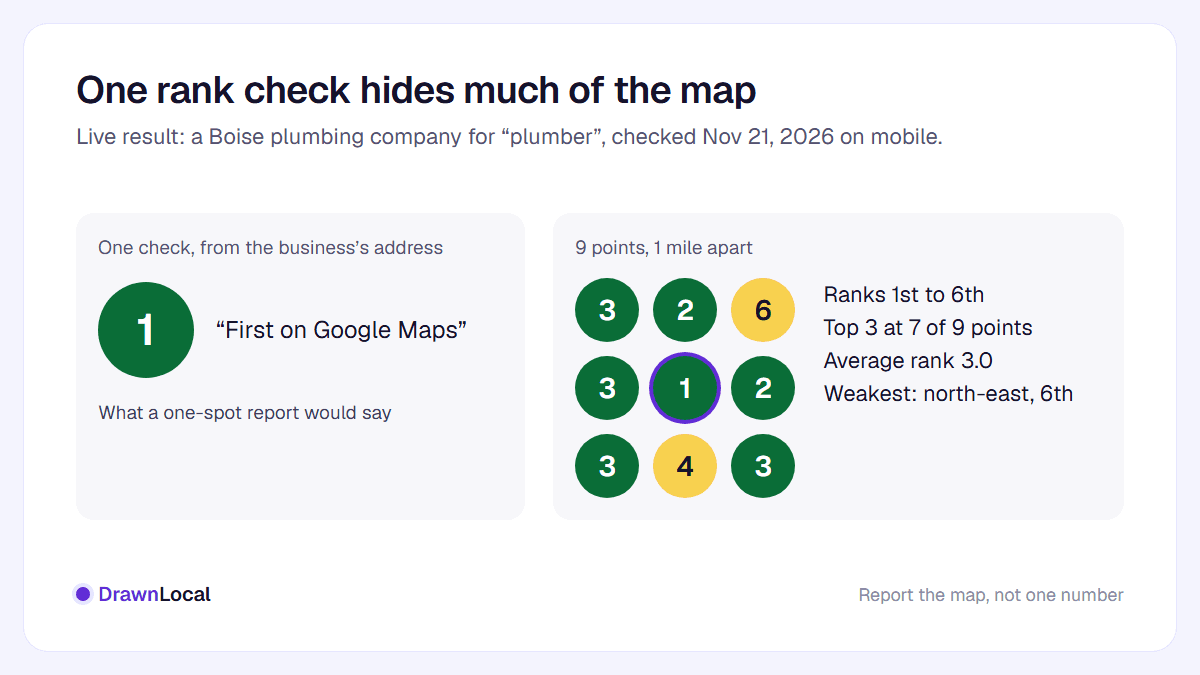
A single rank check hides much of the story, because Google Maps results change with the searcher’s location. Here’s a live example: a Boise plumbing company, checked for “plumber” on Nov 21, 2026.
Checked only from its own address, it ranks first. Across 9 points around it, it ranks anywhere from first to sixth, with the top 3 at 7 of 9 points.
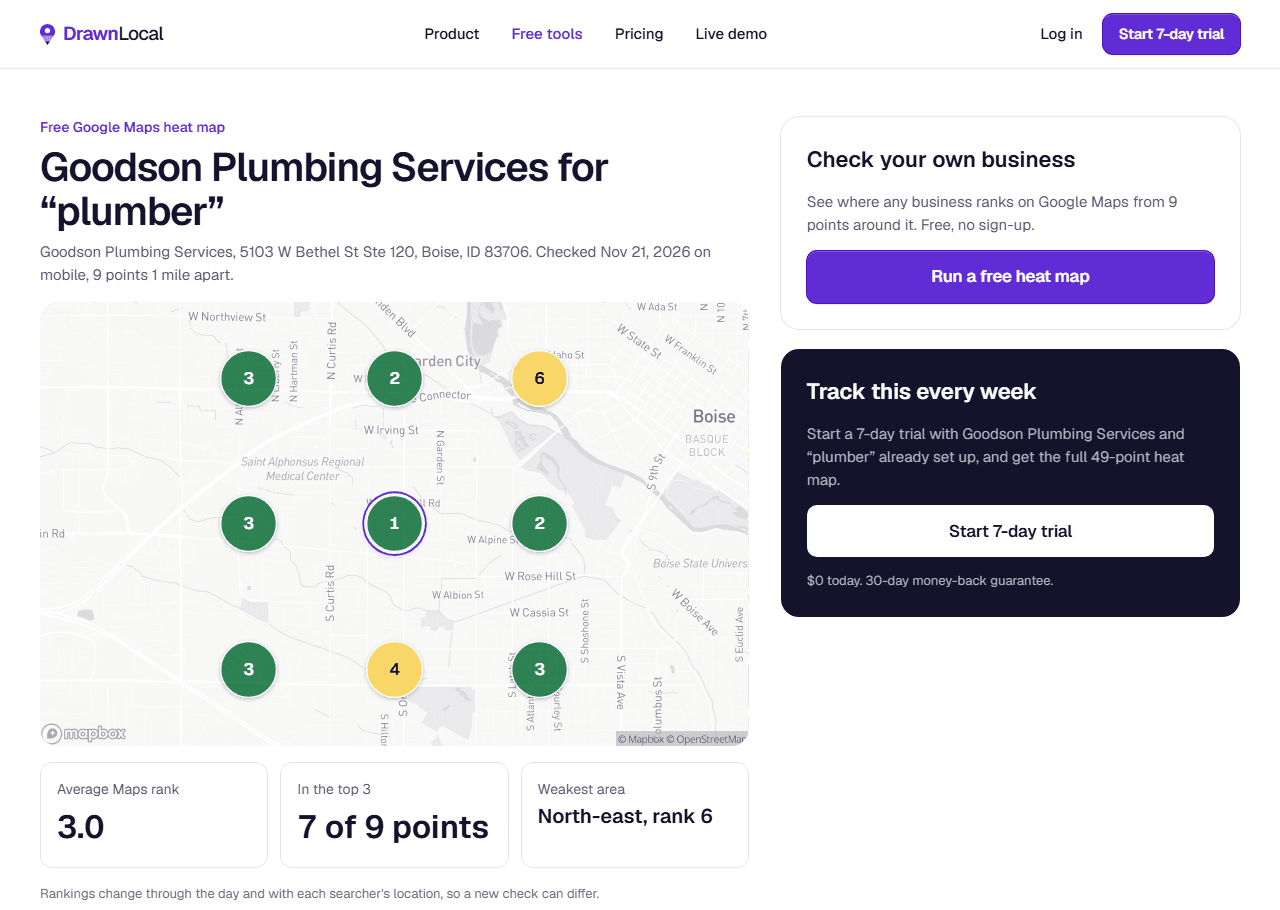
Report the single number, and the client may believe they’re first everywhere. Then they search from the north-east of town and see other plumbers ahead of them. Report the map, and the weak area becomes the plan for next month instead of a surprise.
Why a client sees a different rank explains the causes, so you can explain them to clients too.
Add AI answers to the report
Some customers now ask ChatGPT or Google AI Mode for a recommendation. If a client asks whether AI recommends them and you haven’t checked, it looks like you’re behind.
Checking takes minutes. The same Boise plumber, checked for “best plumber in Boise, ID” on Nov 21, 2026, was recommended by both.
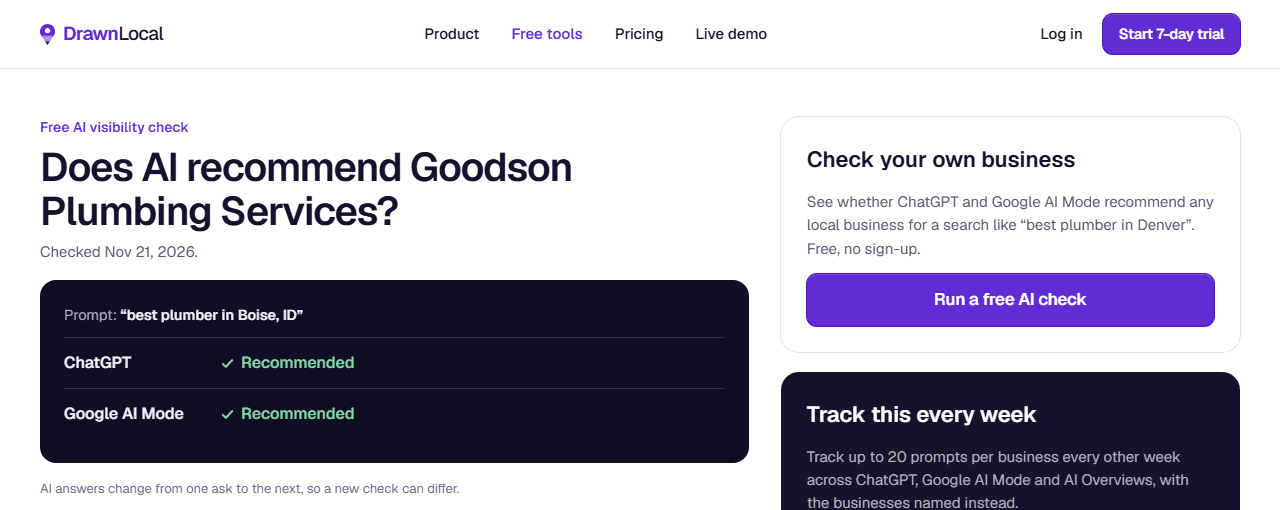
Treat it as a trend, not a ranking: AI answers change from one ask to the next. Track the same few prompts every other week and report whether the client is named, and who is named instead.
How to tell a client about a drop
Letting a client find bad news first is avoided with one short message, sent as soon as you’ve looked into it. A template:
“Hi [name], a heads-up before your report: your rankings for ‘[keyword]’ dropped this week, mainly around [area]. The cause looks like [a new competitor, a profile edit, a change at Google]. Here’s what we’re doing: [one or two actions].”
“I’ll send an update on [date]. Calls from the area you care most about, [area], haven’t changed so far.”
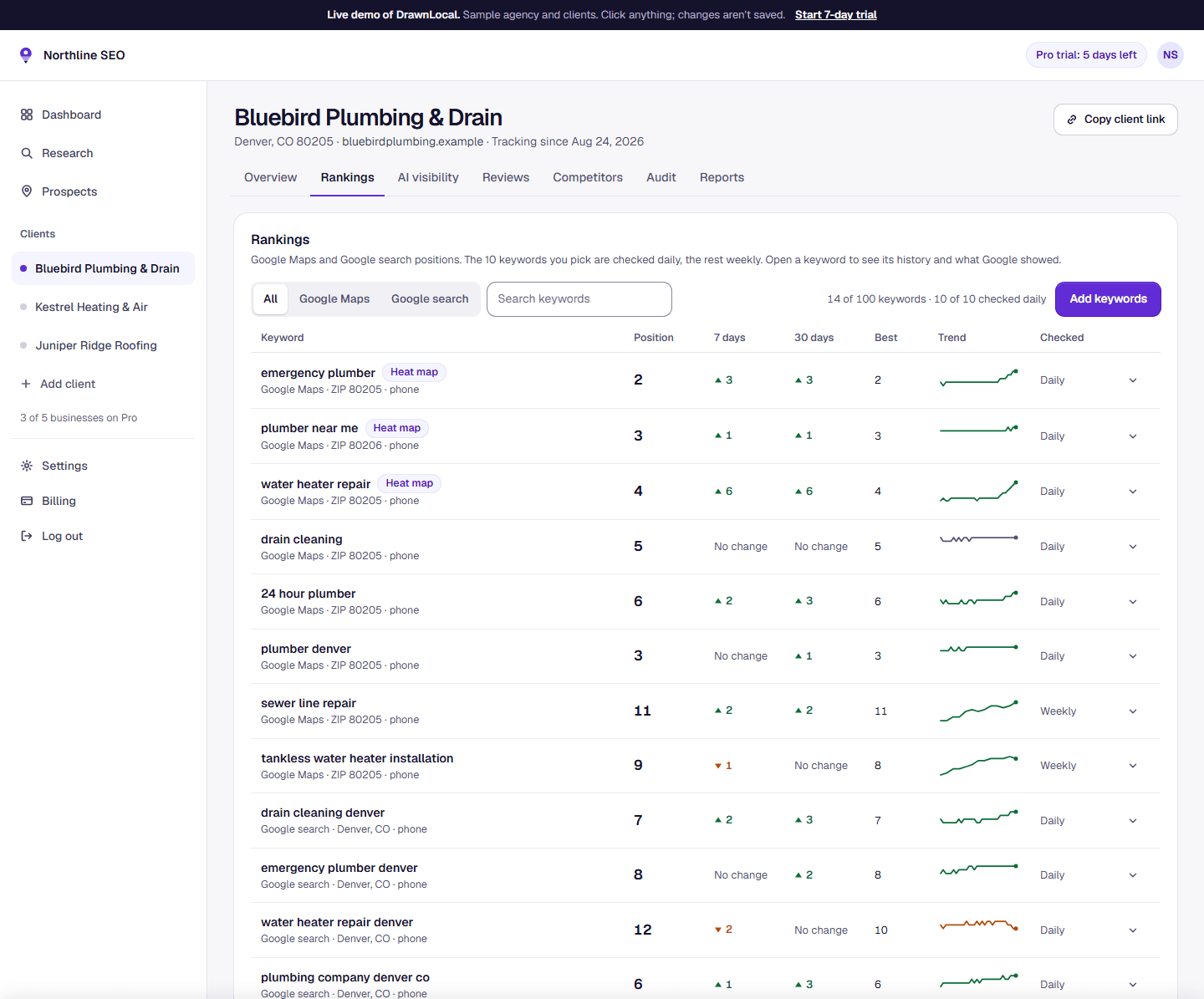
Only include the last line if it’s true. The point is that the client hears it from you, with a cause and a plan, before they notice it themselves.
If you don’t know the cause yet, say so, and say when you’ll know. Silence while you investigate looks the same as not noticing.
Scaling and tools mistakes
- Hiring before writing processes. A new person can only follow steps that exist on paper; otherwise quality depends on your memory. See how to scale an SEO agency.
- Calling everyone a contractor. In the US, the relationship decides it, not the label; the IRS looks at control and the type of relationship. Check with an accountant before the first hire.
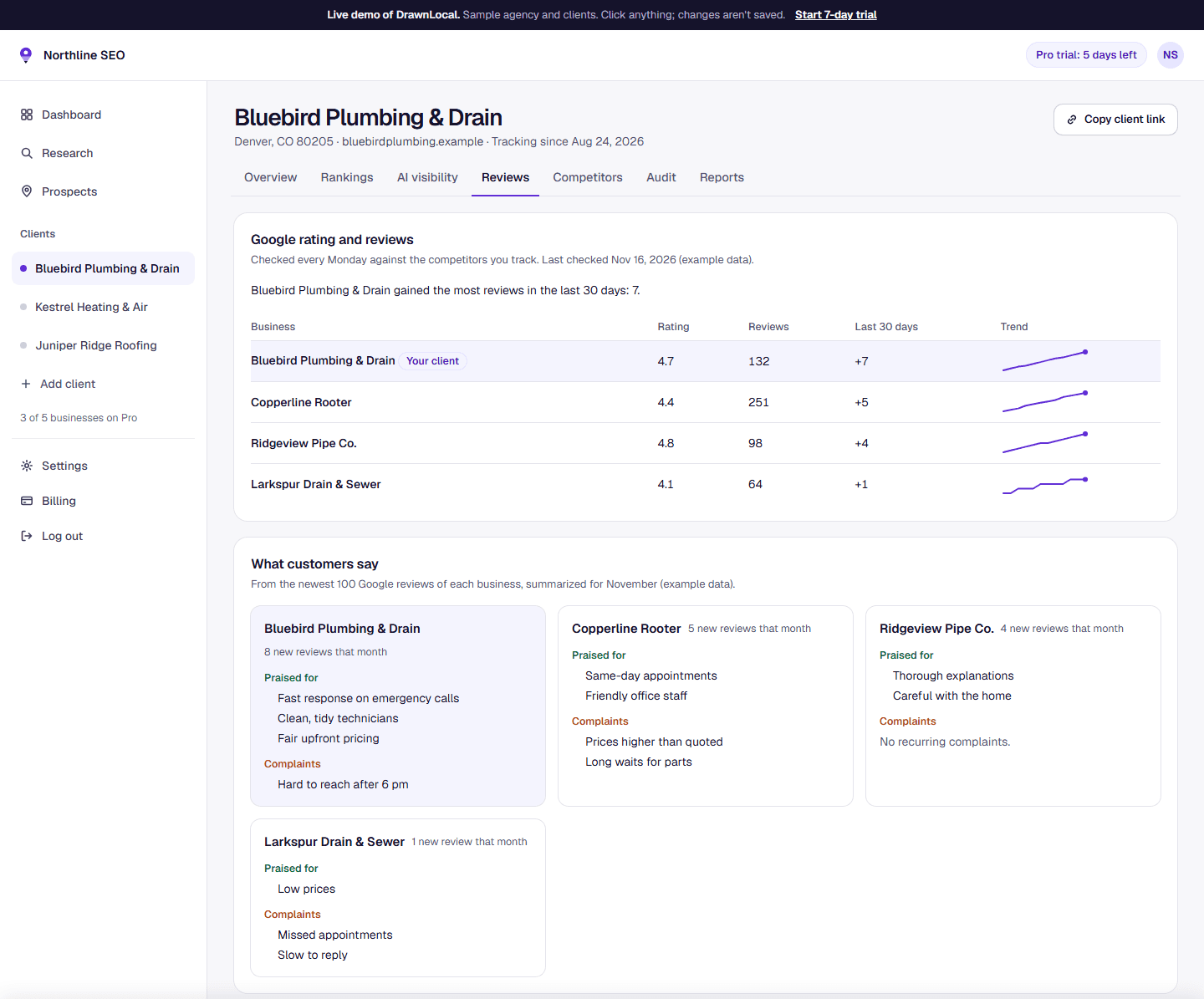
- Paying for overlapping tools. A rank tracker, a heat map tool, a review tool and a reporting tool can cost more than one platform that does all four. Best local rank trackers for agencies compares the options at the same workloads.
An hour-long tool audit
Paying for overlapping tools is a quick mistake to fix. Once a year, set aside an hour:
- List every tool you pay for, with the monthly cost and who uses it.
- Write next to each one the jobs it does: rank tracking, heat maps, reviews, AI visibility, reports, audits.
- Mark the jobs that more than one tool covers.
- Price the alternatives at your real workload, such as the number of businesses and keywords you track.
- Cancel or downgrade what you no longer need, and note the renewal dates of annual plans.
Watch for per-seat pricing as you hire, too. DrawnLocal includes unlimited team members and every tool on every plan; see pricing.
Shortcuts that put a client’s Google profile at risk
Some mistakes don’t just lose a client; they get the client’s profile suspended or its reviews removed. Each of these breaks a Google rule:
- Keywords added to the business name. Google says unnecessary information in the name isn’t permitted and could result in suspension. See keywords in the business name.
- Virtual offices or PO boxes to look local. Google says a virtual office isn’t eligible for a profile and PO boxes aren’t acceptable. See Google Business Profile suspended?.
- Asking only happy customers for reviews, or rewarding reviews. Google’s policy forbids both. See review gating.
- A second profile for the same location to cover another town. Google allows one profile per location.
If a client insists on any of them, put your advice in writing. When a profile is suspended, it’s the client’s business that disappears from Maps.
How three small mistakes lose a client: an example
A made-up story, built from the mistakes above. A new agency signs a roofer at $400 a month to win the deal. Three months later the client is gone. What happened:
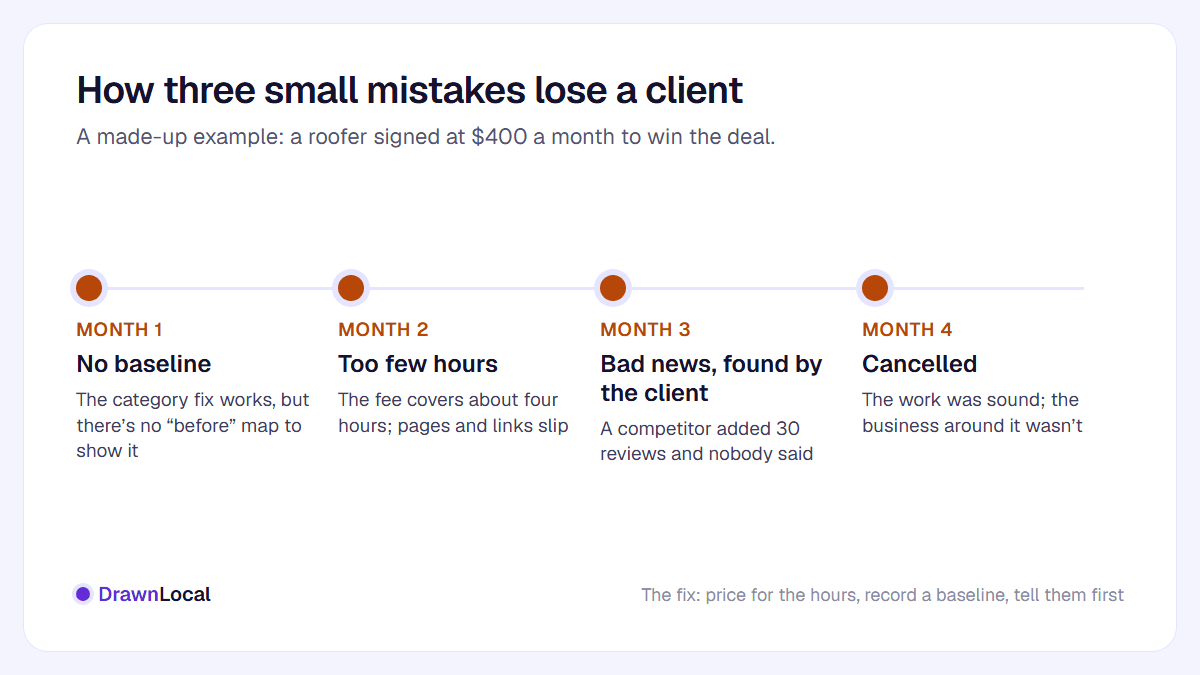
- Month 1: no baseline was recorded, because the profile fixes felt urgent. The category change was a real win, but there’s no “before” map to show it.
- Month 2: the low fee covers about four hours of work, so pages and links slip. The report lists tasks done, with no comparison to anything.
- Month 3: the owner searches from the shop, sees a competitor first and calls to ask what the fee is paying for. Nobody mentioned that the competitor had added 30 reviews.
- Month 4: the roofer cancels. The work was sound; the business around it wasn’t.
Each fix is small: price for the hours the market needs, record the baseline on day one, report against it, and tell the client about the competitor first. Local SEO client retention covers the warning signs to watch.
The numbers that catch these mistakes early
Many of the mistakes above show up in a few numbers months before a client leaves. Check these every month:
| Number | Warning sign |
|---|---|
| Hours per client against the package | Over the package for two months running |
| Profit per client after tools and help | Below your target |
| Proposal win rate | Falling for three months |
| How long clients stay | Several leaving before month six |
| Reports sent on time | Any late |
| Clients contacted between reports | Anyone missed |
| Main keywords in the Maps top 3, against the baseline | Flat for three months |
| Referrals from happy clients | None this quarter |
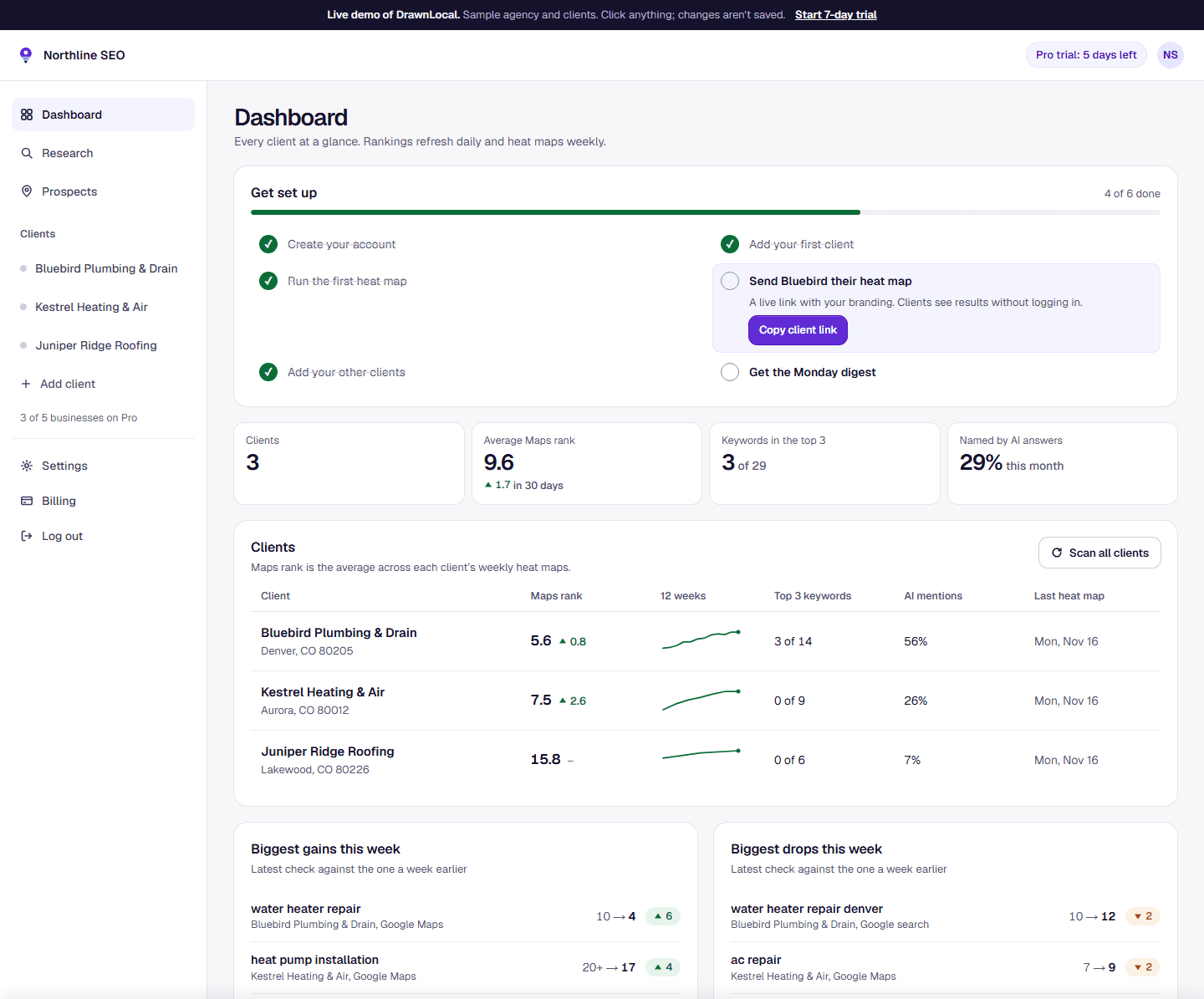
A local SEO platform covers the client side: DrawnLocal shows each client’s heat maps, rankings and reviews against the month they started, and flags big moves in a Monday digest.
When you’ve already made one: how to recover
You’ll probably make some of these. What clients remember is how you handle it:
- Say it first, before the client finds it: what happened, in plain words.
- Take responsibility for your part without blaming the client, Google or a contractor.
- Fix it, and give a date for when it will be fixed.
- Change the process so it can’t happen the same way again, and tell the client what you changed.
A missed report, for example: “Your November report went out late, which is on us. It’s attached now. We’ve moved report day to the 3rd and added a reminder, so it won’t happen again.”
Learn from every client who leaves
A client who leaves can tell you which mistake mattered most. Ask a few questions, kindly, once the decision is made:
- What made you decide to stop?
- Was there a moment when you started to doubt the work?
- What did you expect to see that you didn’t?
- What would have made you stay?
Write the answers in your sales sheet next to the start date and the fee. After a few exits, patterns may show up, such as clients on your cheapest package leaving first, or doubts starting in month three.
A 30-day plan to fix the worst ones
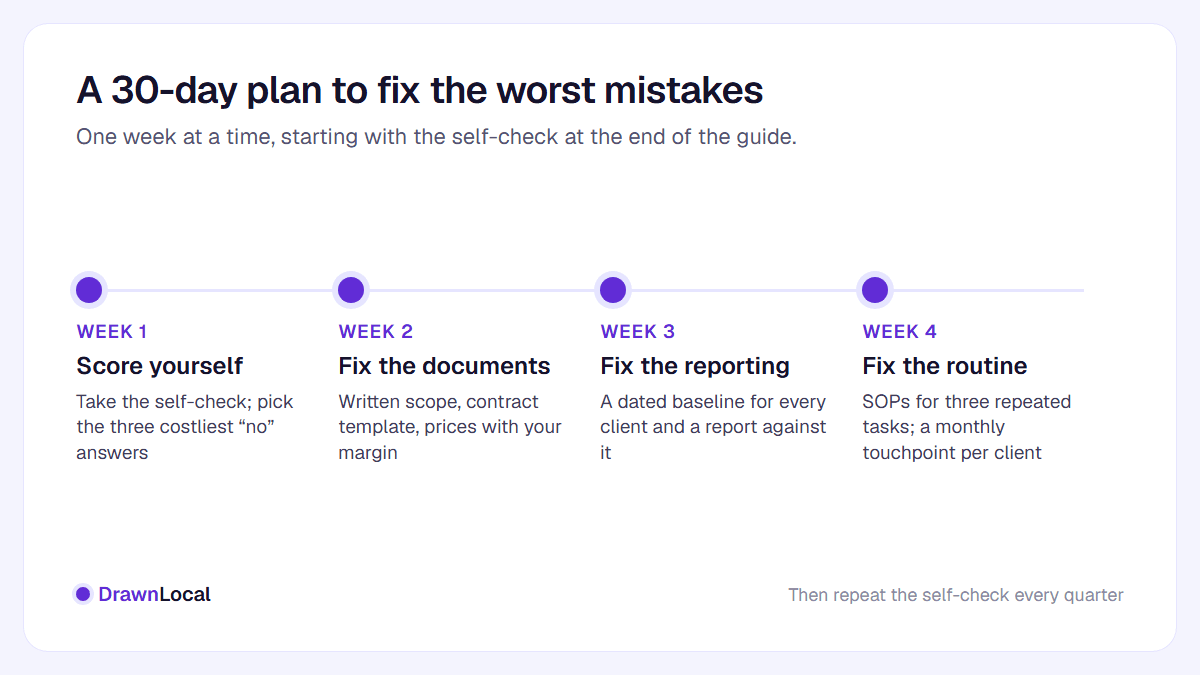
- Week 1: take the self-check below and pick the three “no” answers that cost you most.
- Week 2: fix the documents: a written scope, a contract template and prices with your margin worked out.
- Week 3: fix the reporting: a dated baseline for every client and a report that compares with it.
- Week 4: write SOPs for your three most repeated tasks, and book a monthly touchpoint with every client.
Then take the self-check again every quarter. New mistakes creep in as the agency changes, especially after a hire or a price change.
Keep a mistakes log
A cheap way to avoid repeating a mistake is to write it down. Keep a simple log with one line per mistake: the date, the client, what happened, the cause and the process you changed.
Review it once a month. If the same cause appears twice, the fix didn’t work, and the SOP needs another look. Share the log with anyone you hire, so they learn from your mistakes without having to repeat them.
| Date | What happened | Cause | Process change |
|---|---|---|---|
| Mar 3 | A client’s report went out four days late | Report day wasn’t in the calendar | Report day set for the 3rd, with a reminder two days before |
Self-check: score your agency
Answer yes or no. Each “no” is worth fixing, and the guide in the last column shows how.
| Question | Guide |
|---|---|
| Do you serve one or two clearly defined niches? | How to start a local SEO business |
| Can you show a before-and-after heat map from a real client? | How to read a local SEO heat map |
| Do you give a price range on the first call? | How to sell SEO services |
| Do you know your hours and margin per client? | How much to charge for local SEO |
| Does every client have a written scope and contract? | Local SEO contract |
| Do you record a dated baseline before the first change? | Local SEO client onboarding checklist |
| Does every report compare with the starting month? | Local SEO report template |
| Do clients hear from you between reports? | Local SEO client retention |
| Are your repeated tasks written as SOPs? | How to scale an SEO agency |
| Do you avoid promising rankings, in writing and on calls? | How to sell SEO services |
Fewer than seven yeses? Start with whichever “no” is costing you clients now.
Questions
What is the biggest mistake SEO agencies make?
Promising results they can’t control, usually rankings. Google says no one can guarantee a #1 ranking. Promise the work instead, and report honestly against a starting point.
Why do SEO agencies lose clients?
Often because clients can’t see progress: reports full of tasks, no comparison with the starting month, bad news they discover themselves, and silence between invoices. A baseline, a results-first report and a monthly note go a long way.
How do I avoid scope creep as an SEO agency?
Write the scope into the proposal and contract, list what’s out of scope, and treat every new request as a change with a price. A verbal “sure, we’ll take care of it” quickly becomes permanent free work.
Should a new SEO agency niche down?
Yes, for most. One or two trades in one region means the same keywords, competitors and proof for every client, which makes selling and delivery faster and your pitch sound like experience.
What should an SEO agency track every month?
Hours and profit per client, proposal win rate and how long clients stay. Then whether reports go out on time, client contact between reports, main keywords in the Maps top 3 against the baseline, and referrals.
Sources
- Google: do you need an SEO?
- Google Business Profile Help: third-party policies
- IRS: independent contractor (self-employed) or employee?